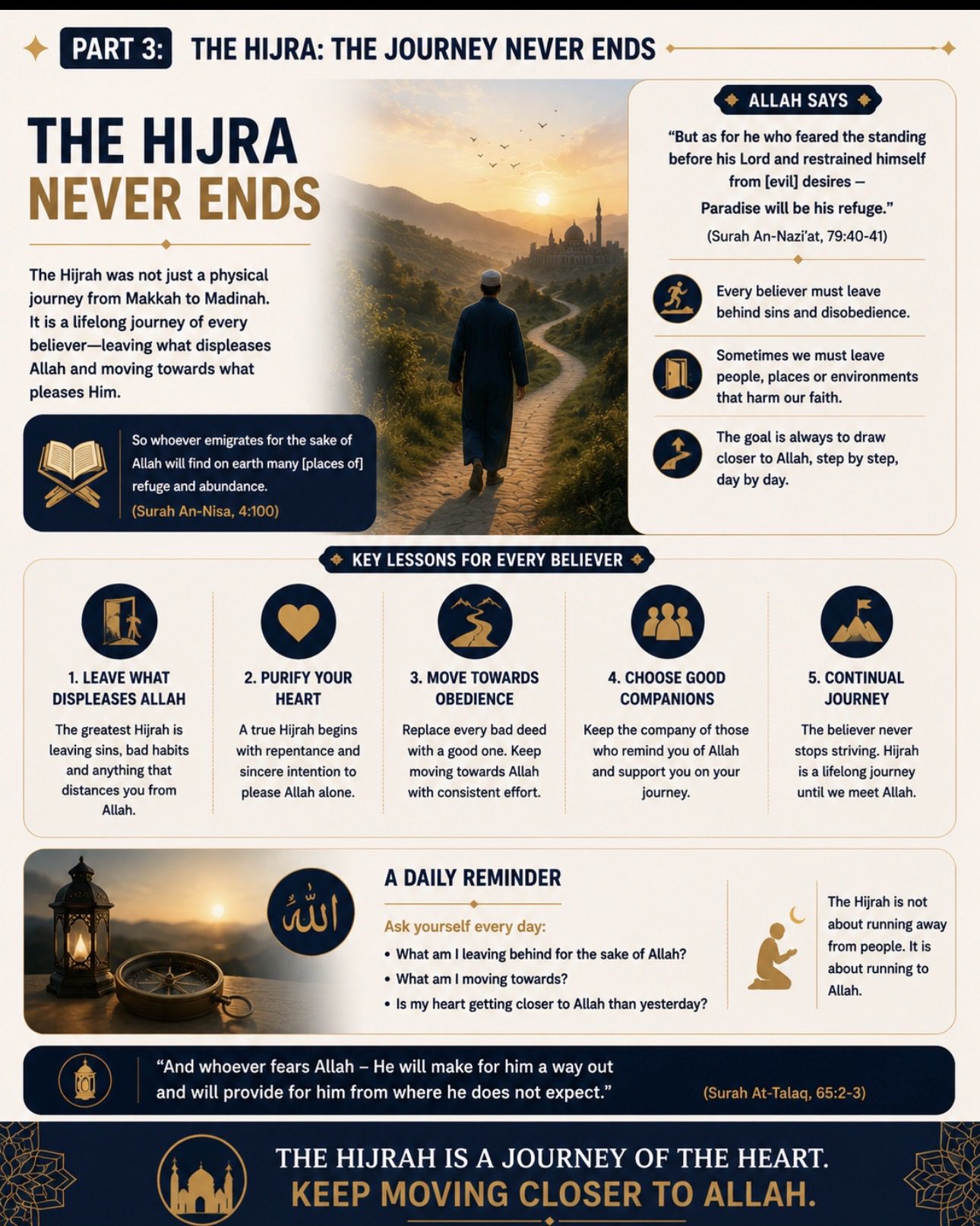
The Hijrah did not begin on the road to Madinah. In one sense, it was on the cards from the very first days of revelation.
When the Prophet ﷺ received the first revelation in the cave of Hira, he was shaken by what had happened. Jibril had come to him in the form of a man, held him firmly and commanded him to read. The Prophet ﷺ did not yet know what this meant. He had not expected revelation, prophethood or the enormous responsibility that was about to be placed upon him.
He returned home to the love of his life, his beloved Khadijah, trembling, and she comforted him with wisdom. She knew his character. She knew he maintained relations with his kin, helped the weak, supported the needy, honoured guests and always stood with truth. A person with such qualities would not be abandoned by Allah.
Then Khadijah took him to her cousin, Waraqah ibn Nawfal. Waraqah was an elderly man who had become blind, but he was a man of knowledge. He had studied the earlier scriptures and had remained upon belief in the One God. When Muhammad ﷺ told him what he had seen, Waraqah immediately understood the significance of what had happened.
He said: “This is the Namus who was sent down to Musa.”
In other words, this was Jibril, the bearer of divine revelation.
Then Waraqah said something astonishing:
“I wish I were young again. I wish I could be alive when your people drive you out.”
The Prophet ﷺ was shocked and asked:
“Will they really drive me out?”
Waraqah replied:
“Yes. No man has ever come with something like what you have brought except that he was met with hostility. If I live to see your day, I will support you with a mighty support.”
This hadith, narrated in Sahih al-Bukhari and Sahih Muslim, shows us that the Hijrah was not a random incident that happened later in the Seerah. From the very beginning, the path of revelation was going to involve opposition, rejection and sacrifice.
The pattern of history
Waraqah was not predicting the future like a fortune-teller. He understood the pattern of history. Every prophet who came with the truth disturbed the falsehood around him. Every messenger who called people back to Allah challenged the idols, power structures and corrupt customs of his society. So Waraqah knew that the Prophet ﷺ would not simply be welcomed and celebrated by everyone.
Being the bearer of the truth is not a smooth ride. People don’t embrace with open arms. It asks people to change. It exposes arrogance, injustice and blind imitation. That is why the people of truth are often resisted before they are accepted. Particularly when you are trying to change systems that were in place and when the elite behaved as if they were in the Makkan Epstein Files.
The Prophet ﷺ was surprised because he had always been the nice guy in the community – the one you could trust, and the one you rely on. They loved him. He was known among his people as al-Amin, the trustworthy one. He had not harmed them. He had not betrayed them. He had not come seeking power, wealth or status. Yet Waraqah understood that once revelation came, the issue would no longer be personal reputation. It would become a struggle between truth and falsehood.
The Prophet ﷺ was surprised. However, Waraqah was highlighting the fact that the hostility he would face, was not personal. It was because of the message he would carry.
He carried revelation. He carried tawhid. He would expose falsehood and call people back to Allah. That message threatened the status, authority and corrupt practices of those who benefited from the old order. So although they knew his character, they still opposed his call.
This is one of the first lessons of the Hijrah: being truthful does not mean life will always be easy. Being close to Allah does not mean there will be no tests. In fact, the greatest people were often tested the most. The Hijrah teaches us that sometimes loyalty to Allah means leaving behind comfort, familiarity and even people who once loved and respected you.
This is an important lesson. Sometimes people reject the truth not because they do not recognise it, but because they do not want to change. Sometimes they resist goodness because it threatens their comfort, their position or their control.
The Prophet ﷺ was being prepared from the very beginning. Thirteen years before the Hijrah, he was told that his people would eventually drive him out. Yet he did not become obsessed with leaving. He did not give up on his people. He continued to call them with patience, mercy and perseverance.
For thirteen years in Makkah, he invited his family, his tribe and the wider community. He called them to worship Allah alone, to abandon idols, to purify their lives and to prepare for the Hereafter. But the response was painful. Only a small number accepted Islam in those early years, while many mocked, rejected and persecuted him and his companions.
This was not unique to the Prophet ﷺ. It was the path of the prophets before him. Nuh spent years calling his people, but they mocked him and rejected him. Ibrahim had to leave his people and migrated more than once, from Iraq to Sham and then to Makkah. Musa left Egypt with Bani Israel and faced hardship after hardship. The Prophet Muhammad ﷺ would also join this noble company of messengers who were forced to leave their homes for the sake of Allah.
Leaving one’s homeland is not easy. A homeland is not just a place on a map. It is memory, family, childhood, language, streets, neighbours and familiarity. To be driven out of your own city is a deep wound. The Prophet ﷺ loved Makkah. It was his birthplace. It was the city of the Ka‘bah. Yet the hostility of Quraysh would eventually make Hijrah necessary.
Before the migration to Madinah, there had already been migration in Islam. Some of the companions were sent to Abyssinia, not once but twice, to escape persecution and protect their faith. This shows that Hijrah was not a sudden decision. It was part of a long struggle to preserve iman when living openly as Muslims became unsafe.
Despite all of this, the Prophet ﷺ did not lose hope. He continued to carry the message. He faced insults, accusations, mockery and harm, yet Allah kept consoling him through revelation. The Makkan surahs are full of comfort, reassurance and strength. Allah reminded him that the rejection of people did not mean the failure of the message.
The Prophet ﷺ was human. He felt pain. He felt sadness. He was hurt by their words and actions. When they insulted him, accused him and harmed his companions, it weighed heavily on him. But Allah strengthened his heart and reminded him that he was not alone. This had been the path of the prophets before him, and it would become the path through which Islam would spread.
The Islamic calendar was established during the caliphate of Umar ibn al-Khattab. As the Muslim state expanded, official letters and records needed to be dated clearly, so Umar gathered the companions and consulted them about where the Muslim calendar should begin. Some suggested the birth of the Prophet ﷺ, others suggested the beginning of revelation, while others mentioned his passing. However, the Hijrah was chosen because it marked the great turning point in Islamic history: the move from persecution to establishment, from vulnerability to community, and from Makkah to Madinah. Although the Prophet ﷺ did not actually migrate in Muharram — he left later and reached Madinah in Rabi‘ al-Awwal — Muharram remained the first month of the Arab calendar. So the Islamic year begins with Muharram, but its counting begins from the Hijrah, because Hijrah represents the birth of the Muslim Ummah as a public, organised community.
So the Islamic calendar begins with Hijrah not because it was the first event in Islam, but because it was the event that changed the future of the Ummah.
So the Hijrah teaches us that truth often comes with sacrifice. It teaches us that being loved by people is not the same as being accepted when you call them to Allah. It teaches us that the people of truth may be tested, opposed and even forced to leave — but if they remain sincere, Allah opens a new door for them.
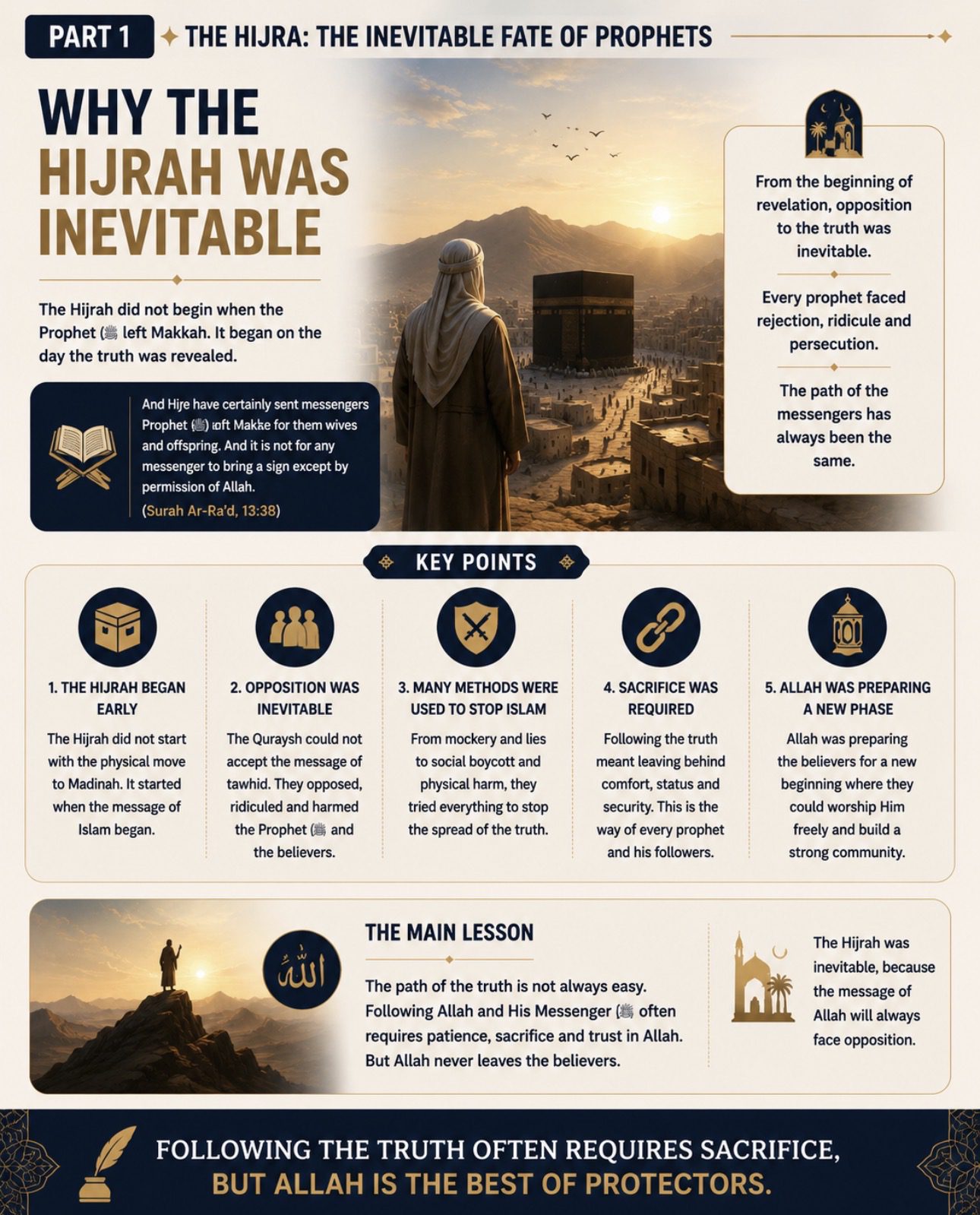
The road to Madinah began long before the Prophet ﷺ left Makkah. It began with revelation. It began with patience. It began with rejection. And it began with the certainty that Allah would not abandon His Messenger.
The Prophet ﷺ did not give up. He had been mocked, threatened and rejected. His companions had been persecuted. For three years, he and his family were placed under a harsh boycott and siege because Quraysh wanted to isolate him and pressure Banu Hashim to withdraw their protection. Abu Talib, although he had not accepted Islam, continued to protect him through the tribal system. Khadijah was also alive during this difficult period, standing beside him with strength and loyalty.
Then, at the end of this painful period, both Khadijah and Abu Talib passed away. The Prophet ﷺ lost the wife who had comforted him from the first day of revelation, and the uncle whose protection had shielded him from the worst of Quraysh. Yet even then, he continued.
He tried every avenue. He called his own people, his family, his tribe and the wider community of Makkah. He approached visitors during the Hajj season, when tribes from across Arabia would come to Makkah. He spoke to people whenever he found an opportunity. But Quraysh tried to block him at every turn. They would follow him, warn people against him and damage his reputation before he even had the chance to speak. It was painful, but he did not give up.
Then, in the eleventh year of prophethood, Allah opened a new door. Six men came from Yathrib. Yathrib was the city that would later become Madinah. The Prophet ﷺ met them during the Hajj season and asked them where they were from. They replied that they were from Yathrib. He asked whether they belonged to the Khazraj, and they said yes. He then invited them to sit and listen to him. He presented Islam to them, and they accepted.
This was not random. Allah had already prepared the people of Yathrib in a remarkable way. They lived alongside Jewish tribes who knew from their scriptures that a final messenger was expected. They would speak about him and warn the Arabs of Yathrib that when he came, they would follow him and gain victory through him. So when these men from Yathrib met the Prophet ﷺ and heard his message, they recognised the signs. They realised that this was the messenger they had been hearing about. They did not hesitate. They accepted Islam and returned to Yathrib carrying the message with them.
The following year, they came back during Hajj – this time as twelve men. This became known as the First Pledge of Aqabah. They pledged not to associate partners with Allah, not to steal, not to commit adultery, not to kill their children, not to invent falsehood, and not to disobey the Prophet ﷺ in what was right.
After this pledge, the Prophet ﷺ sent teachers with them to Yathrib, including Mus‘ab ibn ‘Umayr, to teach the Qur’an and spread Islam. The response in Yathrib was completely different from Makkah. In Makkah, the message had faced walls of hostility. In Yathrib, hearts began to open. Islam entered home after home until the city was being prepared for the arrival of the Messenger of Allah ﷺ.
The next year, a much larger group came: seventy-three men and two women. This became known as the Second Pledge of Aqabah. This pledge was far more serious. It was not only a pledge of belief; it was a pledge of protection. They were not simply saying, “We believe in you.” They were saying, “Come to our city, and we will defend you as we defend our own families.”
The meeting took place secretly at night near Aqabah, in Mina, away from the eyes of Quraysh. Quraysh were watching the Prophet ﷺ closely. They did not want him to meet outsiders or spread his message beyond Makkah. Like all people who cling to power, they wanted to control the narrative. They wanted to show Arabia that everything was under control and that there was no serious challenge to their authority. But Allah was planning something they could not stop.
The people of Yathrib came quietly in the night to meet the Prophet ﷺ. With him was his uncle al-Abbas, who had not yet accepted Islam at that time, but who was concerned for his nephew’s safety. He wanted to make sure that the people of Yathrib understood the seriousness of what they were promising. This was not a casual invitation. If they took the Prophet ﷺ to their city, they would be taking on the hostility of Arabia.
The pledge at Aqabah was therefore one of the great turning points in Islamic history. It was the moment when the Hijrah became possible. After years of rejection, persecution and closed doors, Allah opened a new home for Islam.
The Prophet ﷺ exhausted all the means available to him. He worked with patience. He approached people. He tried different tribes. He endured rejection without giving up. Then, when Allah opened the door, it came from a place many people would not have expected.
Sometimes the opening does not come from where we are standing. Sometimes it comes from somewhere else entirely. Makkah rejected him, but Madinah welcomed him. Quraysh tried to silence him, but Allah gave him supporters who would carry his message to the world. The Hijrah was not an escape from failure. It was the next stage of divine planning.
Hijrah was not only movement from Makkah to Madinah, but a lesson in planning, sacrifice, keeping promises and never giving up.
At the Second Pledge of Aqabah, the paternal uncle of the Prophet ﷺ, al-Abbas wanted to make sure that the people of Yathrib understood the seriousness of what they were promising. He addressed the visitors from Yathrib, telling them the position Muhammad had among them.
We have protected him among his people. If you are truly prepared to protect him as we have protected him, then take him. But if you are not able to fulfil that promise, then leave him with us.
The people of Yathrib understood. This was not a light matter. They were not simply welcoming a guest. They were pledging to defend the Messenger of Allah ﷺ as they would defend their own families, homes and loved ones. They were accepting that Quraysh and others might become their enemies because of this pledge. They accepted.
They pledged obedience, support and protection. This was the moment that opened the door to Madinah.
After this, the Prophet ﷺ began preparing the Muslims for migration. One by one, he instructed his companions to leave Makkah and make their way to Madinah. But he himself waited. He did not move until Allah gave him permission.
Abu Bakr wanted to migrate, but the Prophet ﷺ told him to wait, saying that perhaps Allah would give him a companion for the journey. Abu Bakr understood and prepared two camels in anticipation of that moment.
This part of the Hijrah teaches us another important lesson. The Prophet ﷺ was the Messenger of Allah. He was supported by revelation, by Jibril and by the help of Allah. Yet he still planned carefully. He did not say, “Allah will protect me, so I do not need to prepare.” He took precautions, arranged the journey, chose a route that people would not expect, and took practical steps to avoid being caught.
Reliance on Allah does not mean abandoning planning. True tawakkul is to trust Allah while using the means He has placed before us.
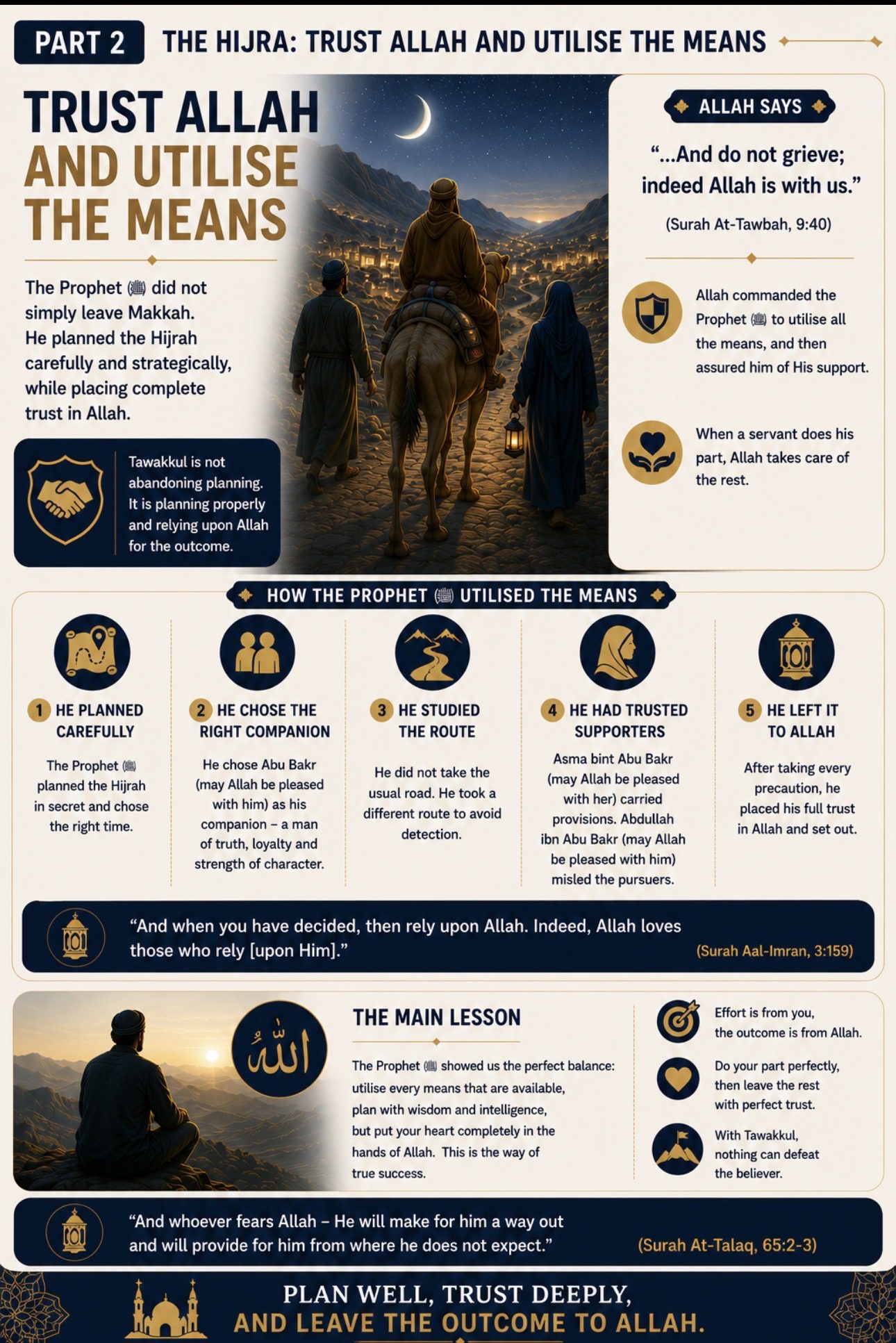
When the Prophet ﷺ finally left Makkah, he left the most beloved city to him. Makkah was his birthplace. It was the city of the Ka‘bah. His memories, family, childhood and years of worship were connected to it. Leaving it was not easy. But Hijrah demanded sacrifice.
The companions also sacrificed. Some left behind their homes. Some left behind their wealth. Some were separated from their families. Suhayb al-Rumi was famously prevented from leaving Makkah unless he gave up his wealth, so he gave it up and migrated for the sake of Allah. Abd al-Rahman ibn Awf, who was extremely wealthy in Makkah, left his wealth behind, arrived in Madinah with little, yet Allah placed barakah in his trade and he became very wealthy again.
This is one of the great lessons of Hijrah: whatever is sacrificed sincerely for Allah is never truly lost. Allah may replace it in this world, or He may store something far greater in the Hereafter.
During the pledge, the people of Yathrib also had a concern. They asked the Prophet ﷺ, in meaning: If Allah gives you victory and you return to Makkah, will you leave us and go back to your people?
The Prophet ﷺ reassured them. He promised that he would remain with them. And he kept that promise.
Abu al-Haytham ibn al-Tayyihan said: “O Messenger of Allah, there are ties and agreements between us and certain people, and we are going to sever them” — meaning the Jews. “If we do that, and then Allah grants you victory and dominance, might it be that you will return to your own people and leave us?”
Years later, when Makkah was conquered, the Prophet ﷺ could have stayed there. It was his home. It was the city he loved. But he returned to Madinah. He had given his word to the Ansar, and he fulfilled it. He lived in Madinah, died in Madinah and was buried in Madinah.
Because of the sacrifice and loyalty of the people of Madinah, the Prophet ﷺ loved them deeply. He made dua for Madinah and asked Allah to place barakah in it. In an authentic hadith, he asked Allah to bless Madinah and to place in it double the blessing of Makkah.
So Hijrah was not the end of difficulty. It was the beginning of a new stage. In Makkah, the enemy was open and visible. In Madinah, the Muslims would face another kind of test: the enemy within. The hypocrites prayed beside them, lived among them and plotted against them quietly. Yet the Prophet ﷺ continued. He built the community, taught the Qur’an, established brotherhood, spread justice and carried the message forward.
The Hijrah therefore teaches us not to give up when the road is difficult. It teaches us to be patient, but not passive. It teaches us to use every halal means available, but when one door closes completely, to look for the door Allah opens elsewhere.
The Prophet ﷺ tried with his people for years. He called them with wisdom and mercy. He endured rejection, insult, persecution and loss. But when Makkah became a dead end for the message, Allah opened Madinah. This is not failure. This is divine planning.
Every year, when we remember the Hijrah, we are not simply remembering a date in history. We are renewing our own pledge to Allah. We are asking ourselves: What am I willing to sacrifice for my faith? What comforts, habits or attachments do I need to leave behind? How can I follow the footsteps of the Prophet ﷺ with patience, planning, courage and trust in Allah?
Hijrah is not only about moving from one land to another. It is about moving from weakness to strength, from fear to trust, from isolation to community, and from attachment to the world to attachment to Allah.
The Prophet ﷺ left Makkah, but he did not leave the mission. He left behind his home, but Allah gave him a city that would become the home of Islam. He left under threat, but he returned years later in victory. That is the promise of Allah. When sacrifice is made for His sake, He opens doors that no one else can close.
Based on the talk delivered to the Al Manaar Convert Club on 10th June 2026
Waraqah ibn Nawfal was Waraqah ibn Nawfal ibn Asad ibn Abd al-‘Uzza ibn Qusay al-Qurashi al-Asadi. He was the cousin of Khadijah, the wife of the Prophet ﷺ, and he played an important role at the beginning of revelation by confirming that the one who had come to the Prophet ﷺ was Jibril. Scholars differed over whether Waraqah should be counted among the Companions. Some scholars did include him among the Sahabah, including al-Tabari, al-Baghawi, Ibn Qani‘, Ibn al-Sakan and others, as mentioned by Ibn Hajar in Al-Isabah fi Tamyiz al-Sahabah. According to this view, he is regarded as a Companion, and it is therefore appropriate to say “may Allah be pleased with him” after mentioning his name.