
The ears are adorned by hearing the words of the Messenger of Allah ﷺ.
وَلاَ حَسَنٌ إِلاَّ سَمَاعُ حَدِيثِكُمْ …. مُشَافَهَةً يُمْلَى عَلَىَّ فَأَنْقُلُ
“Nothing is truly beautiful except hearing your narrations firsthand —
received directly from your lips, dictated to me, and then faithfully transmitted by me.”
It is is a verse from the poem Gharami Sahih (“My Love Is Authentic”) by Ibn Farh al-Ishbili (d. 699 AH / 1300 CE), may Allah have mercy on him:
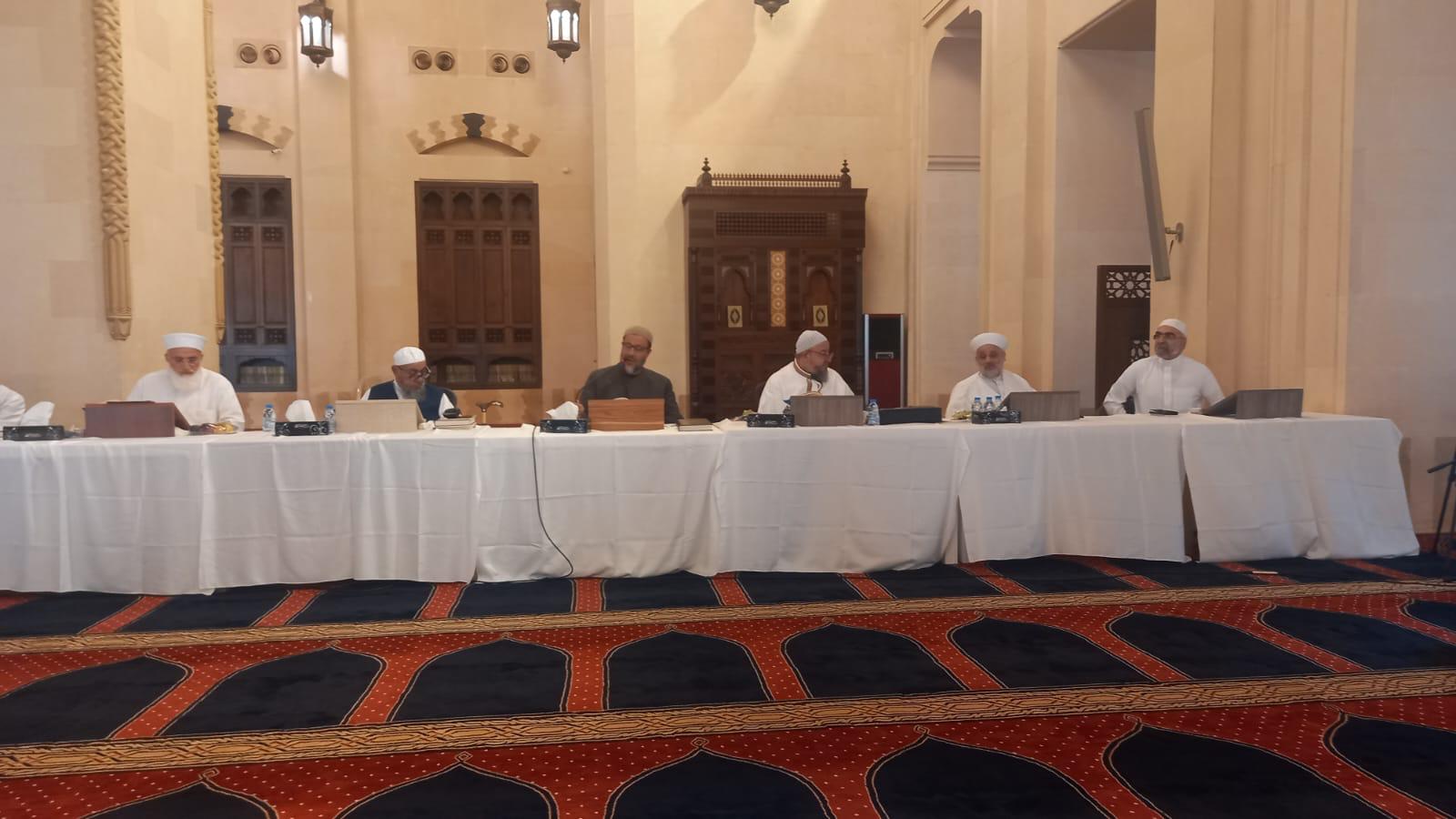
I had not prepared anything in advance for this gathering. However, since I was asked to speak about what Allah, Glorified and Exalted, has honoured us with, then all praise belongs to Allah.
I was about twenty years old when I first began serving the science of hadith, praise be to Allah. Our guide in this field was Shaykh ʿAbd al-Fattah Abu Ghuddah (may Allah have mercy on him). Although we did not sit with him extensively or study directly under him, we benefited greatly from reading his books and his critical editions.
We became deeply attached to the Shaykh’s scholarly editions, and Allah honoured us by enabling us to establish the Tamim Office for Editing Books and Manuscripts in Beirut. We gathered a number of brothers from among the students of knowledge and Shariah, and they worked together with us in the office. Among them was Shaykh Hamid, who helped us with reading manuscripts, establishing the correct text, and editing works, including those relating to the Shafi’i school and others. Allah blessed us with diligent students of knowledge.
Among the first books we worked on, having first studied the Hanafi school, then the Shafi’i school, and later comparative fiqh in the Faculty of Shariah, was Mulla Ali al-Qari’s commentary on Nukhbat al-Fikar.
Mulla Ali al-Qari was an encyclopaedic scholar. His work exhausted us because he frequently quoted by meaning rather than verbatim. Verifying his citations required a great deal of effort. Nevertheless, we did our utmost to serve the book.
This became a blessed beginning for us. Allah honoured us further when Shaykh ʿAbd al-Fattah Abu Ghuddah wrote the introduction to the book, something he rarely did for published works. This was one of Allah’s favours upon us. The Shaykh also granted us a general and specific ijazah (authorisation) in hadith. This was around 1992.
After that, our teacher Shaykh Khalil al-Mays (may Allah have mercy on him) said to us:
“Young men, you’ve published Mulla Ali’s book. Why don’t you publish another one?”
We asked which one.
He replied:
“Doesn’t Mulla Ali have Fath Bab al-’Inayah?”
We said yes.
He explained that Shaykh ʿAbd al-Fattah had begun editing the book back in the 1960s but had stopped after publishing only around five percent of it—essentially just the Book of Purification.
We replied:
“Shaykh, we don’t even have manuscripts. How can we possibly work on it?”
But when Allah wills something, He creates its means.
While performing Hajj, Allah enabled us to purchase a rare lithographic edition printed in Pakistan or India, a beautiful two-volume set. Later Allah blessed us with another, different copy.
We also had a Turkish brother named Engin, who had studied with us in Damascus.
In those days obtaining manuscripts – or even photographs of manuscripts – was extremely difficult. Today you simply press a button and find a million manuscripts online. Back then it was one of the hardest parts of research.
We discovered through manuscript catalogues that a copy existed in Istanbul. However, the authorities were strict, and researchers were often prevented from obtaining photographs, especially Islamic researchers.
Our brother Engin tried through the university. Every six months he managed to photograph another portion of the manuscript and send it to us. May Allah reward him with goodness.
We regarded this as a sign that Allah wanted this book to be served.
Our Shaykh said:
“Put your trust in Allah and begin.”
We did send a letter to Shaykh Abdulfattah seeking his permission and his blessing to work on the book and Alhamdulillah he did not mind. Shaykh Khalil said we will make it a prescribed text for Azhar Lubnan so we did work on it for around three years with five brothers
The book was a prescribed text at al-Azhar, and we worked on it for about six years.
There were around ten brothers in the office altogether, although only about five were working full-time on the project.
Financially, as we would say in English, there was “no money in it.” You certainly didn’t make wealth from publishing such books.
But what were we seeking?
Alhamdulillah, Allah placed blessing in serving these works.
This became the second major book we published.
Shaykh Khalil had remarkable insight. He wanted us to produce a work of evidence-based Hanafi fiqh.
He said:
“Produce for us a Hanafi fiqh book that presents the evidences.”
Mulla Ali had done exactly that. He presented the legal rulings and supported them with hadith.
So we relied upon Allah and began the work.
It was genuinely demanding. Mulla Ali was not simply a Hanafi jurist. He would cite the evidence, explain how it proved the ruling, discuss different aspects of the proof, critique opposing views, expand upon the discussion, and sometimes even prefer an opinion outside the Hanafi school.
This comparative approach was one of the beautiful qualities of Mulla Ali’s scholarship.
Of course, no book is free from passages that may be unclear or difficult.
One observation from my years of living with Mulla Ali’s works may be useful for students who read him.
Sometimes you come across wording that seems awkward or linguistically imperfect. It is tempting to think the manuscript is corrupt.
In many cases, however, it is not a manuscript error at all. Rather, it reflects that Arabic was not Mulla Ali’s native language. At times you sense that something is missing from the expression or that the wording is not entirely smooth.
This is not criticism of Mulla Ali (Allah have mercy on him) but simply an observation based on long experience working with his books.
Another point is that he had memorised an enormous amount of material and often quoted from memory. He would frequently narrate texts according to their meaning rather than quoting them word for word.
That made authenticating his references extremely difficult because we had to trace the original wording of the hadiths.
Despite all of that, Allah enabled us to complete the work as we had promised our Shaykh.
He was delighted with it.
He said:
“This should become a prescribed text at al-Azhar.”
That was, in effect, his endorsement of the book.
Another book that brought Shaykh Khalil great joy was I’laa As-Sunan by Tahanwi. He and many other scholars had long been searching for it. When it finally arrived in Beirut and the Shaykh received a copy, there was great happiness.