
Secret righteous deeds: what only Allah knows
Allah Almighty says about Prophet Yunus:
فَلَوْلَا أَنَّهُ كَانَ مِنَ الْمُسَبِّحِينَ
“If he had not been one of those who glorified Allah,”
لَلَبِثَ فِي بَطْنِهِ إِلَىٰ يَوْمِ يُبْعَثُونَ
“he would have remained in its belly until the Day they are resurrected.” (Surat As-Saffat, 37:143-144)
These verses contain a very important lesson about the value of what we do when nobody is watching.
When Yunus (peace be upon him) called upon Allah from within the darkness of the whale, he was not turning to Allah for the first time. Allah described him as being among those who regularly glorified Him. He already had a connection with Allah before the hardship came. His worship during times of ease became a means of relief during his time of distress.
This is why the Prophet ﷺ said:
تعرَّفْ إلى اللهِ في الرَّخاءِ يعرفك في الشدَّةِ
“Get to know Allah in times of ease, and He will know you in times of hardship.” (Tirmidhi)
Many people remember Allah when they are facing difficulty, but the believer remembers Allah before difficulty arrives. He builds a relationship with Allah while life is comfortable. He prays when there is no crisis. He gives when there is no pressure. He makes du’a when there is no emergency.
Then, when hardship comes, he turns to the One he already knows.
Ease is a test
People often think that hardship is the greatest test. Yet ease can be just as difficult.
When life becomes comfortable, we can forget how dependent we are on Allah. We become occupied with our routines, our plans and our achievements. Gradually, the feeling of neediness towards Allah becomes weaker.
This is why remembering Allah during times of ease is so valuable. It protects the heart from becoming heedless. It reminds us that every blessing comes from Allah and that we remain in need of Him at every moment.
The believer does not wait until he is drowning before he learns how to call upon Allah.
The hidden treasure between you and Allah
One of the most beautiful ways to strengthen our relationship with Allah is through secret righteous deeds.
The Prophet ﷺ said:
من استطاع منكم أن يكون له خَبْءٌ من عمل صالح، فليفعل
“Whoever among you is able to have a hidden righteous deed, let him do so.” (Ibn Abi Shaybah)
A hidden deed is something known only to you and Allah. Nobody praises you for it. Nobody thanks you for it. Nobody even knows it exists.
Perhaps it is a regular charity. Perhaps it is a prayer in the middle of the night. Perhaps it is helping someone who will never know your name. Perhaps it is a sincere du’a for another person.
Whatever form it takes, it becomes a private connection between the servant and his Lord.
The Arabic word khabi’ah, in the hadith, meaning hidden deed has a deeper meaning. A khabi’ah is something precious that is deliberately concealed. The Prophet ﷺ encouraged believers to have a khabi’ah of good deeds. The word suggests a treasure that is carefully protected and kept safe.
The struggle for recognition
One of the reasons hidden deeds are so valuable is that they challenge our ego.
Human beings naturally want recognition. We like to be appreciated. We like people to notice our efforts. Sometimes we do something for Allah and then feel the urge to mention it. We want others to know what we have done. This is one of the greatest tests of sincerity. We have to keep monitoring our intention because Shaytan’s specialty is to ruin our deeds – once he fails to prevent us from doing them, his next attack is to make us crave appreciation for them.
The sincere servant does not need an audience. He is content that Allah has seen his deed. He does not go around with a loudspeaker announcing his good actions, nor does he feel the need to display every act of worship or charity or kindness on social media – he does not take the selfies around the Kaaba, searching for followers and likes.
The less a deed depends upon people’s approval, the more likely it is to be sincere.

Why hidden deeds protect the heart
A hidden deed protects sincerity because it removes worldly expectations.
When you help someone secretly, you are not waiting for thanks. As a result, you are less likely to feel disappointed when people fail to appreciate what you have done.
Your transaction was never with them. It was always with Allah. This is particularly important for those who spend their lives serving others.
A mother may spend years caring for her family without hearing words of appreciation. A carer may sacrifice time and energy, endure grinding boredom and feel utter exhaustion, while receiving little recognition. A teacher, volunteer or community worker may quietly help countless people who never fully understand what was done for them.
If our reward depends upon people’s gratitude, we will often feel hurt and resentful. But if our intention is for Allah, then no effort is lost. Allah sees every sacrifice, every sleepless night and every hidden act of kindness.
A deed that may save you one day
The scholars often compared hidden deeds to savings that a person stores for the future. You may not immediately see their benefit, but they remain with Allah.
This is one of the lessons from Yunus (peace be upon him). His previous worship benefited him when he was trapped in the whale.
In the same way, a hidden act of worship may become a reason for Allah’s mercy during a difficulty that has not yet arrived.
The believer therefore tries to maintain a deed that nobody knows about. He keeps it safe as provision for the day when he will need it most.
The example of the righteous
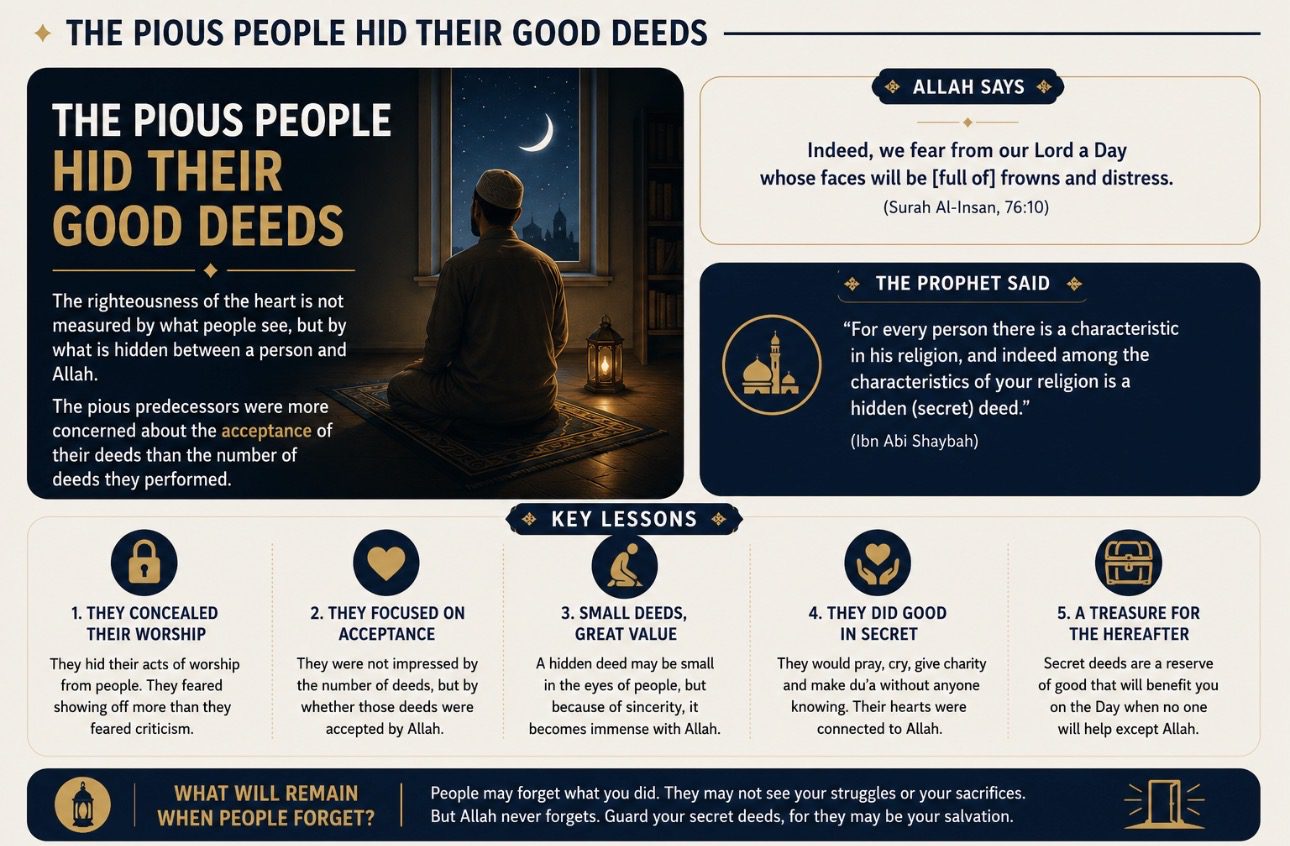
The pious predecessors understood the value of hidden deeds.
Many of them worked hard to conceal their worship. Some would pray during the night while their families thought they were asleep. Others would weep from the fear of Allah and wash their faces before meeting people in the morning. They feared praise more than criticism.
When people praised Ali ibn Abi Talib, he would say:
اللهم لا تؤاخذني بما يقولون، واغفر لي ما لا يعلمون، واجعلني خيراً مما يظنون
“O Allah, do not take me to account for what they say about me. Forgive me for what they do not know, and make me better than what they think of me.”
The righteous understood that praise can sometimes become a test. They were more concerned about whether Allah accepted their deeds than whether people admired them.
Charity that nobody knows about
Among the seven categories of people who will be shaded by Allah on the Day of Judgement is:
ورجل تصدق بصدقة فأخفاها، حتى لا تعلم شماله ما تنفق يمينه
“A man who gives charity and conceals it so completely that his left hand does not know what his right hand has spent.” (Bukhari and Muslim)
This powerful image shows how carefully a believer should guard his sincerity.
The goal is not simply to hide money from people. The goal is to hide pride from the heart.
Conditions for a deed to be accepted
For any deed to be accepted, it needs two things: sincerity and conformity to the Sunnah. It must be done for Allah, and it must be done in the way taught by the Prophet ﷺ. If the deed is not sincere, then outwardly it may look impressive, but with Allah it has no weight. Allah says:
وَقَدِمْنَا إِلَىٰ مَا عَمِلُوا مِنْ عَمَلٍ فَجَعَلْنَاهُ هَبَاءً مَّنثُورًا
“And We will turn to whatever deeds they did, and We will make them like scattered dust.” (Surat Al-Furqan, 25:23)
And if the intention is good, but the action is not in accordance with the Sunnah, then it is still not accepted, because we do not worship Allah according to our own feelings. For example, the idea of Robin Hood stealing from the rich to give to the poor may sound noble on the surface, but it is still flawed because the method is unlawful. A good aim does not make a sinful action acceptable.
The secret of night prayer
One of the greatest hidden deeds is praying at night.
The Prophet ﷺ said:
أفشوا السلام، وأطعموا الطعام، وصلوا بالليل والناس نيام، تدخلوا الجنة بسلام
“Spread salam, feed people, and pray at night while people are asleep; you will enter Paradise in peace.” (Tirmidhi)
There is something special about worship that takes place while the world is asleep.
No one sees the effort. No one hears the du’a. No one witnesses the tears. Yet Allah sees everything.
Many of the righteous treasured these moments because they were free from showing off and closer to sincerity.
Every sincere du’a is answered
Hidden worship includes private du’a. Sometimes people become discouraged because they do not see an immediate answer to their supplications. However, the Prophet ﷺ taught us that no sincere du’a is wasted.
Abu Sa’id al-Khudri reported that the Messenger of Allah ﷺ said:
“There is no Muslim who makes a supplication that contains neither sin nor the severing of family ties except that Allah grants him one of three things: either He hastens the fulfilment of his request, or He stores it for him in the Hereafter, or He averts from him a similar amount of harm.” (Ahmad and Al-Hakim)
Every sincere du’a receives a response. The answer may appear immediately. It may be saved for the Hereafter. Or Allah may protect us from a harm that we never even knew was coming.
Imam Ibn Abd al-Barr explained that this hadith helps us understand the meaning of Allah’s statement:
ادْعُونِي أَسْتَجِبْ لَكُمْ
“Call upon Me; I will respond to you.” (Surat Ghafir, 40:60)
Allah responds with wisdom. He gives what is best, not simply what we desire.
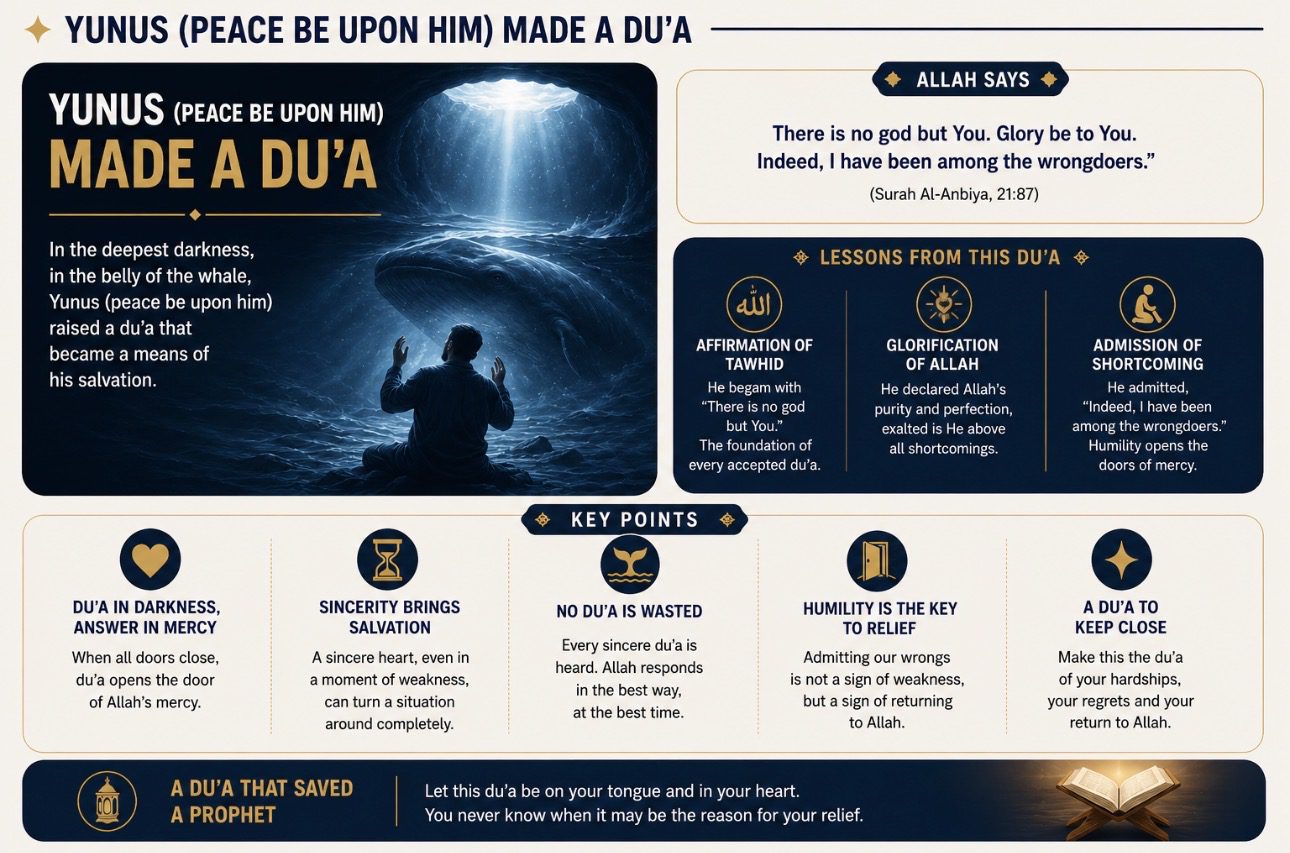
The du’a of Yunus
When Yunus found himself in complete darkness, he turned to Allah and said:
لَا إِلَٰهَ إِلَّا أَنتَ سُبْحَانَكَ إِنِّي كُنتُ مِنَ الظَّالِمِينَ
“There is no god but You. Glory be to You. Indeed, I have been among the wrongdoers.” (Surat Al-Anbiya, 21:87)
This du’a combines recognition of Allah’s greatness with admission of one’s own shortcomings.
It is the du’a of a servant who knows that his only refuge is Allah.
The scholars mention that whoever calls upon Allah with this du’a should do so with sincerity, humility and repentance, while striving to remove the obstacles that prevent du’a from being answered.
What hidden deed will you take to Allah?
Every believer should ask himself: what is the deed that only Allah knows about?
Is there a prayer nobody has seen?
A charity nobody can trace?
A du’a made regularly for another person?
A hidden act of kindness?
A sacrifice made purely for Allah?
Years may pass and people may forget everything we did. The praise of people fades quickly. Their recognition comes and goes. But Allah never forgets.
As Allah says:
وَمَا تُقَدِّمُوا لِأَنفُسِكُم مِّنْ خَيْرٍ تَجِدُوهُ عِندَ اللَّهِ
“Whatever good you send ahead for yourselves, you will find it with Allah.” (Surat Al-Baqarah, 2:110)
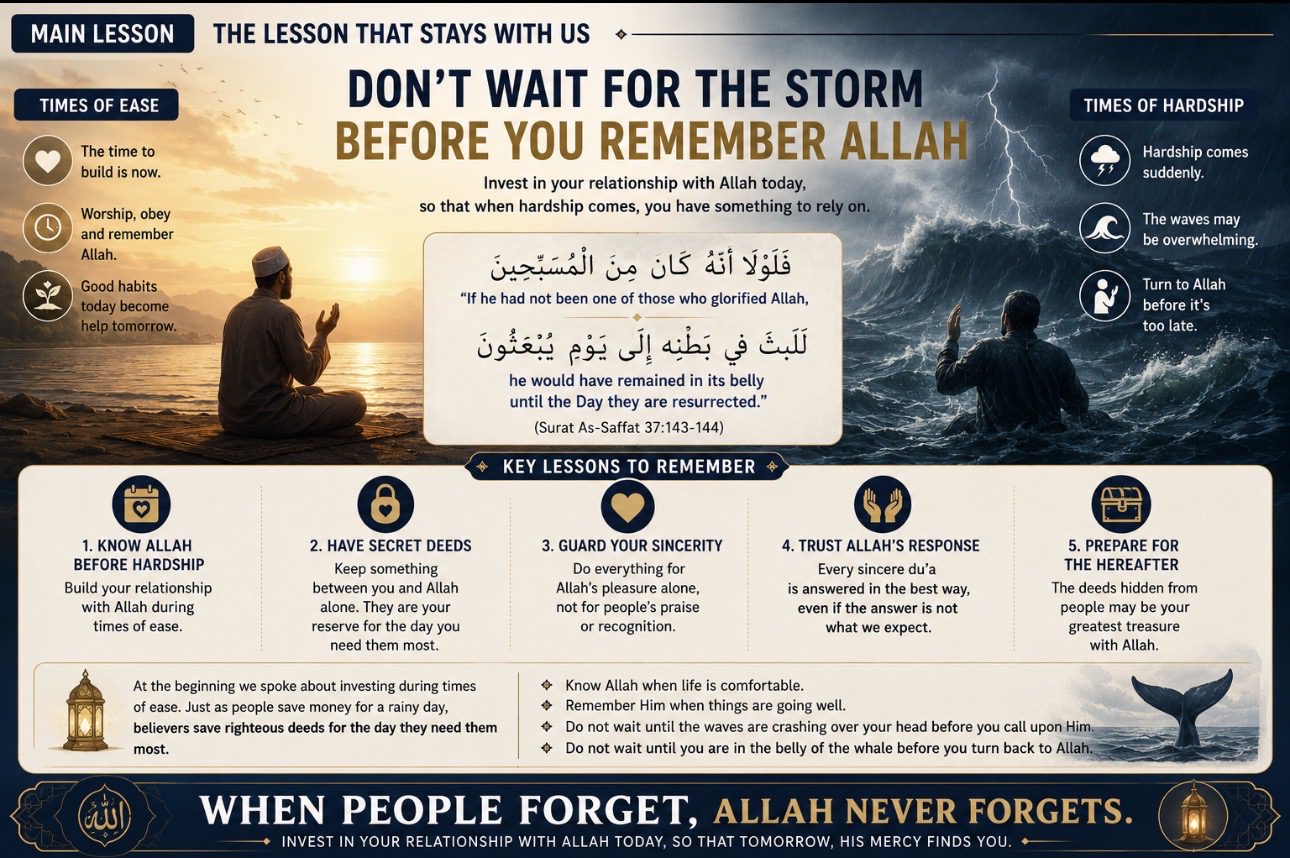
It is wise to realise the using our times of ease and prosperity to invest in the future. These moments, once squandered, do not return. They are opportunities to build our relationship with Allah and to store something for the days when we may need it most. Just as people save for a rainy day, the believer saves through remembrance, du’a, charity and hidden deeds.
So know Allah and remember Him all the time, not only when your face is being struck by the waves of the sea and you feel that you are about to die. Do not wait until the whale has swallowed you before you call upon Him. Turn to Him now, while life is calm, so that when the storm comes, your heart already knows where to return.
And on the Day when we stand before Him with nothing except our deeds, the hidden deeds may be the deeds that benefit us the most.
Based on the khutbah of Shaykh Haytham Tamim on 12th June 2026