
What does seerah mean?
Linguistically, seerah means the way or path. In Arabic, you may say that a person followed the seerah of someone, meaning he followed his path, his way, or his manner.
So when we speak about the Seerah of the Prophet ﷺ, we are speaking about the way he lived. Sometimes people translate seerah as biography, but this is not entirely accurate. It is not just a biography in the modern sense. It is the way of the Prophet ﷺ: how he lived, how he acted, how he worshipped, how he dealt with people, how he led the community, and how he responded to different situations.
Before we go into the Seerah itself, it is useful to clarify a few terms so that we understand where the Seerah sits among the Islamic sciences.
The Qur’an, Hadith and Seerah
There is a distinction between the Qur’an and Hadith. The Qur’an is the word of Allah Almighty. It is infallible, preserved and revealed by Allah. Then we have Hadith, which are the sayings, actions, approvals and descriptions of the Prophet ﷺ.
We also have tafsir, which is the explanation of the Qur’an. We have the books of Hadith, such as Sahih al-Bukhari, Sahih Muslim, the Musnad of Imam Ahmad and other collections. These books gather the narrations from the Prophet ﷺ and are usually arranged according to chapters of Islamic law and practice, such as purification, salah, zakah, fasting, Hajj and so on.
Where does the Seerah fit in? The Seerah is connected to Hadith, but it is broader than Hadith. When you read the books of Hadith, you will find many narrations that are part of the Seerah. They tell us about the Prophet ﷺ: how he prayed, how he communicated, how he traded, how he dealt with people, how he responded to questions, how he behaved in different situations.
All of this is part of his way of life. However, the Seerah is not arranged like the books of Hadith. It is not mainly arranged according to rulings. Of course, you will find many rulings within the Seerah, because the life of the Prophet ﷺ contains guidance in worship, dealings, family life, community life, leadership and many other areas. But the purpose of Seerah is not simply to list rulings. It is to study the life of the Prophet ﷺ and learn from it.
What does the Seerah usually cover?
The books of Seerah usually begin with the life of the Prophet ﷺ from his birth, but many of the larger works go even further back. They speak about the period before his birth in order to paint the picture of the world he was born into.
They discuss the Arabs at that time: their habits, culture, poetry, atmosphere, trade routes, religions, surrounding nations and political realities. They look at the environment of Makkah, the wider Arabian Peninsula and the surrounding powers.
This background is important, because to understand the life of the Prophet ﷺ, we need to understand the world around him. We need to know the situation, the culture, the threats, the trade routes, the religious landscape and the social setting.
In general, the Seerah covers the pre-Islamic background, then the birth of the Prophet ﷺ, then what happened in his life before revelation, then the Makkan period, then the Madinan period, and finally his passing away ﷺ.
So it is similar to biography in some ways, but it is much more than a biography. It is the study of the way of the Messenger of Allah ﷺ.
Why do we study the Seerah?
The big question is: do we need to study the Seerah? Of course we do.
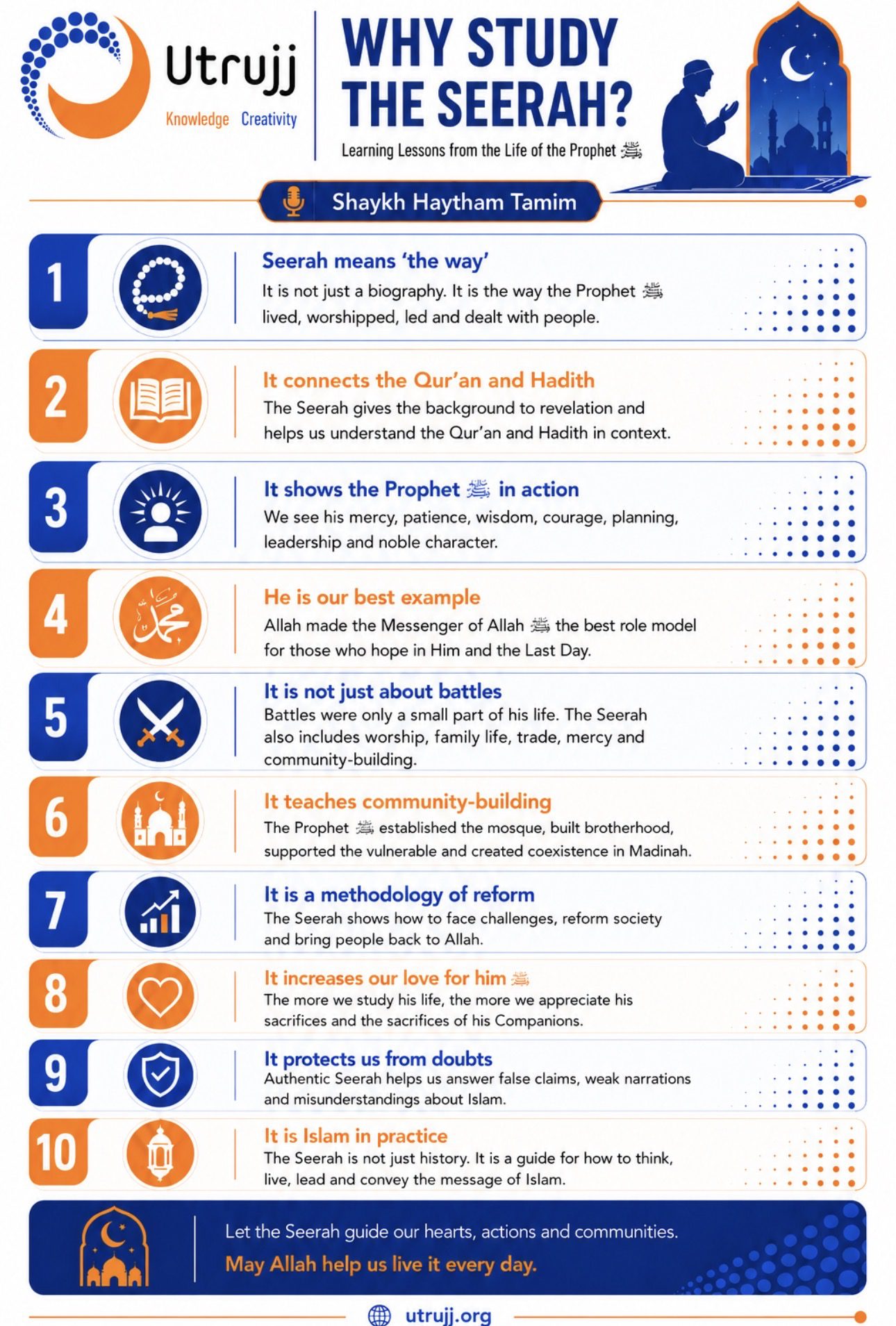
One of the most important reasons is that the Seerah helps us understand the Qur’an. There are many verses in the Qur’an that were revealed in connection with specific events during the lifetime of the Prophet ﷺ. If we do not know what happened, we will not fully understand the meaning of those verses.
For example, when Allah speaks about the Battle of Uhud, or when He mentions the victory at Badr, we need to know what happened in those events. What was the situation? Who was involved? What were the circumstances? What lessons were being taught? Without the Seerah, we only see part of the picture. Through the Seerah, we understand the context.
The Seerah also helps us understand Hadith. Sometimes a narration tells us that the Prophet ﷺ was sitting in the mosque and someone came to him and asked a question. Sometimes the person may have spoken harshly, or behaved in a way that was difficult, and then we see how the Prophet ﷺ responded. We see his patience and his kindness in action, and we see his incredible wisdom and gentleness.
These incidents are very telling. When we see them within the wider Seerah, we are able to feel the atmosphere, and the circumstances and witness the character of the Prophet ﷺ, beyond the the words of the Hadith.
Learning the character of the Prophet ﷺ
Through the Seerah, we learn the character of the Prophet ﷺ. We see how he dealt with pressure. What was his reaction when he was under immense pressure during the Battle of the Trench? What did he do when Madinah was surrounded by around ten thousand troops during the Battle of al-Ahzab? We see his courage as well as his patience, his reliance on Allah, meticulous planning and inspirational leadership.
We also see his organisation. How did he organise his time? How did he organise the community? How did he organise the salah? How did he organise the troops? How did he protect Madinah? How did he appoint people to different roles? How did he bring people together? All of this is found in the Seerah.
Following the best role model
Another reason we study the Seerah is that Allah has instructed us in the Qur’an to follow the Messenger of Allah ﷺ.
Allah Almighty says:
لَقَدْ كَانَ لَكُمْ فِي رَسُولِ اللهِ أُسْوَةٌ حَسَنَةٌ لِّمَن كَانَ يَرْجُوا اللهَ وَالْيَوْمَ الْآخِرَ وَذَكَرَ اللهَ كَثِيرًا
“Indeed, in the Messenger of Allah you have an excellent example for whoever hopes in Allah and the Last Day and remembers Allah often.”
(al-Ahzab 33:21)
Thus, the Prophet ﷺ is the role model to be followed. But how can we follow him if we do not study his life? We need to know his Seerah in order to follow his footsteps.
Learning lessons from every event
This is also why this series is called learning lessons from the Seerah. Every event in the Seerah contains lessons. Every story, every decision, every response of the Prophet ﷺ teaches us something.
Why did he act in this way on this occasion and not in another way? Why did he treat the hypocrites in a particular manner, even though he could have dealt with them differently? What was his plan during the Hijrah? How did he prepare for his migration from Makkah? How did he leave Makkah? How did he rely on Allah while also taking the means?
From the Hijrah, for example, we learn that relying on Allah does not mean abandoning planning. Tawakkul is not laziness. It does not mean that we sit back and say, “Allah will take care of it,” without doing our part. We have to plan ahead. We have to do our homework. We have to research, prepare and carry out our due diligence. Then we place our trust in Allah.
Establishing a community
Another major reason we study the Seerah is that it teaches us how to establish a community. How do we build a harmonious, loving and caring community? How do we live with people of different beliefs? How do we create coexistence in practice?
Madinah was not only made up of Muslims. There were Muslims, there were Jewish tribes, and there were also others who were neither Muslim nor Jewish. It was a society with different groups, different beliefs and different loyalties. So how did the Prophet ﷺ bring the community together? How did he create coexistence in practice?
Coexistence, care and community support
Today we speak a great deal about coexistence, but when we read the Seerah, we see coexistence lived and applied in the best way. We also see how the Prophet ﷺ organised financial support within the community. Today, for example, governments may support people who are unemployed, provide housing benefit, or offer different forms of assistance. This idea of protecting and supporting the vulnerable within society was established by the Prophet ﷺ in his community.
How do we protect the community? How do we support the community? How do we look after those who are struggling?When you read the Seerah, you see this in practice.
You also see the Prophet ﷺ caring for the environment. Today, we speak about the environment, global warming and many other issues. But when the Prophet ﷺ arrived in Madinah, he carried out a form of rehabilitation for the city. He changed many things to make Madinah healthier, cleaner and better for the community. He was also kind towards animals and towards the creation of Allah Almighty. This is all part of the Seerah. It is not only about battles, dates and events. It is about a complete way of life.
How authentic is the Seerah?
Another big question people often ask is: what about the authenticity of the Seerah? Is it as authentic as the Qur’an? Of course not. The highest and most authentic book is the Qur’an. Nothing can match the Qur’an in its authenticity. However, this does not mean that we cannot rely on the Seerah, or that the Seerah is not accurate or authentic. That is not the case.
There is something important we need to understand. The scholars of Seerah did not always treat the narrations of Seerah in exactly the same way that the scholars of Hadith treated Hadith narrations.
Earlier, we mentioned the distinction between the Qur’an, Hadith and Seerah. The Qur’an is at the highest level. Then we have Hadith. Then we have Seerah, which is connected to Hadith but broader than it. The scholars did not always apply the same strict conditions to Seerah reports that they applied to Hadith reports. Sometimes they did, but not always.
Why were Hadith narrations treated more strictly?
The scholars commented on this many times. They explained that Hadith is often used as a basis for rulings: halal and haram, permissible and impermissible. If you want to say that something is halal or haram, you need strong authentication. You need firm ground to stand on. You cannot say, “This is halal,” or, “This is haram,” without proper evidence and authentication. This is why the scholars were very strict when narrating Hadith related to rulings.
A Hadith is what is attributed to the Prophet ﷺ: his words, his actions, his tacit approvals and his descriptions or qualities. For example, if a narration describes him as kind, this is also included within Hadith.
But the Seerah is not always focused on halal and haram. Usually, the Seerah is telling us about the life of the Prophet ﷺ: that he travelled to a certain place, came from a certain place, met a certain person, received a delegation in the mosque, conquered Makkah, organised the community, and so on.
If a report is not connected to halal and haram, the scholars of Seerah were usually not as strict with it as the scholars of Hadith were with legal narrations.
A newer approach to Seerah
More recently, perhaps over the last forty or fifty years, some scholars began rewriting the Seerah with a different approach. They began treating Seerah narrations more like Hadith narrations, going through the chains and reports and assessing them according to stricter standards.
This gave rise to works on what is sometimes called the authentic Seerah of the Messenger of Allah ﷺ. This approach was not as common in earlier generations in the same way. So today, we have a newer approach to the Seerah, where some scholars try to filter the narrations more strictly.
However, again, we do not need to be equally strict with every type of narration if it is not related to halal and haram. As some scholars used to say, when we narrate about halal and haram, we are very strict; when we narrate about virtues, stories and general lessons, we are more lenient. This is a common approach among the scholars.
Weak narrations in the Seerah
This also explains why, when you read the Seerah, you may sometimes come across weak narrations. In some cases, you may even find reports that are not authentic. However, generally speaking, the Seerah is not full of fabricated narrations. There are some, but they are not the majority. There are also weak narrations, and this is normal in Seerah literature.
Of course, fabricated narrations should not be relied upon as evidence. But the presence of some weak reports does not mean we throw away the Seerah. If a narration is not connected to halal and haram, and it does not contradict established principles, scholars may be more flexible in mentioning it for background, context or lessons. This has been the common practice among the scholars of Seerah.
The Seerah gives us Islam in practice
Studying the Seerah is important. The Seerah gives us a better understanding of Islam. It gives us a better understanding of the Qur’an. It gives us a better understanding of the character of the Messenger of Allah ﷺ in practice, not just in theory.
The Qur’an tells us that the Prophet ﷺ is the role model. But how do we see this role model in action? We see him through the Seerah. The scholars therefore studied the Seerah by combining the Qur’an and Sunnah. In the Seerah, you will find many events where the Prophet ﷺ received revelation connected to a particular incident. You will also find major moments such as his Farewell Sermon before he passed away. But the most important point is this: the Seerah is the life of the Messenger of Allah ﷺ, the best of Allah’s creation. That is the core of it.
Seeing the best of creation in action
When we study the seerah we see the best of Allah’s creation in action. We see him when he is sad. We see him when he is happy. We see him with his Companions. We see him praying. We see him in the battlefield. We see him travelling. We see him leading. We see him dealing with family, neighbours, enemies, hypocrites, believers, children, the elderly and the vulnerable.
In every situation, we learn plenty of lessons. So the Seerah is a way of life. It shows us how the Prophet ﷺ lived, and how we should live our lives in accordance with his guidance.
The Seerah is not only battles
Unfortunately, sometimes people misunderstand the Seerah. Some people think the Seerah is a catalogue of battles, as the early writings of Seerah often focused on the military expeditions of the Prophet ﷺ, known in Arabic as al-maghazi. These were the battles and expeditions that he led or was involved in. Because of this, some people reduce the Seerah to battles. But this is unfair. The battles were only a very small part of the life of the Prophet ﷺ.
After revelation began, the Prophet ﷺ received revelation for twenty-three years. That is the period of his mission after prophethood. Now ask yourself: if we gathered all the days and months connected to battles, how much would they amount to? Even if we were generous and said six months altogether, that is still only six months out of twenty-three years. It is a very small percentage.
Some people deliberately try to present the Prophet ﷺ as though his life was mainly about the battlefield. But that is not true. He is the mercy whom Allah sent to humanity.
Allah Almighty says:
وَمَآ أَرْسَلْنَـٰكَ إِلَّا رَحْمَةً لِّلْعَـٰلَمِينَ
“We have not sent you except as a mercy to the worlds.”
(al-Anbiya 21:107)
At the same time, there were battles that he had to face, and he did face them ﷺ. But they were not the whole story. They were a small part of a much greater life and mission.
The Seerah gives context
Many times, when I read a Hadith or an ayah, and I want to understand it more deeply, I have to go back to the Seerah. I need to ask: what was happening at the time this ayah was revealed? What was taking place when the Prophet ﷺ said this Hadith? Who was present? What was the situation? What was the background?
Then, when you go through the details, you begin to understand the context. For example, you may find that the Prophet ﷺ said something because he had received a delegation of new Muslims. They had come to learn about Islam, and he was teaching them for seven days or ten days in his mosque. Once you know this, you understand the Hadith differently. You see the atmosphere, the purpose and the setting.
Without that context, you may read the words but miss the point of the whole event. You may miss the reason behind it, or the wisdom in the Prophet’s response ﷺ.
The history of divine revelation
Through the Seerah, we learn about the character of the Prophet ﷺ. We learn about the Muslim community. And without doubt, we also learn about historical events. Perhaps the best way to describe the Seerah is that it is the history of divine revelation.
From the age of forty until the age of sixty-three, the Prophet ﷺ received revelation for twenty-three years. The Seerah gives us the sequence of those years: the events, the revelation, the challenges, the responses, and the divine guidance that came during his lifetime ﷺ.
We also see other elements within the Seerah. We see the hypocrites involved in certain historical events. We see how they plotted against the Prophet ﷺ, his family and his community. We see the plots of different tribes and how the Prophet ﷺ dealt with them.
We see the establishment of the Muslim market in Madinah. How did the Prophet ﷺ plan for it? What rules and regulations did he put in place? What was acceptable, and what was not acceptable?
We see that very early after arriving in Madinah, he established the mosque. This shows us the importance of the mosque as the centre of worship, learning, community and leadership.
We also see the brotherhood in Madinah: the brotherhood between the Muhajirun and Ansar, and even the brotherhood among the Muhajirun themselves. All of these matters are found in the Seerah. So the Seerah is very rich and very condensed. There are so many things to learn from it.
Different types of Seerah books
There are many books on the Seerah of the Prophet ﷺ. Some are short, some are medium-sized, and some are huge works. You may find a short booklet on the Seerah, and you may also find a work of twenty volumes. It depends on what you want from the Seerah and what you want to learn.
But whatever level we study, the purpose is not just to collect information. We need to put the Seerah into action. We need to teach ourselves, our children, our students, our schools, our companies and our communities the best practice of the Prophet ﷺ in different situations.
His life gives us guidance in so many areas: worship, family, leadership, trade, community work, education, mercy, discipline, planning and sacrifice.
Conveying the message
The main mission of the Prophet ﷺ was to convey the message. How can we follow in his footsteps? Of course, this does not mean that everyone must drop everything in their life and dedicate themselves only to conveying the message in a formal way. Not necessarily.
You can convey the message in your own clinic. You can convey the message in your own school. You can convey the message in your own business. You can convey the message by embodying the character of the Prophet ﷺ. This too is a form of conveying the message.
Everyone, in their own position, can convey the message of Islam. When people see truthfulness, sincerity, good character, trustworthiness and mercy in you, they are seeing something from the guidance of the Prophet ﷺ.
Through studying his Seerah, we see his truthfulness. We see his dedication. We see his sincerity. We see how he raised a generation that changed the course of history.
The values that built a civilisation
The Prophet ﷺ raised a generation that transformed the reality around them. They changed the course of history and built a new civilisation — a civilisation that the West is indebted to, whether it accepts that or not. How did this happen? They established love for learning. They understood the importance of knowledge. They lived by good character, truthfulness, fulfilling promises, trustworthiness and responsibility. These are the values and principles we live by as Muslims.
Today, in the corporate world, many of these values are translated into modern language: transparency, leadership, integrity, accountability and trust. But when you go deeper, you will find these principles clearly in the Seerah of the Prophet ﷺ.
Not in the typical way
In this series, we are going to study the Seerah, but not necessarily in the typical way. We will focus on different topics, different periods and different lessons.
We may look at the Makkan period and ask: what was the main focus of the Prophet ﷺ during that time? What stages did he go through? Why did he do certain things and not others? What changed before revelation and after revelation? We will make these comparisons, insha’Allah, and try to understand the lessons behind the events.
The Seerah brings the pieces together
Studying the Seerah brings us closer to the Prophet ﷺ. To be honest, things are not the same after you study the Seerah. When you have studied it properly, your understanding becomes deeper. You begin to see things in perspective.
Without the Seerah, pieces of information may feel as though they are floating in the air. You may study something from the Qur’an, and something from Hadith, but you may not know how they connect. Where does this fit? What was happening? What is the bigger picture? When you study the Seerah, the pieces come together.
It is like a jigsaw. The Qur’an, the Sunnah, the Hadith, the events, the people, the sacrifices, the challenges — they all begin to connect. The Seerah brings them together and allows you to see the life of the Prophet ﷺ in motion.
The more you study the Seerah, the more you understand the life of the Prophet ﷺ. It gives you greater closeness to him. It also makes you appreciate his Companions more. You appreciate the sacrifices that he made ﷺ, and the sacrifices they made, in order to deliver this message to us, preserve it and protect it. So the Seerah of the Prophet ﷺ is not just about dates and incidents. It is about a way of thinking, a way of applying Islam, and a way of living.
The Seerah as a methodology of reform
The Seerah of the Prophet ﷺ is about the way of conducting yourself. It is also a methodology of reform: how to reform a community, how to respond to reality, and how to face the challenges around you. The Seerah is a reflection of the actions of the Prophet ﷺ: first, as the Messenger of Allah, and second, as a human being. Through his Seerah, we understand how he reformed his reality. We see how he faced the challenges of his time ﷺ. So yes, the Seerah is a methodology for reforming the community.
And this, by the way, was the mission of all prophets and messengers. Allah does not send a messenger except when there is a need for a messenger: when people have moved away from the truth, from the message, and from the oneness of Allah Almighty. Then Allah sends a messenger to reform them and bring them back to the straight path.
The more we study the Seerah, the more we love the Prophet ﷺ. It increases our love for him, and without doubt, we need to increase our love for him.
A recommended book on the Seerah
There are many books on the Seerah of the Prophet ﷺ. To be honest, one of my favourite books — among many, of course — is al-Seerah al-Nabawiyyah fi Daw’ al-Qur’an wa’l-Sunnah, which means The Prophetic Seerah in the Light of the Qur’an and Sunnah. It is by Shaykh Muhammad Abu Shahbah.
He passed away relatively recently, around thirty or forty years ago. The book is beautiful. I do not think it has been translated into English yet, but with the new AI tools, translation has become much easier now. It is in two volumes, and it is a beautiful work for several reasons.
First, the author was a great muhaddith. He was a deep thinker, an encyclopaedic scholar, and someone with very wide reading. To cut a long story short, his book is very valuable because he went through the narrations of the Seerah and collected authentic narrations. When something was related to halal and haram, and the narration was weak, he rejected it. So it is a very well-done book.
The first time I came across this book was probably thirty-five years ago. Subhan Allah, I became attached to it, and I am still attached to it. It is a very good book. Insha’Allah, I will go through this book and other books as well, but this will be one of the main books I refer to.
Responding to accusations against the Seerah
Another important feature of this book is that the author goes through accusations made by orientalists and non-Muslims against the Prophet ﷺ. He replies to them in a very scientific and authentic manner. He discusses their claims, debates them and refutes them in a solid and beautiful way.
So through this book, you can also learn how to deal with accusations and doubts around certain issues in the Seerah of the Prophet ﷺ. You also learn how to deal with some narrations that are found in famous books of Seerah, how to refute what is weak or baseless, and how to stick to authentic narrations. In this way, we keep the Seerah of the Prophet ﷺ clear from these attacks.
Delivered by Shaykh Haytham Tamim to the Al Manaar Convert Club on 7th July 2026