
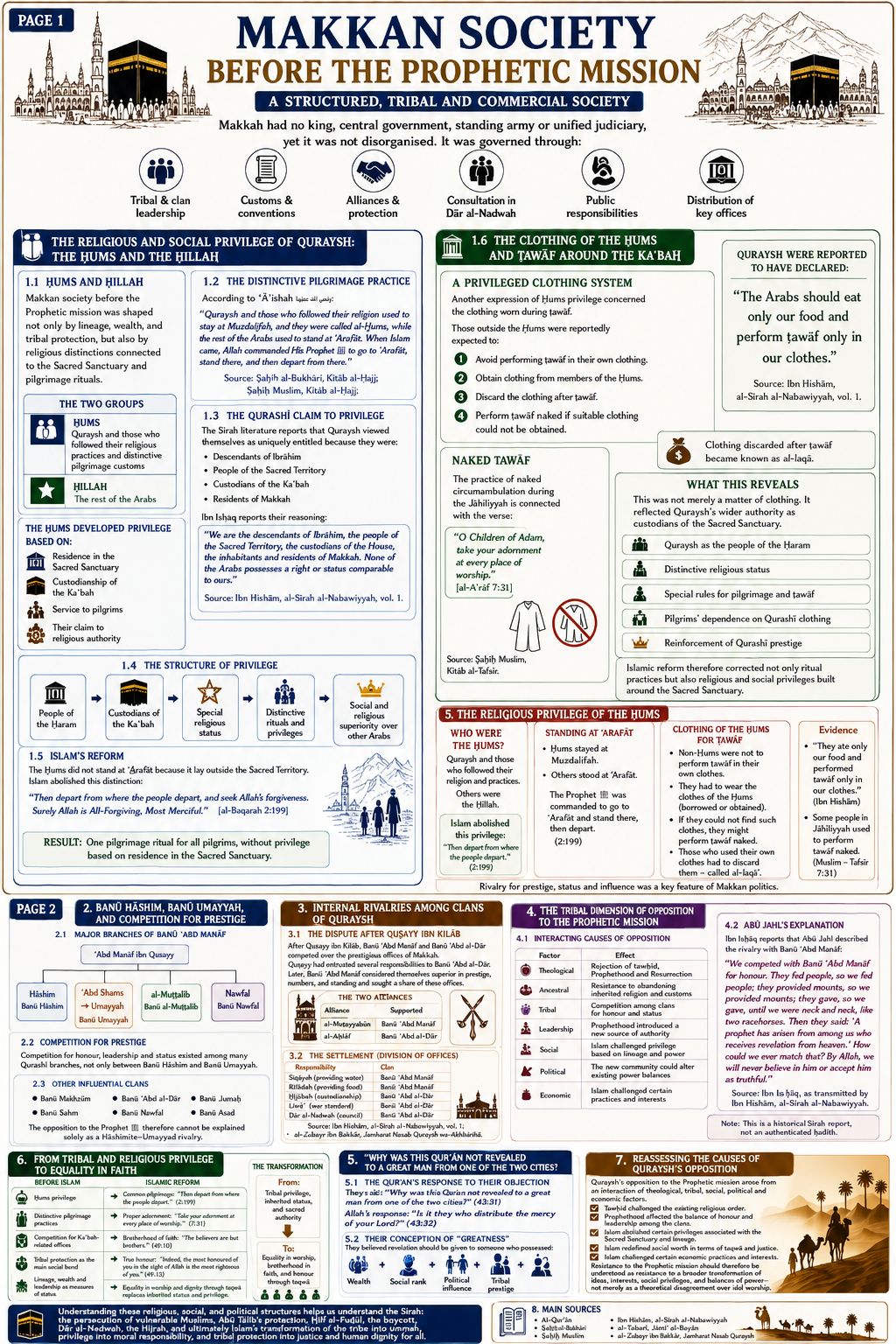
The religious and social privilege of Quraysh: the Hums and the Hillah
Makkan society before Islam was not divided only by lineage, wealth and tribal protection. There was also a form of religious distinction connected to the Haram and the rituals of Hajj.
One of the clearest examples was the Hums. The term Hums was used for Quraysh and those who followed some of their distinctive pilgrimage practices. The rest of the Arabs were referred to in this context as the Hillah.
Quraysh had developed a strong sense of religious privilege because they lived in the Sacred Sanctuary, looked after the Ka’bah and served the pilgrims.
Aisha explained:
كَانَتْ قُرَيْشٌ وَمَنْ دَانَ دِينَهَا يَقِفُونَ بِالْمُزْدَلِفَةِ، وَكَانُوا يُسَمَّوْنَ الْحُمْسَ، وَكَانَ سَائِرُ الْعَرَبِ يَقِفُونَ بِعَرَفَاتٍ
“Quraysh and those who followed their religion used to remain at Muzdalifah, and they were called al-Hums, while the rest of the Arabs used to stand at Arafat.” (Bukhari; Muslim)
When Islam came, the Prophet ﷺ was commanded to stand at Arafat like everyone else and then depart from there.
Allah said:
ثُمَّ أَفِيضُوا مِنْ حَيْثُ أَفَاضَ النَّاسُ وَاسْتَغْفِرُوا اللَّهَ ۚ إِنَّ اللَّهَ غَفُورٌ رَحِيمٌ
“Then depart from where the people depart, and seek Allah’s forgiveness. Surely Allah is All-Forgiving, Most Merciful.” (Surat al-Baqarah, 2:199)
Arafat lies outside the boundaries of the Haram. Quraysh regarded themselves as the people of the Sacred Sanctuary and felt that they should not leave its boundaries during Hajj.
The seerah literature describes the way they viewed themselves:
“We are the descendants of Ibrahim, the people of the Sacred Territory, the custodians of the House and the inhabitants of Makkah. None of the Arabs has a right or status like ours.”
(Ibn Hisham, al-Sirah al-Nabawiyyah)
This was more than a small difference in ritual. Because Quraysh were the people of the Haram and custodians of the Ka’bah, they came to see themselves as possessing a special religious status. That sense of privilege then led to distinctive pilgrimage practices which separated them from other Arabs.
Islam removed this distinction. Everyone stood together at Arafat and everyone departed from the same place. The lesson was clear: closeness to the Sacred House did not give a tribe the right to create religious privileges for itself.
Clothing and tawaf
Another practice connected with the Hums concerned the clothes worn by pilgrims during tawaf. According to the seerah accounts, people who were not from the Hums were discouraged from performing tawaf in the clothes in which they had arrived. They were expected instead to use clothing supplied by the Hums.
Quraysh are reported to have said:
“The Arabs should eat only our food and perform tawaf only in our clothes.”
(Ibn Hisham, al-Sirah al-Nabawiyyah)
If someone could not obtain such clothing, some would perform tawaf naked. This practice of naked tawaf in the Jahiliyyah is established in authentic reports.
Allah said:
يَا بَنِي آدَمَ خُذُوا زِينَتَكُمْ عِنْدَ كُلِّ مَسْجِدٍ
“O Children of Adam, take your adornment at every place of worship.” (Surat al-A’raf, 7:31)
The hadith literature explains that this verse was connected to the practice of some people performing tawaf without clothing. (Muslim)
This was not only about clothes. It showed how the religious status of Quraysh could translate into social authority over those coming to perform Hajj. Because the Hums regarded themselves as having a distinctive religious position, special rules developed around pilgrimage and tawaf. Some pilgrims became dependent on them for suitable clothing, and this reinforced the prestige and authority of Quraysh.
Islam did not only correct an individual ritual here and there. It dismantled practices which had allowed religious status to become a form of social privilege.
Quraysh was not one united bloc
It is also important not to imagine Quraysh as one single political group which always thought and acted in the same way. Quraysh consisted of many clans. Sometimes they cooperated, and sometimes they competed fiercely with one another for honour, leadership, influence and the prestigious responsibilities connected with the Ka’bah.
This rivalry existed long before the Prophetic mission. A good example appeared after Qusayy ibn Kilab.
Qusayy had entrusted important Makkan offices to Banu Abd al-Dar. Later, Banu Abd Manaf believed that their own prestige and standing gave them a claim to some of these responsibilities.
Quraysh divided into alliances. Those who supported Banu Abd Manaf became known as al-Mutayyabun, while those supporting Banu Abd al-Dar became known as al-Ahlaf.
Eventually, a settlement was reached. Responsibilities for Siqayah, providing water to pilgrims, and Rifadah, providing food and hospitality, went to Banu Abd Manaf. Other important offices, including Hijabah, the custodianship of the Ka’bah, Liwa, responsibility for the banner, and Dar al-Nadwah, the council house, remained with Banu Abd al-Dar.
This tells us something important. Looking after the Ka’bah was not only an administrative job. These offices brought honour, legitimacy and political influence. Makkan politics was shaped by a combination of lineage, prestige, service of the Haram, trade, alliances and rivalry between the clans.
Banu Hashim, Banu Umayyah and competition for honour
Several important branches came from Abd Manaf. Hashim became the ancestor of Banu Hashim. Abd Shams was the ancestor of the line from which Banu Umayyah emerged. Al-Muttalib became the ancestor of Banu al-Muttalib, while Nawfal became the ancestor of Banu Nawfal.
Banu Hashim and Banu Umayyah became two of the prominent houses of Quraysh, and there was competition between different branches for honour and status.
But we should be careful not to reduce all Makkan politics to a simple struggle between Banu Hashim and Banu Umayyah. It was far more complicated than that. Banu Makhzum, Banu Abd al-Dar, Banu Jumah, Banu Sahm, Banu Nawfal, Banu Asad and other clans also played important roles in Makkan society and later in the response to Rasulullah ﷺ.
So the opposition to the Prophet ﷺ cannot only be explained as a Hashimite-Umayyad rivalry.
Why did Quraysh oppose the Prophet ﷺ?
When we talk about the opposition of Quraysh, we often say they rejected Islam because it challenged their religion. That is true, but it is not the whole picture.
Several things were happening at the same time. The most important was theological. Islam rejected their idols and called them to tawhid, prophethood and resurrection.
There was also attachment to the religion of their forefathers. They did not want to abandon what they had inherited. But there were tribal and political considerations as well.
Prophethood created a completely new source of authority. If Muhammad ﷺ was truly the Messenger of Allah, then his authority could not only be measured against that of the chiefs of Quraysh. Revelation was above tribal leadership.
There was also the question of honour and competition between clans.
One revealing report in the seerah is attributed to Abu Jahl. He is reported to have explained the rivalry between his people and Banu Abd Manaf:
“We competed with Banu Abd Manaf for honour. They fed people, so we fed people. They provided mounts, so we provided mounts. They gave, so we gave, until we were neck and neck like two racehorses. Then they said, ‘A prophet has arisen from among us who receives revelation from heaven.’ How can we ever compete with that? By Allah, we will never believe in him or accept him as truthful.”
(Ibn Ishaq, as transmitted by Ibn Hisham)
This is a seerah report, not an authenticated Prophetic hadith, but it gives us an important insight into the way tribal rivalry could shape the response to revelation.
If prophethood came from Banu Hashim, what could another clan produce to equal it? You can compete in wealth, in feeding pilgrims and in influence, but how do you compete with revelation from heaven?
“Why was this Qur’an not revealed to a great man?”
The Qur’an itself tells us that ideas of social status and leadership influenced some of the objections to the Prophet ﷺ.
Allah says:
وَقَالُوا لَوْلَا نُزِّلَ هَذَا الْقُرْآنُ عَلَىٰ رَجُلٍ مِنَ الْقَرْيَتَيْنِ عَظِيمٍ أَهُمْ يَقْسِمُونَ رَحْمَتَ رَبِّكَ
“They said, ‘Why was this Qur’an not revealed to a great man from one of the two cities?’ Is it they who distribute the mercy of your Lord?” (Surat al-Zukhruf, 43:31–32)
Look at the objection. They were not only asking, “Is this message true?” They were also asking, “Why him?” According to their way of thinking, greatness was measured through wealth, political status and social leadership. Allah answered them very clearly:
أَهُمْ يَقْسِمُونَ رَحْمَتَ رَبِّكَ
“Is it they who distribute the mercy of your Lord?” (Surat al-Zukhruf, 43:32)
Prophethood is not an office which people allocate according to tribal prestige. Allah chooses His messengers.
From tribal privilege to equality before Allah
When you put all of this together, you begin to see that Islam was changing much more than the objects people worshipped.
Before Islam, Quraysh could claim special privilege because they were the people of the Haram. The Hums developed their own distinctive pilgrimage practices, while the clans of Quraysh competed for prestigious offices connected with the Ka’bah. A person’s tribe was also his primary source of protection, while lineage, wealth and leadership carried enormous social weight.
Islam began to change these assumptions.
Allah said:
ثُمَّ أَفِيضُوا مِنْ حَيْثُ أَفَاضَ النَّاسُ
“Then depart from where the people depart.” (Surat al-Baqarah, 2:199)
There was no longer a special pilgrimage practice only because someone belonged to Quraysh.
Allah said:
يَا بَنِي آدَمَ خُذُوا زِينَتَكُمْ عِنْدَ كُلِّ مَسْجِدٍ
“O Children of Adam, take your adornment at every place of worship.” (Surat al-A’raf, 7:31)
The degrading customs associated with naked tawaf were brought to an end.
Allah said:
إِنَّمَا الْمُؤْمِنُونَ إِخْوَةٌ
“The believers are but brothers.” (Surat al-Hujurat, 49:10)
Faith created a bond which went beyond tribe.
And Allah said:
إِنَّ أَكْرَمَكُمْ عِنْدَ اللَّهِ أَتْقَاكُمْ
“Indeed, the most honoured of you in the sight of Allah is the one with the most taqwa.” (Surat al-Hujurat, 49:13)
This was a completely different measure of honour. Not your tribe, not your wealth, not how many people follow you and not whether your family controls one of the offices of Makkah. Your value before Allah is measured by your taqwa.
Understanding the opposition of Quraysh
So when we ask why Quraysh opposed Rasulullah ﷺ, it is too simplistic to give only one reason. It was not only that they were worried about their trade, and it was not only that they were attached to their idols. Their opposition came from several factors working together.
Tawhid challenged the religious order. Prophethood changed the balance of honour and authority. Islam rejected privileges which had developed around lineage and the Sacred Sanctuary. It challenged unjust social practices and certain economic practices. And it created a community in which people from different tribes and social classes could stand together on the basis of faith.
This helps explain why the response to Rasulullah ﷺ varied so much even within Quraysh. Some people protected him although they did not accept Islam. Some became Muslim very early. Some remained neutral for a time, while others became among his fiercest opponents.
They were all living within the same society, but they did not all have the same interests, loyalties, personalities or understanding. Once we understand that, the politics of Makkah in the seerah begins to make much more sense.
Supplementary to the talk delivered to the Al Manaar Convert Club on 1st September 2026.
Related posts