
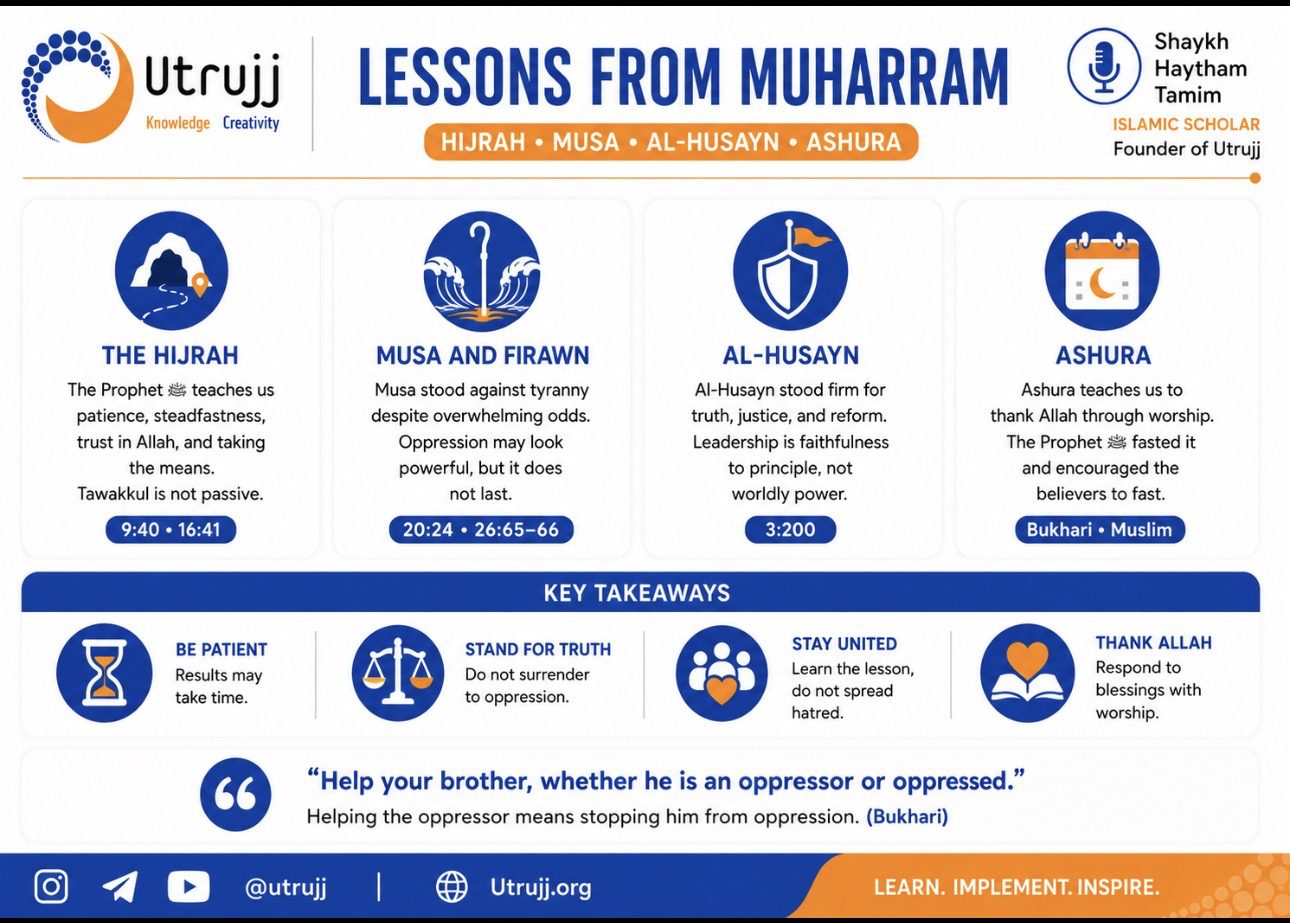
Muharram is a special month. It is the beginning of the Hijri year, and within it is the tenth of Muharram, the Day of Ashura.
Although the Hijrah itself took place in Rabi’ al-Awwal, the Islamic calendar begins with Muharram and counts its years from the Hijrah. So when the new Hijri year begins, it naturally reminds us of the Hijrah of the Prophet ﷺ and the many lessons within it.
The Tenth of Muharram: Standing firm against tyranny
As we know from the seerah of the Prophet ﷺ, when he migrated to Madinah, he found that the Jewish community was fasting on the tenth of Muharram. He asked them why they were fasting, and they replied that it was the day on which Allah saved Musa (peace be upon him) from Fir‘awn.
The Prophet ﷺ fasted that day and instructed the believers to fast it as well, saying:
“We have more right to Musa than you.”
(Bukhari and Muslim)
The tenth of Muharram therefore preserves the memory of confronting tyrants and standing against oppression.
Musa (peace be upon him) and Fir‘awn
Throughout the Qur’an, we repeatedly encounter the story of Musa (peace be upon him). Allah commanded him:
“Go to Fir‘awn. Indeed, he has transgressed.”
(Surah Taha, 20:24)
Fir‘awn had exceeded every limit. The story of Musa (peace be upon him) is the most frequently repeated story in the Qur’an; no other story is mentioned as often. This is because the struggle between truth and tyranny is a pattern that continues to be repeated in human history and in our own reality.
At the heart of the story is the lesson that we must face our circumstances despite the challenges before us. Fir‘awn was a powerful tyrant. He possessed wealth, manpower, political control, laws, weapons and every resource available to him. Musa and Harun (peace be upon them), by contrast, were only two individuals.
Looking at the situation purely from a worldly perspective, someone might have said, “How can two men possibly confront such a powerful ruler? He has all the resources, weapons and latest technology at his disposal. Go home, rest and save yourselves.”
But Allah teaches us that whenever we experience tyranny, we must not give up because the oppressor appears overwhelmingly powerful. Whenever we are confronted by injustice and oppression, we must not surrender.
We all know how the story ended. Allah saved Musa (peace be upon him) and his people, while Fir‘awn and his followers drowned in the sea.
Allah’s support is not restricted to the prophets
Someone might argue that Musa (peace be upon him) was a messenger who was supported by miracles. This is undoubtedly true. However, Allah never said that His support was limited exclusively to His prophets and messengers.
Allah’s support does not cease. To receive it, however, we need sincerity and truthfulness – ikhlas and sidq.
As the saying goes:
“Whoever is truthful with Allah, Allah will fulfil His promise to them.” (Nasa’i)
When you are sincere and truthful with Allah, He can make the seemingly impossible possible for you.
Allah’s support is not the exclusive property of the prophets and messengers. Allah says:
“Indeed, We will support Our messengers and those who believe during the life of this world and on the Day when the witnesses will stand.”
(Surah Ghafir, 40:51)
This is a clear statement from Allah. Allah supports true believers, who have done their utmost within their ability.
Al-Husayn (may Allah be pleased with him) and the stand against oppression
The tenth of Muharram also reminds us of Al-Husayn (may Allah be pleased with him), who stood against the tyranny and rule of Yazid.
According to the historical narrations, Al-Husayn (may Allah be pleased with him) travelled from Makkah towards Kufa accompanied by approximately seventy members of his family and supporters. It is reported that, in his will, he explained the purpose behind his stand:
“I did not rise out of arrogance or pride, nor to spread corruption or oppression. Rather, I rose seeking reform in the nation of my grandfather, Rasulullah ﷺ. I seek to enjoin what is right and forbid what is wrong.”
Once again, we see the principle of resisting tyranny. Someone might say, “But Al-Husayn did not win. He and members of his family were killed.”
The Prophet ﷺ said:
“Al-Hasan and Al-Husayn are the leaders of the youth of Paradise.”
(Tirmidhi)
He also said:
“Al-Husayn is from me, and I am from Al-Husayn. May Allah love whoever loves Al-Husayn.”
(Tirmidhi and Ibn Majah)
Though he did not receive an immediate worldly victory, he did not surrender or abandon the truth. He did everything within his ability and, according to the historical accounts, offered three possible alternatives to those who had surrounded him. They refused all of them and insisted upon killing him.
The central lesson is that confronting tyranny is not determined by how much power or how many resources a person possesses. It is about remaining steadfast upon the truth and clinging to it, even when one feels alone.
A believer must be willing to set an example and refuse to surrender. If everyone gives up, no one will remain to stand, speak and defend the truth against oppression.
Through these events, Allah teaches us that truth must be upheld, even when the balance of worldly power appears to be against it. Allah states in the Quran:
وَلْتَكُنْ مِّنكُمْ أُمَّةٌ يَدْعُونَ إِلَى الْخَيْرِ وَيَأْمُرُونَ بِالْمَعْرُوفِ وَيَنْهَوْنَ عَنِ الْمُنكَرِ ۚ وَأُولَٰئِكَ هُمُ الْمُفْلِحُونَ
“Let there be among you a group who call to goodness, enjoin what is right and forbid what is wrong. It is they who will be successful.” (Surah Ali Imran, 3:104)
And also:
كُنتُمْ خَيْرَ أُمَّةٍ أُخْرِجَتْ لِلنَّاسِ تَأْمُرُونَ بِالْمَعْرُوفِ وَتَنْهَوْنَ عَنِ الْمُنكَرِ وَتُؤْمِنُونَ بِاللَّهِ
“You are the best community raised for humanity: you enjoin what is right, forbid what is wrong and believe in Allah.” (Surah Ali Imran, 3:110)
Standing against oppression
The Qur’an and Sunnah teach us how to stand against oppression wherever it occurs. The Prophet ﷺ taught us that the oppressor must be stopped. We should neither permit, nor accept oppression, nor turn a blind eye to it.
Muharram is therefore a symbol of resisting oppression and spreading justice throughout the Ummah. However, this does not mean that we should continue mourning Al-Husayn (may Allah be pleased with him) until the Day of Judgement, nor should we perpetuate hatred from one generation to the next. We learn the lessons from what happened, and then we move forward.
We follow the instructions of the Prophet ﷺ rather than allowing ourselves to be governed entirely by emotion. If anyone were to be mourned continuously until the Day of Judgement, it would be the Prophet ﷺ. Yet we do not do this because prolonged and excessive mourning is not permitted in Islam.
The lasting lesson of Muharram
The message of Al-Husayn (may Allah be pleased with him) was a message of reform and unity. He wanted to reform the Ummah and stand against tyranny. This was also the message of the Prophet ﷺ.
We should not contradict that message by spreading hatred, dividing the Ummah and blaming one another for historical events in which neither we nor the people around us participated. Instead, we should focus on the challenges that confront us today.
We cannot return to the past and change history. What we can do is return to the guidance of the Prophet ﷺ, oppose tyranny and oppression, and stand together as one nation, one Ummah, one heart and one body against our real enemies – not against one another.
The Prophet ﷺ said:
“Help your brother, whether he is an oppressor or he is oppressed.”
The Companions asked, “We understand helping him when he is oppressed, but how do we help him when he is an oppressor?”
The Prophet ﷺ replied:
“By preventing him from oppressing others.”
(Bukhari)
Stopping the oppressor is also helping them, because you are preventing them from committing more sins and causing more harm.
Sometimes people think that remaining silent means they are neutral. But if someone is being oppressed and we have the ability to help, simply looking away allows the oppression to continue.
Of course, everyone acts according to their ability and within the guidance of Islam. Not everyone can respond in the same way. But we should never become comfortable with injustice or convince ourselves that it has nothing to do with us.
Muharram is therefore a symbol of standing against oppression and spreading justice within the Ummah. The lesson is not that you must always have more power before you stand for the truth. The lesson is steadfastness. It is about holding on to the truth even when you feel alone.
Allah says:
“O you who believe, be patient, persevere in patience, remain steadfast and be mindful of Allah so that you may succeed.”
(Surah Ali Imran, 3:200)
This verse was not revealed specifically about Karbala. It is used here because its general message of patience and steadfastness applies to believers in every age.
Commemorating victory through worship
We see in the Sunnah that the Prophet ﷺ fasted on the tenth of Muharram. This is a symbolic way of commemorating the victory and support granted by Allah.
That victory is commemorated through fasting and worship, not through practices that contradict the principles of Islam or the guidance of the Prophet ﷺ.
A similar lesson can be seen in the conquest of Makkah. Umm Hani (may Allah be pleased with her), the cousin of the Prophet ﷺ and the sister of Ali (may Allah be pleased with him), narrated that when the Prophet ﷺ entered Makkah, he prayed eight rak‘ahs in her home.
The scholars differed over the nature of these eight rak‘ahs. A well-known opinion is that they were Salat al-Fath, the Prayer of Victory. Some scholars accepted this interpretation, while others said that they were the Duha prayer.
According to the second opinion, the Prophet ﷺ had not yet prayed Duha that day, so he entered the house of Umm Hani (may Allah be pleased with her) and prayed eight rak‘ahs. Regardless of the difference of opinion concerning which prayer it was, the scholars agree that he prayed eight rak‘ahs. He therefore marked the conquest of Makkah with worship.
This is prophetic guidance – when something good happens to us, we should celebrate it through acts of worship. We should not celebrate in foolish or inappropriate ways that take us beyond the boundaries established by Islam.
Celebrate, but celebrate through worship: through fasting, remembrance of Allah, prayer, du‘a and other righteous deeds. According to some schools of Islamic law, a person may also pray two rak‘ahs in gratitude to Allah.
The Prophet ﷺ said:
“I hope that fasting the Day of Ashura will expiate the sins of the previous year.”
(Muslim)
He also said:
“If I live until next year, I will certainly fast the ninth.”
(Muslim)
It is therefore recommended to fast Ashura, along with the ninth of Muharram.
We ask Allah to enable us to be among those who always follow the Book of Allah and the Sunnah of the Prophet ﷺ. We ask Allah to make us one hand, one body and one heart and enable us to stand against oppression in any form and in any place. Ameen.
Based on the khutbah of Shaykh Haytham Tamim on 26th June 2026

Related posts