
In an age where success is often measured by status, wealth and influence, Islam offers a very different vision of greatness. The Prophet Muhammad ﷺ taught that true honour is not found in being served, but being a servant of Allah, the Most High, and then serving others. As for being a servant of Allah, much has already been written and said. I want to spend some time discussing the latter, service.
Service (khidmah) is not just performing an act of kindness; it is a form of expression of our servitude to Allah.
The Messenger of Allah ﷺ said:
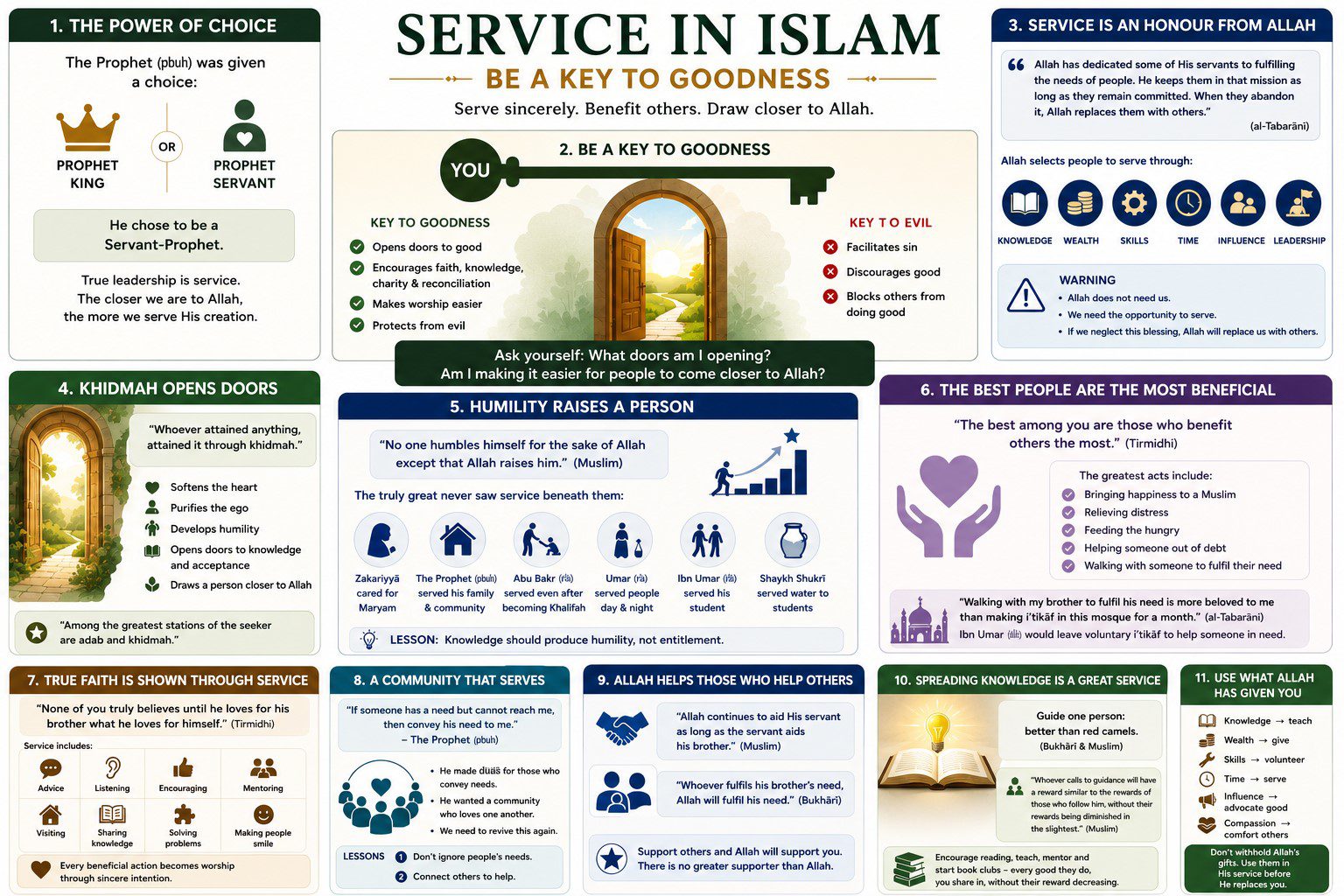
“Allah has treasures of goodness and treasures of evil. The keys to these treasures are people. Glad tidings (Tuba) for those whom Allah makes keys to goodness and locks against evil, and woe to those whom Allah makes keys to evil and locks against goodness.” (Ibn Majah, al-Tabarani)
This hadith reminds us that every one of us opens doors. The question is: what doors are we opening?
Some people become keys to goodness. They encourage prayer, charity, learning, reconciliation and compassion. They make it easier for others to draw closer to Allah. Others become barriers to goodness by discouraging beneficial work, promoting negativity or facilitating wrongdoing. Every conversation, every action and every opportunity either unlocks goodness or closes its door.
The Prophet ﷺ chose service over kingship
Perhaps the clearest demonstration of the value of service is found in an extraordinary incident narrated by Abu Hurayrah (may Allah be pleased with him) who said.
“Jibreel was sitting with the Messenger of Allah ﷺ looking towards the sky, when he saw an angel. So Jibreel said to him: ‘Indeed, this angel has never descended before today.’ So when the angel had descended, he said: ‘O Muhammad! I have been sent by your Lord (to inquire) whether He should make you a Prophet-king or a Prophet-servant.” [Musnad Al-Ahmad]
The angel descended with a choice from Allah: should the Prophet ﷺ be a Prophet-King or a Prophet-Servant?
“So Jibreel indicated to me that I should humble myself: So I said: ‘A servant-Prophet.’” [Al-Baghawee in Sharh As-Sunnah]
Guided by Jibreel, the Messenger of Allah ﷺ chose to be a Servant-Prophet.
The greatest human being who ever lived deliberately chose servanthood over worldly authority. His leadership was never defined by privilege, but by sacrifice, compassion and service. He served his family, comforted the vulnerable, visited the sick, counselled his companions and carried the burdens of his community. This teaches us that in Islam, leadership is service, and the closer a person is to Allah, the more they benefit His creation.
Service is an honour entrusted by allah
The Prophet ﷺ also said:
“Allah has dedicated some of His servants to fulfilling the needs of people. He keeps them in that mission as long as they remain committed. When they abandon it, Allah replaces them with others.” (al-Tabarani)
This hadith transforms the way we think about community work. Serving others is not a favour we do for people; it is an honour Allah grants us. If He has blessed someone with knowledge, wealth, influence, leadership, professional expertise or simply time and compassion, these are trusts (amanat) to be used in His service.
Yet the hadith also contains a sobering warning. Allah does not need us. If we neglect the opportunities He has given us, He will replace us with others who will fulfil that responsibility. The privilege of serving is itself a blessing that should never be taken for granted.
Khidmah refines the soul
The great scholars of Islam consistently regarded service as one of the fastest paths to spiritual refinement. Khwaja Mu’in al-Din Chishti famously said:
“Whoever attained anything, attained it through khidmah.”
Why? Because service and good character go hand in hand, and they are among the greatest stations for the people of Allah. Service softens the heart. It disciplines the ego, develops humility and teaches sincerity. A person who constantly serves others cannot easily become arrogant. Khidmah reminds us that every blessing we possess belongs to Allah and is meant to benefit His creation.
Humility elevates
The Prophet ﷺ said:
“No one humbles himself for the sake of Allah except that Allah raises him.” (Muslim)
History repeatedly demonstrates this principle.
- Prophet Zakariyya cared for Maryam (peace be upon them).
- The Prophet ﷺ constantly served his family and companions.
- Abu Bakr (may Allah be pleased with him) continued serving an elderly woman even after becoming Khalifah.
- Umar ibn al-Khaṭṭab (may Allah be pleased with him) personally carried food to hungry families at night.
- Abdullah ibn Umar (may Allah be pleased with him) insisted on serving his own students during their travels.
Even centuries later, great scholars embodied this prophetic character. Shaykh Shukri al-Luḥafi, despite being one of the foremost experts in the ten canonical Qur’anic recitations, quietly served water to students of knowledge in the mosque. His scholarship increased his humility, not his sense of entitlement. That is why knowledge should always produce service.
The best people benefit others
The Prophet ﷺ declared:
“The best among you are those who benefit others the most.” [Tirmidhi]
He also taught that walking with a fellow Muslim to fulfil their need is a beloved form of servanthood.
The Prophet ﷺ said:
“Walking with my brother to fulfil his need is more beloved to me than making i’tikaf in this mosque for a month.” (al-Tabarani)
This is a remarkable teaching. It highlights that Islam does not confine worship to rituals. Relieving someone’s distress, feeding the hungry, supporting a struggling family, comforting the lonely or helping another person solve a problem are all acts beloved to Allah. Even the act of bringing happiness to another human being or the act of smiling is recorded as charity
The companions understood this deeply. Abdullah ibn Umar (may Allah be pleased with him) would leave his voluntary worship in order to help someone in need because he recognised that serving people was itself a form of worship.
Service is the fruit of faith
Faith is not merely an inward belief.
The Prophet ﷺ said:
“None of you truly believes until he loves for his brother what he loves for himself.” [Tirmidhi]
True faith produces sincere concern for others. Service may take many forms. It may be giving wise advice, mentoring a young person, listening to someone in distress, visiting the sick, making people smile or helping reconcile families. Every beneficial action becomes an act of worship when done sincerely for Allah.
Allah helps those who help others
One of the most comforting promises in the Sunnah is the Prophet’s statement:
“Allah continues to aid His servant as long as the servant aids his brother.” (Muslim)
And in another narration:
“Whoever fulfils his brother’s need, Allah will fulfil his need.” (Bukhari)
If we seek Allah’s support in our own lives, one of the greatest means of attaining it is by supporting His servants. Another way to understand this is if you want Allah’s support, then be there for your brother. When you face a block and obstacles, turn to helping others as a means. Through supporting them, Allah will support you.
But if you ignore and do not respond to the needs of people, then your own needs may go unanswered, especially when you are in a position of privilege and have the ability to help.
Serving others is never a loss. Rather, it is an investment that brings barakah into our wealth, our time, our families, our health and our lives.
Spreading knowledge is one of the greatest forms of service
Among the highest forms of khidmah is guiding people towards beneficial knowledge.
Teaching, mentoring, recommending beneficial books, encouraging reading, organising study circles and creating book clubs all cultivate a community rooted in learning and faith.
The Prophet ﷺ said to Ali ibn Abi Talib (may Allah be pleased with him):
“By Allah, if Allah guides one person through you, it is better for you than red (the most valuable) camels.” (Bukhari & Muslim)
Red camels represented the greatest worldly wealth of that time. Yet guiding just one person to Allah is worth more.
Sometimes guidance begins with something surprisingly simple: recommending a book, inviting someone to a study circle or encouraging them to develop a habit of reading. We should never underestimate small acts that become the beginning of someone else’s journey to Allah.
The Prophet ﷺ also said:
“Whoever calls to guidance will receive a reward equal to those who follow it, without their rewards being diminished in the slightest.” (Muslim)
This is one of the most inspiring motivations for spreading beneficial knowledge.
- Every person who learns because of you…
- Every prayer inspired by something you shared…
- Every book that transforms someone’s life…
- Every person who goes on to teach others…
All continue to add to your scale of good deeds while those who benefit lose nothing of their own reward. This is the beauty of sincere service.
Become a key to goodness
We are living in extraordinary times, facing challenges from every direction. Yet we are also a community rich in talents and resources. These challenges present opportunities to make use of the blessings we have been given. Every blessing Allah has granted us is an opportunity to serve.
- Knowledge is for teaching.
- Wealth is for giving.
- Skills are for volunteering.
- Influence is for advocating for good.
- Compassion is for comforting others.
Our communities need teachers, organisers, mentors, volunteers, carers and people who quietly solve problems without seeking recognition. The Prophet ﷺ did not build a community of spectators. He built a community of servants. Perhaps the question each of us should ask is not, “What can my community do for me?” but rather:
“Who benefits because Allah placed me here?”
May Allah make us among those who unlock the treasures of goodness, become keys to guidance, and dedicate our lives to serving His creation sincerely for His sake. Ameen.