
It is a great privilege to read through the Seerah of Prophet Muhammad ﷺ and try to explore how things used to be: what the society was like, what the connections were, and how people lived.
In the previous sessions, we covered the trade routes, the products they used to sell, the markets, and the civilisations surrounding Arabia at that time. We spoke about the Persians, the Romans and the different powers around the Arabian Peninsula. It is very important to understand the context. Once you understand the context, you can see much more clearly the challenges Prophet Muhammad ﷺ was facing at that time.
Knowing the geography alone is not enough. You need to know the geography and the politics. You also need to understand the society, the customs, the habits and the practices people were living with.
Last time, we spoke about the tribes and the structure of the Arabian tribes. At the top of these tribes was Quraysh, and Prophet Muhammad ﷺ was from Quraysh. Quraysh was regarded as having one of the most eloquent forms of Arabic, and the Quran was revealed in their tongue.
When Uthman ibn Affan (may Allah be pleased with him) commissioned copies of the Mushaf, he instructed the Qurayshi members of the committee that if they differed with Zayd ibn Thabit over the Arabic wording, they should write it in the tongue of Quraysh:
إِذَا اخْتَلَفْتُمْ أَنْتُمْ وَزَيْدُ بْنُ ثَابِتٍ فِي شَيْءٍ مِنَ الْقُرْآنِ فَاكْتُبُوهُ بِلِسَانِ قُرَيْشٍ، فَإِنَّمَا نَزَلَ بِلِسَانِهِمْ
“If you and Zayd ibn Thabit differ concerning anything in the Quran, write it in the language of Quraysh, for it was revealed in their language.”
(Sahih al-Bukhari)
Today, I want to take you through some of the practices of that society: what existed before the Prophet ﷺ was sent, what continued during his lifetime, and what he then had to live with, reject and later reform.
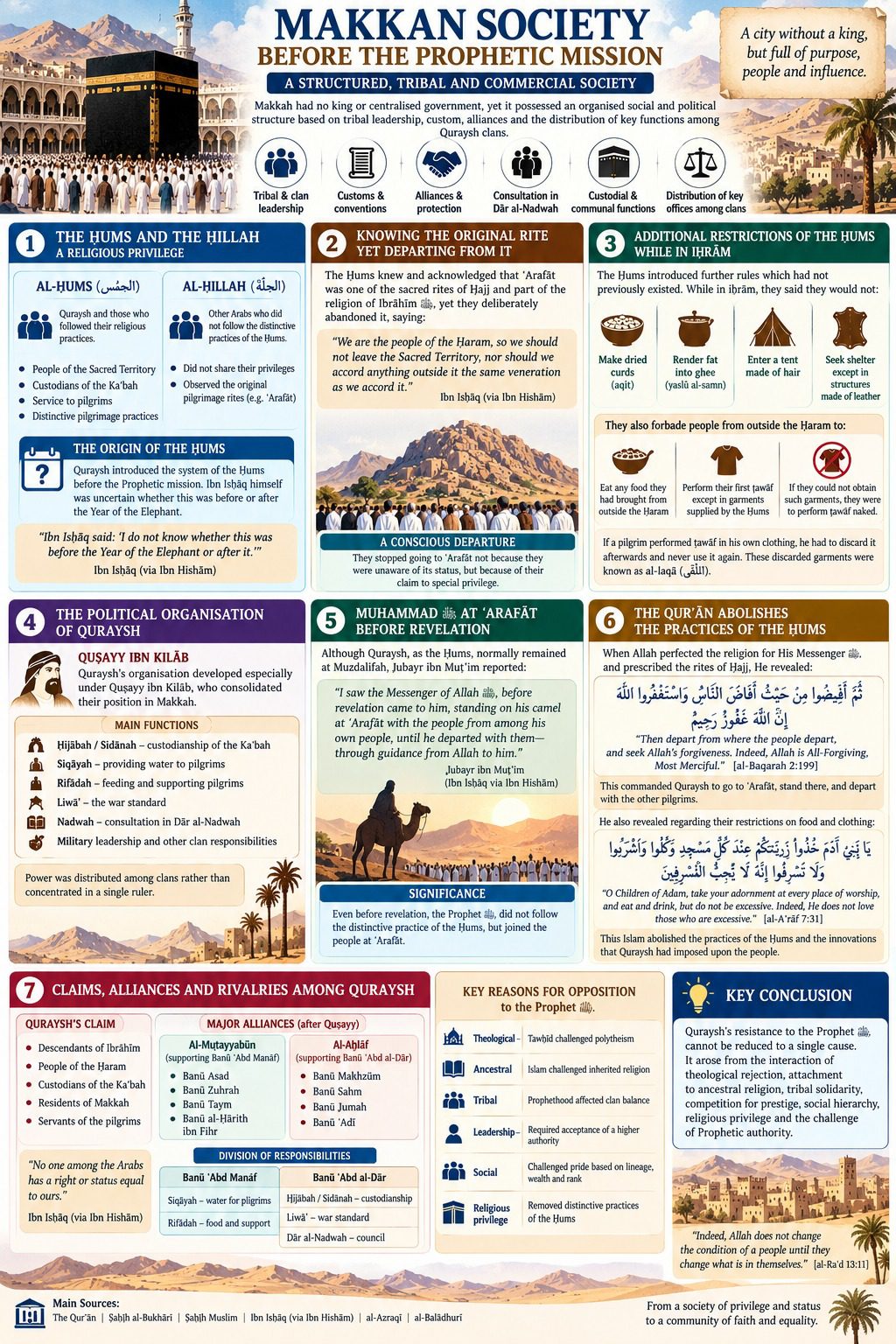
Quraysh and al-Hums
Because Quraysh considered themselves very special, and because they believed themselves to be the descendants of Ibrahim (peace be upon him), they gave themselves a special status. They said: we are the guardians of the Ka’bah. We are the servants of the Ka’bah. Nobody else has this privilege; it belongs to us. And you know, when arrogance begins to play with you and you start following what it dictates, this is what can happen.
Quraysh said, in effect: we are the descendants of Ibrahim, we have a special status, we are the custodians of the Ka’bah, and we serve the pilgrims. Therefore, we should have special recognition. So they called themselves al-Hums.
Linguistically, the word hums is connected with strength, severity and firmness. They regarded themselves as strong and particularly devoted to the Haram. Another explanation is connected with being strict or excessive in one’s religious practice, because they imposed these restrictions upon themselves.
Quraysh, along with those tribes who followed their religious practices, came under this banner of al-Hums. What did that mean?
They began inventing practices and then following their own inventions as though they were part of the religion. Ibn Ishaq mentions these practices in the Seerah. The precise point at which all of these customs developed is not always easy to establish, but what we need to know is that these practices were operating during the period surrounding the life of the Prophet ﷺ.
Al-Hums refused to stand at Arafah
For instance, the Hums would not stand at Arafah during Hajj. Because Arafah is outside the boundary of the Haram. They said: We are the people of the Haram, so we remain inside the Haram. The rest of the pilgrims would go to Arafah. Quraysh themselves knew that standing at Arafah was connected with the Hajj of Ibrahim (peace be upon him). They did not necessarily deny that. But they said: we are the people of the Haram, the servants of the Ka’bah, so how can we leave the sacred boundary? Therefore, instead of standing at Arafah, they would remain at Muzdalifah, which lies within the Haram.
Aisha (may Allah be pleased with her) explained this clearly:
كَانَتْ قُرَيْشٌ وَمَنْ دَانَ دِينَهَا يَقِفُونَ بِالْمُزْدَلِفَةِ، وَكَانُوا يُسَمَّوْنَ الْحُمْسَ، وَكَانَ سَائِرُ الْعَرَبِ يَقِفُونَ بِعَرَفَاتٍ، فَلَمَّا جَاءَ الإِسْلَامُ أَمَرَ اللَّهُ نَبِيَّهُ ﷺ أَنْ يَأْتِيَ عَرَفَاتٍ، ثُمَّ يَقِفَ بِهَا، ثُمَّ يُفِيضَ مِنْهَا
“Quraysh and those who followed their religion used to stay at Muzdalifah, and they were called al-Hums, while the rest of the Arabs would stand at Arafah. When Islam came, Allah commanded His Prophet ﷺ to go to Arafah, stand there, and then depart from there.”
(Sahih al-Bukhari)
Allah addressed this practice in the Quran:
ثُمَّ أَفِيضُوا مِنْ حَيْثُ أَفَاضَ النَّاسُ وَاسْتَغْفِرُوا اللَّهَ ۚ إِنَّ اللَّهَ غَفُورٌ رَحِيمٌ
“Then depart from where the people depart, and seek Allah’s forgiveness. Indeed, Allah is Most Forgiving, Most Merciful.”
(Surat al-Baqarah, 2:199)
The classical commentators explain that this was a command to Quraysh and the Hums to stand at Arafah with everybody else, rather than claiming a special exemption for themselves. And we also have a very interesting narration from Jubayr ibn Mut’im. He said that on the day of Arafah he had gone looking for a camel which he had lost, and he saw the Prophet ﷺ standing at Arafah. He was surprised because the Prophet ﷺ was from Quraysh and therefore, according to the custom of the Hums, should have remained at Muzdalifah.
Jubayr said:
أَضْلَلْتُ بَعِيرًا لِي، فَذَهَبْتُ أَطْلُبُهُ يَوْمَ عَرَفَةَ، فَرَأَيْتُ النَّبِيَّ ﷺ وَاقِفًا بِعَرَفَةَ، فَقُلْتُ: هَذَا وَاللَّهِ مِنَ الْحُمْسِ، فَمَا شَأْنُهُ هَاهُنَا؟
“I lost a camel of mine, so I went searching for it on the day of Arafah. I saw the Prophet ﷺ standing at Arafah, and I said, ‘By Allah, this man is from the Hums. What is he doing here?’”
(Sahih al-Bukhari)
So although Prophet Muhammad ﷺ was from Quraysh, he did not follow this invented privilege of the Hums. He stood at Arafah.
You can see Allah’s care for Prophet Muhammad ﷺ. He was protected from becoming absorbed into these invented religious customs. He did not buy into this idea that because Quraysh were the custodians of the Ka’bah they could give themselves a different form of Hajj from everybody else. They were effectively changing the flow of the Hajj because of their own sense of privilege.
The special clothing of al-Hums
What else did the Hums do? They had special clothing. Yes, they had Hums clothes. You could almost call it a brand — and it became a business as well. They promoted this idea among the tribes coming to Makkah. If you came to Makkah and wanted to perform your first tawaf, according to their rule you should not perform tawaf in your own clothes. They said that your clothes had been contaminated by the sins you had committed while wearing them. Therefore, you should not circumambulate the Ka’bah wearing those clothes.
So what were your options? One option was to obtain clothing from the Hums. The Hums would provide clothes for pilgrims to perform tawaf in. A man from the Hums could give clothing to another man, and a woman from the Hums could provide clothing for another woman.
The authentic narration describes exactly this practice:
كَانَ النَّاسُ يَطُوفُونَ فِي الْجَاهِلِيَّةِ عُرَاةً إِلَّا الْحُمْسَ، وَالْحُمْسُ قُرَيْشٌ وَمَا وَلَدَتْ، وَكَانَتِ الْحُمْسُ يَحْتَسِبُونَ عَلَى النَّاسِ، يُعْطِي الرَّجُلُ الرَّجُلَ الثِّيَابَ يَطُوفُ فِيهَا، وَتُعْطِي الْمَرْأَةُ الْمَرْأَةَ الثِّيَابَ تَطُوفُ فِيهَا، فَمَنْ لَمْ يُعْطِهِ الْحُمْسُ طَافَ بِالْبَيْتِ عُرْيَانًا
“During the pre-Islamic period, people used to perform tawaf around the House naked except for the Hums. The Hums were Quraysh and their descendants. A man from the Hums would give clothes to a man in which he would perform tawaf, and a woman would give clothes to a woman. Whoever was not given clothes by the Hums would perform tawaf around the House naked.”
(Sahih al-Bukhari)
So there was a whole system developing around this idea. You come to Makkah, your own clothes are supposedly not suitable because they have been contaminated by your sins, and therefore you need clothing approved by the Hums. It becomes a brand. It becomes a business.
Of course, they did not literally have a shop saying “Al-Hums” on the front, but you understand what I mean. They created a religious custom, promoted it among the pilgrims, and then an economic system grew around that custom.
So you either bought the clothing from them. That was option number one. Or, if you knew somebody from al-Hums and they were willing to do so, you could borrow clothing from them. But suppose you did not have enough money to buy new clothes, and nobody was willing to lend you any of the Hums clothing. What did you do then? There were two possibilities. If the person was a dignitary, somebody highly respected and of high social standing, the Seerah narrators mention that he or she could perform tawaf wearing their own clothes. But once they had finished the tawaf, those clothes had to be abandoned. No matter how expensive they were, no matter how valuable they were, they could not be worn again.
Look at the rules they invented for themselves. These discarded clothes even had a special name in the books of Seerah. They were known as al-laqa (اللَّقَى), because they were cast aside and abandoned. Ibn Hisham mentions that if someone performed tawaf in the clothes in which they had come from outside the Haram, those clothes would afterwards be discarded, and neither that person nor anybody else would benefit from them.
What did they do with them afterwards? Did they throw them away? Did they leave them? Did they burn them? Allah knows best. But the important point is that according to their invented rule, you were not supposed to wear them again.
That was if you were a dignitary, somebody important enough to be allowed to perform tawaf in your own clothes. But if you were not? Then what could you do? You took your clothes off. Yes, you performed tawaf naked. Unfortunately, this became an established practice. The authentic narrations confirm that people in the Jahiliyyah would perform tawaf naked if they could not obtain clothing from al-Hums. Urwah narrated:
كَانَ النَّاسُ يَطُوفُونَ فِي الْجَاهِلِيَّةِ عُرَاةً إِلَّا الْحُمْسَ، وَالْحُمْسُ قُرَيْشٌ وَمَا وَلَدَتْ، وَكَانَتِ الْحُمْسُ يَحْتَسِبُونَ عَلَى النَّاسِ، يُعْطِي الرَّجُلُ الرَّجُلَ الثِّيَابَ يَطُوفُ فِيهَا، وَتُعْطِي الْمَرْأَةُ الْمَرْأَةَ الثِّيَابَ تَطُوفُ فِيهَا، فَمَنْ لَمْ يُعْطِهِ الْحُمْسُ طَافَ بِالْبَيْتِ عُرْيَانًا
“During the pre-Islamic period, the people used to perform tawaf around the Ka’bah naked, except for al-Hums. Al-Hums were Quraysh and their descendants. A man from al-Hums would give clothes to another man in which to perform tawaf, and a woman would give clothes to another woman. Whoever was not given clothing by al-Hums would perform tawaf around the House naked.”
(Sahih al-Bukhari)
And this was not restricted to men. It is documented that some women also performed tawaf with very little or no clothing. The reports even preserve verses recited by a woman while performing tawaf in this condition. So I am mentioning this simply to help you picture the society in which Prophet Muhammad ﷺ was living and the practices which had become normalised.
Islam abolishes naked tawaf
Now let me take you very quickly towards the end of the Seerah so you can see the contrast between the two pictures: before Islam and after Islam.
In the ninth year after the Hijrah, Prophet Muhammad ﷺ appointed Abu Bakr al-Siddiq (may Allah be pleased with him) as the Amir of Hajj.
Abu Hurayrah (may Allah be pleased with him) narrated that Abu Bakr sent a group of people on the Day of Sacrifice to make a public announcement:
لَا يَحُجُّ بَعْدَ الْعَامِ مُشْرِكٌ، وَلَا يَطُوفُ بِالْبَيْتِ عُرْيَانٌ
“After this year, no polytheist shall perform Hajj, and no naked person shall perform tawaf around the House.”
(Sahih al-Bukhari)
Ali ibn Abi Talib (may Allah be pleased with him) was also sent by the Prophet ﷺ to proclaim Surat al-Bara’ah and make the same announcement. So Abu Bakr (may Allah be pleased with him) was the Amir of Hajj in year nine. Prophet Muhammad ﷺ then performed his Farewell Hajj in year ten.
You can see the transformation. Previously, naked tawaf had become an accepted practice. Now the announcement was being made publicly throughout the pilgrimage:
No more naked tawaf. No more polytheistic pilgrimage around the Sacred House. The old system was being dismantled.
The other restrictions of al-Hums
Naked tawaf was not the only thing connected with al-Hums. They also said: we are al-Hums, therefore we have to restrict ourselves from certain things. Who imposed these restrictions? They imposed them on themselves.
There was no revelation telling them to do this. There was no divine command. They invented these practices and then bound themselves to them. For example, during ihram they would say they could not make aqit, dried curds. They could not render fat into ghee. Because that was the rule they had invented. They decided this was what religious devotion required, and then they followed it.
They also would not enter certain tents if the tents were made from hair, such as goat-hair tents. Of course, tents in Arabia were commonly made from animal hair. But according to their restrictions, while in ihram they would not enter them.
If they wanted shelter from the very hot sun, they would only take shelter beneath particular structures, such as structures made from leather. Again, where did this prohibition come from? There was no revelation.
They created these restrictions themselves and then treated them as religious rules.
And anybody who came under their umbrella — allies, associated tribes and groups who had agreements with Quraysh — could also follow these practices.
So when we say al-Hums, it was not necessarily restricted only to Quraysh. Quraysh were at the centre of it and established these customs, but other groups affiliated with them could enter into the practices of al-Hums as well.
Al-Hums and al-Hilla
Those who were not from al-Hums were known as al-Hilla. So broadly speaking, you had al-Hums and al-Hilla. If you were not part of al-Hums, you were among al-Hilla and therefore were not bound by all these special restrictions that al-Hums had invented for themselves. And you can see how people can make life extremely difficult for themselves. They invent a restriction, then another restriction, then another restriction, until eventually the invented rules begin to look as though they are part of the religion itself.
The Prophet ﷺ restores the Hajj of Ibrahim
When Prophet Muhammad ﷺ performed his Hajj in year ten, people saw very clearly which path he would follow.
Would Prophet Muhammad ﷺ follow the customs of al-Hums because he himself was from Quraysh? Or would he follow the original practice of Ibrahim (peace be upon him)? He went to Arafah. He stood at Arafah with everybody else. Allah had already abolished the special privilege Quraysh had claimed for themselves:
ثُمَّ أَفِيضُوا مِنْ حَيْثُ أَفَاضَ النَّاسُ وَاسْتَغْفِرُوا اللَّهَ ۚ إِنَّ اللَّهَ غَفُورٌ رَحِيمٌ
“Then depart from where the people depart, and seek Allah’s forgiveness. Indeed, Allah is Most Forgiving, Most Merciful.”
(Surat al-Baqarah, 2:199)
أَفِيضُوا مِنْ حَيْثُ أَفَاضَ النَّاسُ — depart from where the people depart.
Everybody is equal. Everybody stands at Arafah. There is no separate Hajj for Quraysh because they think they have a special status. And Prophet Muhammad ﷺ stood there on Arafah. During that Farewell Hajj, while he was at Arafah, the famous verse announcing the perfection of the religion was revealed:
الْيَوْمَ أَكْمَلْتُ لَكُمْ دِينَكُمْ وَأَتْمَمْتُ عَلَيْكُمْ نِعْمَتِي وَرَضِيتُ لَكُمُ الْإِسْلَامَ دِينًا
“Today I have perfected your religion for you, completed My favour upon you, and chosen Islam as your religion.”
(Surat al-Ma’idah, 5:3)
The authentic narration from Umar ibn al-Khattab (may Allah be pleased with him) confirms that this verse was revealed on a Friday while the Prophet ﷺ was standing at Arafah. So Prophet Muhammad ﷺ abolished these Jahiliyyah practices, the invented restrictions and the businesses which had grown around them.
“Take your adornment at every masjid”
The Quran also abolished this whole idea that people should approach the Ka’bah naked because their normal clothes were supposedly contaminated by sin.
Allah says:
يَا بَنِي آدَمَ خُذُوا زِينَتَكُمْ عِنْدَ كُلِّ مَسْجِدٍ وَكُلُوا وَاشْرَبُوا وَلَا تُسْرِفُوا ۚ إِنَّهُ لَا يُحِبُّ الْمُسْرِفِينَ
“O children of Adam, take your adornment at every place of worship, and eat and drink, but do not be excessive. Indeed, He does not love those who are excessive.”
(Surat al-A’raf, 7:31)
خُذُوا زِينَتَكُمْ — take your adornment. Here, zeenah includes the clothing with which a person properly covers himself. So Allah established that when you approach worship, you cover your awrah. You do not worship Allah by exposing yourself.
The Quran therefore overturned the practice and changed the status quo which people had followed for many years. And again, think of how deeply embedded these practices had become. People had been born into them. They had watched their parents doing them. They had seen generations doing them. They had businesses attached to them. They had prestige attached to them. Then revelation came and said: no. This is not from Allah.
Other superstitions in Jahiliyyah
Having said that, these were not the only practices Prophet Muhammad ﷺ had to face.
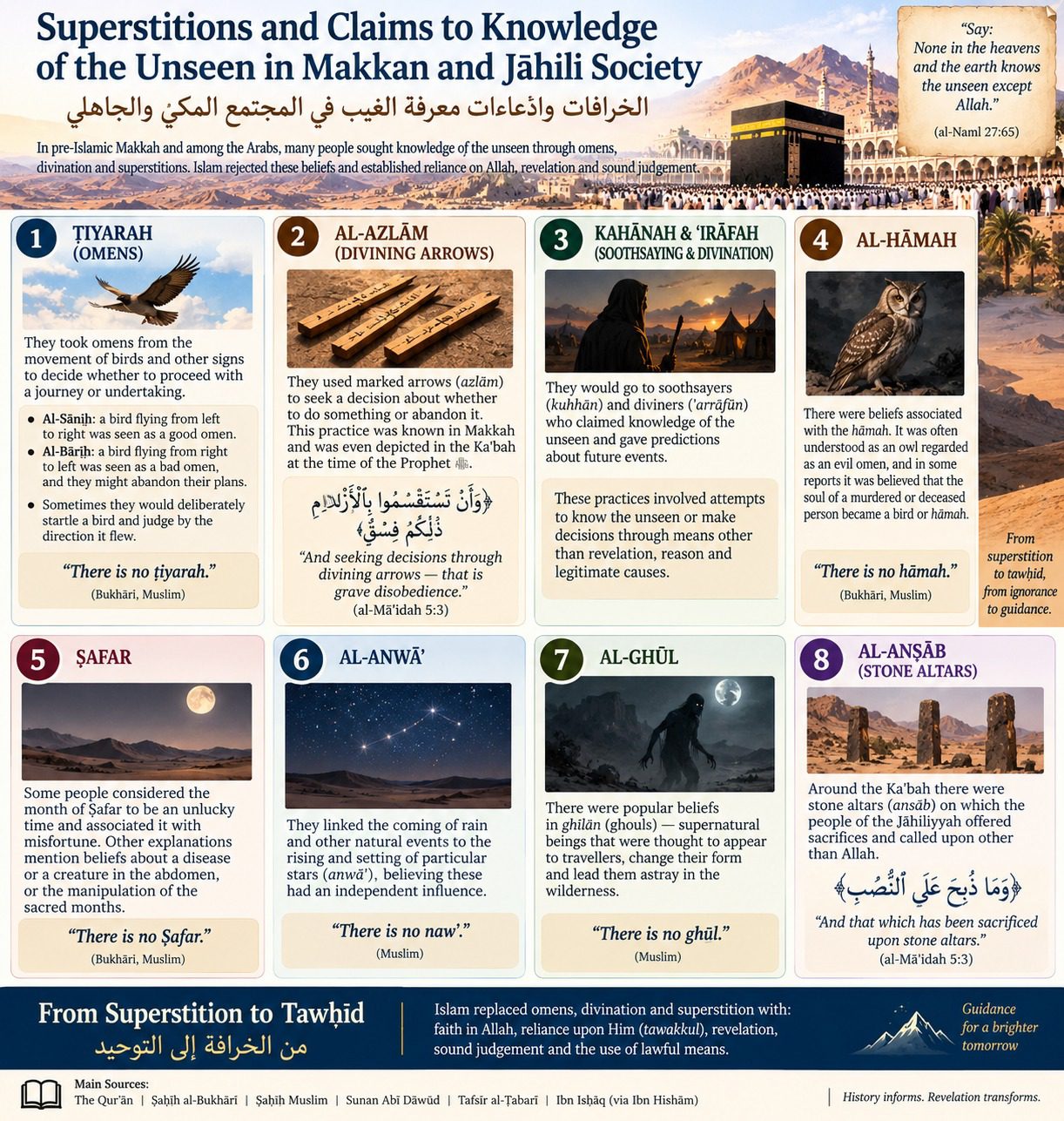
There were many other customs and superstitions in Makkah and throughout Arabia. I want to take you through some of them because, again, I am trying to paint the picture for you. When you understand what people believed and what they did, you begin to understand the scale of the challenge Prophet Muhammad ﷺ was facing. One of the practices connected with superstition and supposed knowledge of the unseen was something called tiyarah.
Tiyarah – taking omens from birds
Tiyarah means taking omens, and historically one common form involved birds. Someone wanted to do something: perhaps travel, begin a business venture or make an important decision. They would take a bird and release it. If the bird flew in one direction — for example, from the left towards the right — they considered it a good sign. Excellent. Go ahead. Do it. But if the bird flew in the opposite direction, they would say: no, this is a bad sign. Do not travel. Do not do the deal. Do not proceed. Where did they get this from? Nowhere. This was a practice people had developed and then believed in.
Prophet Muhammad ﷺ came and rejected this. He said:
لَا عَدْوَى وَلَا طِيَرَةَ وَلَا هَامَةَ وَلَا صَفَرَ
“There is no [independently operating] contagion, no evil omen, no hamah and no Safar.”
(Sahih Muslim)
And in another hadith, the Prophet ﷺ said:
الطِّيَرَةُ شِرْكٌ، الطِّيَرَةُ شِرْكٌ
“Taking evil omens is shirk. Taking evil omens is shirk.”
(Sunan Abi Dawud, Jami al-Tirmidhi, Sunan Ibn Majah)
The report continues with the point that Allah removes such feelings through tawakkul, reliance upon Him. So Islam brought people back to sanity. There is no connection between whether a bird flies to your right or your left and whether your journey is going to succeed. The bird is simply flying. You do not build your life around this. You rely upon Allah سبحانه وتعالى. You do your homework. You think properly. You take the available means. Then you decide whether to proceed or not.
Islam gives an alternative: istikhara
And notice that Islam does not simply remove something and leave you with nothing. If you are genuinely unsure — shall I do this or shall I not do this? Is this the right decision or not? — we have istikhara. So look at the replacement. Instead of throwing a bird into the air and seeing which direction it flies, you turn directly to Allah.
The Prophet ﷺ taught the Companions istikhara very carefully. Jabir ibn Abdullah (may Allah be pleased with him) said:
كَانَ رَسُولُ اللَّهِ ﷺ يُعَلِّمُنَا الِاسْتِخَارَةَ فِي الْأُمُورِ كُلِّهَا كَمَا يُعَلِّمُنَا السُّورَةَ مِنَ الْقُرْآنِ
“The Messenger of Allah ﷺ used to teach us istikhara in all matters just as he used to teach us a surah from the Quran.”
(Sahih al-Bukhari)
So if you are confused, you pray and ask Allah for guidance. That is completely different from superstition.
Seeking decisions through divining arrows
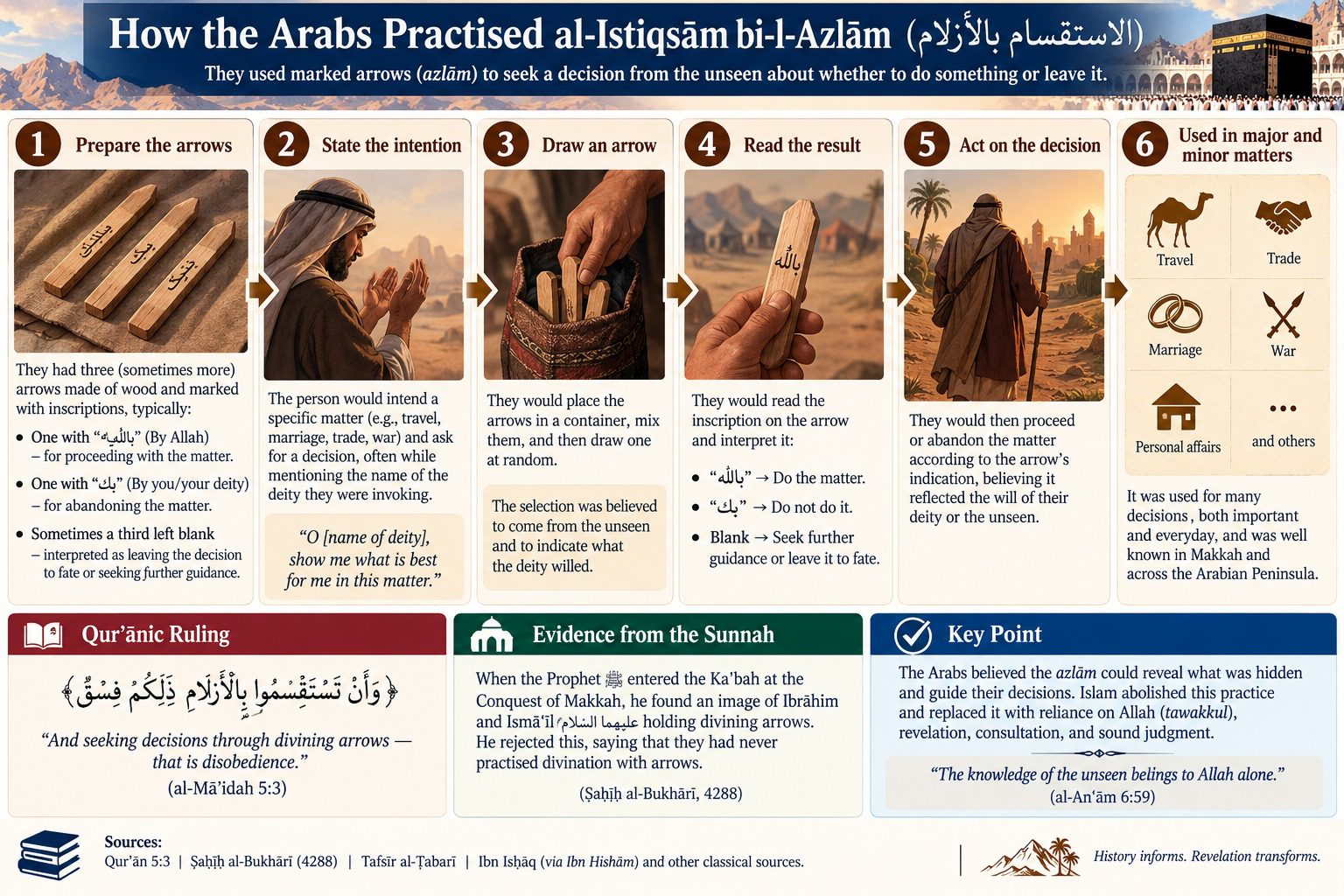
Another practice was al-istiqsam bil-azlam — seeking decisions through divining arrows.
The Quran mentions this explicitly.
Allah says:
وَأَنْ تَسْتَقْسِمُوا بِالْأَزْلَامِ ۚ ذَٰلِكُمْ فِسْقٌ
“And [forbidden to you is] seeking decisions through divining arrows. That is grave disobedience.”
(Surat al-Ma’idah, 5:3)
وَأَنْ تَسْتَقْسِمُوا بِالْأَزْلَامِ — seeking a decision through the azlam.
What were the azlam? They were arrows, or more accurately wooden shafts or lots, which were marked in different ways. A person would want to make a decision: shall I do this, or shall I not do it? Instead of deciding through reason, consultation or reliance upon Allah, they would draw one of these marked arrows and treat the result as guidance about what they should do. So they had a system of divination.
This practice was well known in Makkah, and these divining arrows were connected to the religious practices around the Ka’bah itself. They had become part of the religious and social environment in which Prophet Muhammad ﷺ was sent. And again, Islam came and said: ذَٰلِكُمْ فِسْقٌ — this is fisq, disobedience.
It abolished the practice altogether. They would use these divining arrows in a very practical way. How did they do it? They had something like a leather bag or a long container. Inside it they would place the azlam, the marked arrows or sticks. Usually there were several of them with different markings. One would indicate that the person should proceed, another would indicate that he should not proceed, and another might be blank, meaning that the process had to be repeated.
So they would place the arrows inside the container, mix them together, and because the container was long you could not see which one you were taking. You would put your hand inside and pull one out.
If the arrow indicated that you should do it, then you proceeded. If it indicated that you should not, you abandoned the matter. If the blank arrow came out, you repeated the process.
This is the practice the Quran refers to when Allah says:
وَأَنْ تَسْتَقْسِمُوا بِالْأَزْلَامِ ۚ ذَٰلِكُمْ فِسْقٌ
“And [forbidden to you is] seeking decisions through divining arrows. That is grave disobedience.”
(Surat al-Ma’idah, 5:3)
This was not some unusual practice that people did once in a while. It was embedded in daily life. If someone wanted to conduct a trade, start a business, travel, marry, or make some other important decision, he might use al-istiqsam bil-azlam.
They could go to the Ka’bah, where these practices were associated with the idols, and there would be people responsible for administering them. More likely there was also money involved. So once again, you can see that a religious superstition could become a business as well.
Islam abolished this completely. And when you read the Quran now, you understand what Allah is referring to. You can picture the practice which was taking place in their society.
Casting lots and the story of Yunus ﷺ
By the way, there is another form of drawing lots mentioned in the Quran in the story of Yunus (peace be upon him).
When the ship became overloaded, lots were cast to determine who would be thrown overboard. Allah says:
فَسَاهَمَ فَكَانَ مِنَ الْمُدْحَضِينَ
“Then he drew lots and was among those who lost.”
(Surat al-Saffat, 37:141)
So they cast lots, and the lot fell upon Yunus (peace be upon him).
The narrations mention that his name came out, and they were reluctant to throw him overboard because they knew him to be a righteous man. So the process was repeated, and again the lot fell upon him. It was repeated again, until eventually they accepted that he was the one upon whom the lot had fallen.
Then Yunus (peace be upon him) was thrown into the sea. The point here is that casting lots as a method of selection was something known among people. But this is different from the azlam of Jahiliyyah, where people were trying to discover divine approval or the unseen through arrows associated with idols. Islam abolished that kind of divination.
Fortune-telling and claims to know the unseen
Another practice of Jahiliyyah, and something that appears in many societies, was fortune-telling.
Of course, they did not necessarily have the crystal ball that you might imagine today. They had their own methods of deceiving people. A person would go to a fortune-teller, somebody who claimed to know things hidden from ordinary people. In Arabic this is known as kihanah.
The fortune-teller, the kahin, would claim to know something about your future: what is going to happen to you, whether something will succeed, perhaps whom you will marry, whether you should travel, and so on.
And you still see similar things today. Sometimes somebody says, “Let me read your palm,” or “Let me tell you your future,” or they use cards or other methods. This was common in Jahiliyyah, but Islam prohibited it because knowledge of the unseen belongs to Allah.
Allah says:
قُلْ لَا يَعْلَمُ مَنْ فِي السَّمَاوَاتِ وَالْأَرْضِ الْغَيْبَ إِلَّا اللَّهُ
“Say, ‘None in the heavens and the earth knows the unseen except Allah.’”
(Surat al-Naml, 27:65)
So the principle is very clear. Nobody independently possesses knowledge of the future or the unseen.
The Prophet ﷺ also warned strongly against going to fortune-tellers. He said:
مَنْ أَتَى عَرَّافًا فَسَأَلَهُ عَنْ شَيْءٍ لَمْ تُقْبَلْ لَهُ صَلَاةٌ أَرْبَعِينَ لَيْلَةً
“Whoever goes to a fortune-teller and asks him about something, his prayer will not be accepted for forty nights.”
(Sahih Muslim)
So Islam was closing the door to this whole culture of people claiming access to the unseen.
Al-Hamah: the superstition surrounding the owl
Another belief which existed in that society was something called al-hamah.
I have collected some of the main practices because I want you to imagine that you are walking through that society. What would you see? What would people believe? What would be considered normal in everyday life?
One of these beliefs was connected with the owl, al-bumah in Arabic.
The owl was often regarded as an evil omen.
And even today, in some cultures, people still use the owl negatively. If they are displeased with somebody, they might compare that person to an owl, as though the owl itself carries some kind of misfortune.
But Islam rejected this.
The Prophet ﷺ said:
لَا عَدْوَى وَلَا طِيَرَةَ وَلَا هَامَةَ وَلَا صَفَرَ
“There is no [independently operating] contagion, no evil omen, no hamah and no Safar.”
(Sahih al-Bukhari, Sahih Muslim)
لَا هَامَةَ — there is no hamah. Delete this belief. There is nothing in the owl itself which brings evil or misfortune. But their belief sometimes went even further.
Some Arabs believed that when a person was murdered and his blood had not been avenged, his soul, or something associated with his soul, would appear in the form of an owl. The owl was imagined as crying out because the murdered person was demanding revenge. In some descriptions, the owl was imagined as saying: اسقوني، اسقوني — “Give me drink, give me drink,” meaning: satisfy my thirst for revenge. Of course, the owl was not actually speaking. This was their interpretation of its cry.
When they heard the sound of the owl, they could take it as though the murdered person were calling upon the tribe: take revenge for me. So this superstition became connected with the wider culture of revenge. And Prophet Muhammad ﷺ said: لَا هَامَةَ. There is no such thing. Do not attach supernatural meaning to an owl’s cry. Do not build decisions around it. Do not build a cycle of revenge around it. Wake up and use your intellect.
The superstition surrounding the month of Safar
Another belief concerned the Arabic calendar. One of the months is Safar, the second month of the Islamic lunar calendar, after Muharram and before Rabi’ al-Awwal. Some people in Jahiliyyah regarded Safar as an unlucky month. They associated it with misfortune and evil. So somebody might say: “I will not get married in Safar.” Or: “I will not travel during Safar.” Or: “I will not begin this project in Safar.” Why? Because they believed the month itself carried misfortune.
There was also another interpretation of the Jahili belief in Safar, connected by some scholars with disease or something harmful believed to exist within the body. There are different explanations of exactly what was meant by Safar in the hadith.
But the important point is that the Prophet ﷺ abolished the superstition.
He said:
لَا عَدْوَى وَلَا طِيَرَةَ وَلَا هَامَةَ وَلَا صَفَرَ
“There is no [independently operating] contagion, no evil omen, no hamah and no Safar.”
(Sahih al-Bukhari, Sahih Muslim)
لَا صَفَرَ — there is no Safar in this superstitious sense. Delete this belief from your mind. There is no evil month. There is no inherently unlucky month. There is no day which, by itself, has the power to bring you bad luck. A month is a month. A day is a day. Good and harm occur by the decree of Allah سبحانه وتعالى, not because a calendar month possesses some independent power.
Al-Anwa’: attributing rain to the stars
Then we have another belief which was widespread: al-anwa’. This is connected with the stars. The Arabs would sometimes connect the coming of rain and other natural events with the rising or setting of particular stars. They would say, for example: we received this rain because of such-and-such a star. The star moved into this position, therefore the rain came. The Prophet ﷺ corrected this very clearly.
After rain had fallen one night, Prophet Muhammad ﷺ led the Fajr prayer and then turned to the people and said:
هَلْ تَدْرُونَ مَاذَا قَالَ رَبُّكُمْ؟
“Do you know what your Lord has said?”
They replied:
اللَّهُ وَرَسُولُهُ أَعْلَمُ
“Allah and His Messenger know best.”
He said that Allah said:
أَصْبَحَ مِنْ عِبَادِي مُؤْمِنٌ بِي وَكَافِرٌ، فَأَمَّا مَنْ قَالَ مُطِرْنَا بِفَضْلِ اللَّهِ وَرَحْمَتِهِ فَذَلِكَ مُؤْمِنٌ بِي كَافِرٌ بِالْكَوْكَبِ، وَأَمَّا مَنْ قَالَ مُطِرْنَا بِنَوْءِ كَذَا وَكَذَا فَذَلِكَ كَافِرٌ بِي مُؤْمِنٌ بِالْكَوْكَبِ
“Some of My servants have entered the morning believing in Me and others disbelieving in Me. As for the one who says, ‘We have been given rain by the grace of Allah and His mercy,’ that person believes in Me and rejects the star. But the one who says, ‘We have been given rain because of such-and-such a star,’ that person rejects Me and believes in the star.”
(Sahih al-Bukhari, 846; Sahih Muslim, 71)
So again, Islam was correcting the way people understood the world around them. The star does not independently create the rain. The star does not decide that rain will fall. It does not control your provision. Everything is under the control of Allah.
If somebody studies astronomy or weather patterns and says that a particular celestial movement coincides with a season or helps us calculate certain patterns, that is a different matter. The problem is to attribute independent power and causation to the star itself. This was the belief Prophet Muhammad ﷺ was abolishing. So once again, the Prophet ﷺ was not only changing rituals. He was changing how people understood cause and effect, the unseen, nature and the world around them.
Anything that suggests something is outside the control of Allah and is instead controlled independently by the stars is wrong. If somebody attributes that independent power to the stars, this is a matter of belief.
Prophet Muhammad ﷺ explained this very clearly in the hadith. After rainfall, people may wake up with two completely different attitudes. One person wakes up as a believer and says: we received this rain through the mercy and favour of Allah. Another attributes the rain to the star itself.
The Prophet ﷺ said that Allah said:
أَصْبَحَ مِنْ عِبَادِي مُؤْمِنٌ بِي وَكَافِرٌ، فَأَمَّا مَنْ قَالَ: مُطِرْنَا بِفَضْلِ اللَّهِ وَرَحْمَتِهِ، فَذَلِكَ مُؤْمِنٌ بِي كَافِرٌ بِالْكَوْكَبِ، وَأَمَّا مَنْ قَالَ: مُطِرْنَا بِنَوْءِ كَذَا وَكَذَا، فَذَلِكَ كَافِرٌ بِي مُؤْمِنٌ بِالْكَوْكَبِ
“Some of My servants have entered the morning believing in Me, and others disbelieving in Me. As for the one who says, ‘We have been given rain by the favour and mercy of Allah,’ he believes in Me and rejects the star. But the one who says, ‘We have been given rain because of such-and-such a star,’ he disbelieves in Me and believes in the star.”
(Sahih al-Bukhari, Sahih Muslim)
So the rain is not coming because the star independently controls it. It comes by Allah سبحانه وتعالى.
Al-Ghul
Number seven is something even more interesting. The Arabs had a belief in something called al-ghul. The word ghoul in English actually comes from the Arabic word ghul. What was al-ghul?
There was a popular belief that supernatural beings would appear to travellers in the desert. Imagine you are travelling through the desert at night. It is completely dark, you are frightened, you are alone, and you can begin imagining all sorts of things.
Perhaps sometimes what people experienced might have been connected to the jinn, Allah knows best, but they developed this particular idea of the ghul. They believed that the ghul would appear to travellers and somehow divert them from their route. It would make them lose their direction in the wilderness until eventually they were lost. So if somebody became lost in the desert, who did it? The ghul. Prophet Muhammad ﷺ rejected this belief. He said:
لَا عَدْوَى وَلَا طِيَرَةَ وَلَا غُولَ
“There is no contagion [operating independently], no evil omen and no ghul.”
(Sahih Muslim)
In another narration:
لَا عَدْوَى وَلَا صَفَرَ وَلَا غُولَ
“There is no contagion [operating independently], no Safar and no ghul.”
(Sahih Muslim)
So Prophet Muhammad ﷺ was rejecting the superstition they had attached to the ghul: this idea that some desert creature was appearing, changing people’s direction and causing them to become lost. And even Western culture later adopted the word ghoul. Some of you are probably smiling now and thinking, “What is this?” But this was genuinely part of people’s beliefs. And unfortunately, different forms of superstition still exist today.
Sacrifices on stone altars
Number eight is another important practice, and Allah mentions it explicitly in the Quran:
وَمَا ذُبِحَ عَلَى النُّصُبِ
“And that which has been sacrificed upon stone altars.”
(Surat al-Ma’idah, 5:3)
Around the Ka’bah there were different stones or altars upon which people would make sacrifices. Somebody would come with a goat, a ram or another animal and slaughter it there for the idols.
Allah prohibited eating these sacrifices because they had not been slaughtered for Allah. They were being offered in connection with the idols.
The verse says:
حُرِّمَتْ عَلَيْكُمُ الْمَيْتَةُ وَالدَّمُ وَلَحْمُ الْخِنزِيرِ وَمَا أُهِلَّ لِغَيْرِ اللَّهِ بِهِ وَالْمُنْخَنِقَةُ وَالْمَوْقُوذَةُ وَالْمُتَرَدِّيَةُ وَالنَّطِيحَةُ وَمَا أَكَلَ السَّبُعُ إِلَّا مَا ذَكَّيْتُمْ وَمَا ذُبِحَ عَلَى النُّصُبِ وَأَنْ تَسْتَقْسِمُوا بِالْأَزْلَامِ ۚ ذَٰلِكُمْ فِسْقٌ
“Forbidden to you are carrion, blood, the flesh of swine, that over which a name other than Allah has been invoked, that which has been strangled, beaten to death, fallen from a height, gored, or partly eaten by a predator — unless you are able to slaughter it — and that which is sacrificed upon stone altars, and that you seek decisions through divining arrows. That is grave disobedience.”
(Surat al-Ma’idah, 5:3)
So when you read وَمَا ذُبِحَ عَلَى النُّصُبِ, this is the practice being referred to. Stones had been erected around Makkah and sacrifices were offered upon or for them.
Islam abolished all of this. Before Prophet Muhammad ﷺ performed his Farewell Hajj, the old polytheistic practices surrounding the pilgrimage were removed. As we mentioned, the announcement was made that no naked person should perform tawaf and no mushrik should perform Hajj after that year. The Sacred House was being returned to pure tawhid.
The images of Ibrahim and Ismail inside the Ka’bah
There is another very interesting detail. When Prophet Muhammad ﷺ conquered Makkah in the eighth year after the Hijrah, he came to the Ka’bah. There were images inside it, including representations of Ibrahim and Ismail (peace be upon them). But they had depicted Ibrahim and Ismail holding azlam, divining arrows. Look at that. They were attributing their own Jahiliyyah practice to Ibrahim and Ismail. Prophet Muhammad ﷺ became angry because Ibrahim and Ismail had never practiced this.
Ibn Abbas (may Allah be pleased with them both) narrated:
أَنَّ النَّبِيَّ ﷺ لَمَّا رَأَى الصُّوَرَ فِي الْبَيْتِ لَمْ يَدْخُلْ حَتَّى أَمَرَ بِهَا فَمُحِيَتْ، وَرَأَى إِبْرَاهِيمَ وَإِسْمَاعِيلَ عَلَيْهِمَا السَّلَامُ بِأَيْدِيهِمَا الْأَزْلَامُ، فَقَالَ: قَاتَلَهُمُ اللَّهُ، وَاللَّهِ إِنِ اسْتَقْسَمَا بِالْأَزْلَامِ قَطُّ
“When the Prophet ﷺ saw the images inside the House, he did not enter until he ordered that they be erased. He saw Ibrahim and Ismail, peace be upon them, with divining arrows in their hands and said, ‘May Allah condemn them! By Allah, Ibrahim and Ismail never sought decisions through divining arrows.’”
(Sahih al-Bukhari)
So Prophet Muhammad ﷺ was saying: do not attribute to Ibrahim and Ismail something they never did. You invented the practice, and then you created an image suggesting that Ibrahim and Ismail themselves practised it. He ordered those images to be removed. So you can see how many Jahiliyyah practices Prophet Muhammad ﷺ had to deal with. It was not one issue. There was a whole collection of beliefs, customs, practices and religious innovations which had become embedded in society. And unfortunately, we still have different forms of Jahiliyyah practices today.
Why we need to understand the society of Makkah
This is why, before we move deeply into the events of the Seerah, I want us to understand the atmosphere in Makkah and Arabia, particularly Makkah because this is where the Seerah of Prophet Muhammad ﷺ begins. We need these introductions to paint the picture. Where was he born? What kind of society was he born into? What were people doing? What was the structure of the community? What were their thoughts? What were their ideas? What did they believe? What did they practice? What kinds of businesses did they have? What did they trade? What was regarded as normal?
When you understand all of this, you can begin to appreciate the magnitude of what Prophet Muhammad ﷺ was facing when revelation came.
Forms of marriage in Jahiliyyah
Unfortunately, among the practices of Jahiliyyah were also unusual forms of marriage.
The ordinary form of marriage existed, of course. A man would approach a woman’s guardian, agree a dowry and marry her. That form of marriage had existed for a very long time. But alongside it, they had developed other forms. Aisha (may Allah be pleased with her) described four types of marriage that existed during Jahiliyyah.
She said:
أَنَّ النِّكَاحَ فِي الْجَاهِلِيَّةِ كَانَ عَلَى أَرْبَعَةِ أَنْحَاءٍ
“Marriage during the time of Jahiliyyah was of four types.”
She first described the normal marriage that continued in Islam. Then she described another type called nikah al-istibda’.
Aisha said:
وَنِكَاحٌ آخَرُ كَانَ الرَّجُلُ يَقُولُ لِامْرَأَتِهِ إِذَا طَهُرَتْ مِنْ طَمْثِهَا: أَرْسِلِي إِلَى فُلَانٍ فَاسْتَبْضِعِي مِنْهُ، وَيَعْتَزِلُهَا زَوْجُهَا وَلَا يَمَسُّهَا أَبَدًا حَتَّى يَتَبَيَّنَ حَمْلُهَا مِنْ ذَلِكَ الرَّجُلِ الَّذِي تَسْتَبْضِعُ مِنْهُ … وَإِنَّمَا يَفْعَلُ ذَلِكَ رَغْبَةً فِي نَجَابَةِ الْوَلَدِ
“Another type was that a man would say to his wife after she became pure from menstruation, ‘Send for such-and-such a man and have relations with him.’ Her husband would then stay away from her and would not touch her until it became clear that she had become pregnant by that man… He would do this because he desired a child of noble or exceptional qualities.”
(Sahih al-Bukhari)
This was called nikah al-istibda’.
So, for example, a man might see somebody who was regarded as an outstanding warrior — a strong man, muscular, physically impressive, perhaps somebody known for courage and strength. Believe it or not, he might tell his own wife to go and sleep with that man. Then the husband himself would not touch her until it became clear that she was pregnant. Why? Because he wanted the child to inherit the qualities of that man. He wanted those qualities — strength, nobility, courage or physical ability — to come into his own family or tribe. This was an actual recognised practice. Islam abolished it.
Aisha concludes the hadith by saying:
فَلَمَّا بُعِثَ مُحَمَّدٌ ﷺ بِالْحَقِّ هَدَمَ نِكَاحَ الْجَاهِلِيَّةِ كُلَّهُ إِلَّا نِكَاحَ النَّاسِ الْيَوْمَ
“When Muhammad ﷺ was sent with the truth, he abolished all the forms of marriage of Jahiliyyah except the marriage practised by people today.”
(Sahih al-Bukhari)
So once again, Prophet Muhammad ﷺ was not coming into an empty society and merely teaching people how to pray. He was reforming deeply established social practices as well.
Talk delivered to the Al Manaar Convert Club on 15th September 2026.
Related posts