
When we study someone’s life, we always look beyond the person to their family, the place they were born and raised. Their environment plays a huge part in shaping them and influencing them.
Maryam (peace be upon her) is no different – in order to know her we begin by examining the family to which she was born and how she grew up. She is mentioned in five surahs, and there is not just a surah named after her, but a surah named after her family, Ale Imran, as well!
The environment matters but guidance belongs to Allah
While the environment matters, it does not always guarantee how someone will turn out. A bad environment does not always produce bad people and vice versa. Look at the son of Nuh (peace be upon him). His father was one of the five resolute messengers, the ulul ‘azm: Nuh, Ibrahim, Musa, ‘Isa and Muhammad (peace be upon them). Despite, one of his two sons did not follow him. This is the reality. It reminds us that guidance belongs to Allah Almighty:
إِنَّكَ لَا تَهْدِي مَنْ أَحْبَبْتَ وَلَٰكِنَّ اللَّهَ يَهْدِي مَنْ يَشَاءُ
“You cannot guide those you love, but Allah guides whom He wills.” (Surah al-Qasas 28:56)
We may put a great deal of effort into our children. We bring them to Islamic schools and Islamic circles, and do everything we can to support them. If they do not follow the right path, of course we feel upset and tear our hair. But we need to understand that we are not the ones who place guidance in their hearts.
Does this mean we sit back, do nothing and say that Allah will look after them? Of course not. Do your best. But be careful of thinking that the outcome is entirely the result of your intelligence, your organisation or your programmes.
There was a mother who was proud that her son had become a hafiz. She would boast about how she took him to Islamic circles and how her son had turned out compared to others. She attributed his achievement to herself and the upbringing she had given him. Two years later, her son went off the rails, and she became ashamed to admit he was her son. She went down on her knees, begging Allah and recognising that guidance was His gift. After a few months, Allah brought her son back to the right path. She had learnt the lesson the hard way: make the effort, but do not take credit for what Allah has granted.
We have to do our best, but we have to be balanced in our approach. Pushing children too hard can make them resent us and what we are teaching them. At the other extreme, we cannot simply leave them without direction. Allah describes us as a balanced nation:
وَكَذَٰلِكَ جَعَلْنَاكُمْ أُمَّةً وَسَطًا
“Thus We have made you a balanced nation.” (Surah al-Baqarah 2:143)
Wasat is between the two extremes. This is the balance we need in bringing up and teaching our children. We have to be moderate and this is how we do the tarbiya of our children.
Live the deen with conviction
Maryam grew up in a very righteous environment. Her mother was a pious woman who dedicated the child in her womb to Allah. Her father was a learned rabbi in his community, following the true religion of Musa (peace be upon him). She was surrounded by knowledge and worship, and Zakariyya (peace be upon him) became her guardian.
This environment was supportive. What she heard, what she ate and the people around her were good. Everything was pure. Of course this helps. Maryam’s mother made du‘a and dedicated her to worship, but all of this would not necessarily guarantee that Maryam would turn out as she did. She could have walked away. She could have left that place of worship. She did not. She was convinced by what she was learning and lived it from the bottom of her heart.
She was living her religion, not just following the instructions of her mother, her father, her maternal aunt or the rabbis around her. She learnt, and she embodied what she learnt. There is a difference between living Islam through your actions and following a series of instructions. Two people may appear to be doing the same things: praying, studying and serving. Yet one is grounded and strong, while the other is fragile. When the instructions stop and nobody is watching, the difference becomes clear.
What do we want for our children? We want them to be grounded, strong and able to understand their deen and their message. Are we raising a generation that carries the message, or a generation that only carries the name? Sometimes we concentrate on memorisation and forget understanding. This does not mean that memorisation is unimportant. It means that we must give understanding its place as well.
Keep asking Allah for steadfastness
Even in a righteous environment, we do not have immunity from going astray. We should never take guidance for granted.
The Prophet ﷺ would often supplicate:
يَا مُقَلِّبَ الْقُلُوبِ ثَبِّتْ قَلْبِي عَلَى دِينِكَ
“O Turner of hearts, keep my heart firm upon Your religion.” (Tirmidhi 2140)
We need to keep asking Allah to preserve our faith. In our obligatory prayers, we recite at least seventeen times a day:
اهْدِنَا الصِّرَاطَ الْمُسْتَقِيمَ
“Guide us to the straight path.” (Surah al-Fatihah 1:6)
We are already praying, so why do we keep asking for guidance? Because we need Allah to keep us on that path.
The Prophet ﷺ also sought refuge from misguidance – al-hawr ba‘d al-kawr, which is decline after being in a good state.
اللَّهُمَّ إِنِّي أَعُوذُ بِكَ مِنَ الْحَوْرِ بَعْدَ الْكَوْرِ
Allahumma inni a’udhu bika minal-hawri ba’dal-kawr
“O Allah, I seek refuge in You from declining (or slipping back) after having been firm (or in abundance/guidance).”(An Nasai).
Takwir means to assemble, which kawr means to unravel. So just as you wrap a turban and then unwind it, we ask Allah to protect us from our imaan dismantling and losing the guidance He has given us and from undoing the progress we have made.
Teach children how to think
We need to help children develop their own understanding. Do not think on their behalf. Many of us are guilty of this: we tell them what to do at every stage, then expect them to know how to make decisions.
Teach them how to fish. Help them develop the right process of thinking. Sometimes they will get it wrong. We get things wrong as well. This is part of learning.
Maryam did not give up when she faced difficulties. Sometimes we try once or twice, find something too difficult and give up. We should not surrender.
Maryam was the only female student among the rabbis, and she competed with them in knowledge and understanding. Sometimes she surpassed them, and they were jealous of her. She excelled in her studies. She had an inquisitive mind: she asked, researched and went deeper. She was not satisfied with the first glimpse of knowledge.
Acquired knowledge and gifted knowledge
Knowledge can be divided into two categories: al-‘ilm al-kasbi and al-‘ilm al-wahbi.
Kasbi knowledge is acquired through effort. You study, ask questions and write notes. You earn that knowledge through the work you put in. Without effort, you will not acquire it.
Wahbi knowledge is gifted by Allah. In the story of Musa and al-Khidr, Allah says:
فَوَجَدَا عَبْدًا مِنْ عِبَادِنَا آتَيْنَاهُ رَحْمَةً مِنْ عِنْدِنَا وَعَلَّمْنَاهُ مِنْ لَدُنَّا عِلْمًا
“They found a servant of Ours to whom We had given mercy from Us and taught knowledge from Our presence.” (Surah al-Kahf 18:65)
Al-Khidr did not acquire this particular knowledge by attending Oxford or Cambridge. No college could give it to him. It was a gift from Allah Almighty. Why mention this distinction? Because when we acquire knowledge with ikhlas (sincerity), Allah can grant us a deeper understanding. There are different levels of gifted knowledge, with what Allah grants His prophets and messengers at a different level from the understanding He grants others.
Maryam was patient and persistent in seeking knowledge. She asked questions and continued going deeper and deeper until she excelled. Allah then gifted her special knowledge and special qualities. The secret behind this was having patience in studying, and sincerity. We need to make the effort, and we need to do it for Allah. Not for people’s approval.
Seek the approval of Allah
If we seek knowledge for status, we damage the very thing we are seeking. We want people to say how knowledgeable we are. We want to be put on social media and see how many likes we receive, or whether we have gone viral. Do it for Allah. The approval we should be seeking is His approval.
The Prophet ﷺ delivered the message he had been commanded to deliver, even when people rejected him. He did not receive their approval at the beginning. Think of what happened at Ta’if, when he was attacked and driven away, he made dua:
إِنْ لَمْ يَكُنْ بِكَ عَلَيَّ غَضَبٌ فَلَا أُبَالِي
“If You are not displeaed with me, I do not mind.” (Ibn Ishaq)
This is the depth of that connection. Even if the whole world is against you, your concern is to do what pleases Allah.
The taste of iman
The Prophet ﷺ said:
ذَاقَ طَعْمَ الْإِيمَانِ مَنْ رَضِيَ بِاللَّهِ رَبًّا وَبِالْإِسْلَامِ دِينًا وَبِمُحَمَّدٍ رَسُولًا
“The one who is content with Allah as Lord, Islam as religion and Muhammad as Messenger has tasted faith.” (Muslim)
We have iman, but there is also the sweetness of iman. This contentment is something inside the heart. Nobody else can see it. Allah knows whether we are truly content with Him as our Lord, with Islam as our deen and with His Messenger ﷺ.
When we reach this level, salah becomes a connection with Allah. We feel renewed. We feel the pressure being lifted as we turn to Him. Our worship has life in it. It should not become a box-ticking exercise: give me two minutes, I will pray and be back with you. Look at our own salah. How are we performing it?
We need to work on ourselves because our children see Islam through us. We are like a mirror. The clearer the mirror, the clearer the reflection.
This is a difficult responsibility. May Allah help you fulfil it in the best way. The children you are teaching will be the leaders of the future. One may become a prime minister, another a minister or an MP. You are planting the seeds. We want them to be confident, to understand Islam and to know how to think, so that they can face reality with understanding.
Vulnerability is part of being human
Imagine Maryam returning to her community carrying her baby. She came from a righteous family. Her father was a leading rabbi, her mother a devoted worshipper, and righteousness surrounded her. Now this young woman was returning with ‘Isa (peace be upon him).
Her people confronted her:
يَا أُخْتَ هَارُونَ مَا كَانَ أَبُوكِ امْرَأَ سَوْءٍ وَمَا كَانَتْ أُمُّكِ بَغِيًّا
“O sister of Harun, your father was not an evil man, nor was your mother unchaste.” (Surah Maryam 19:28)
Imagine the pressure of that situation. Allah had instructed her not to speak. It was not easy.
Earlier, during the pains of childbirth, she had said:
يَا لَيْتَنِي مِتُّ قَبْلَ هَٰذَا وَكُنْتُ نَسْيًا مَنْسِيًّا
“If only I had died before this and been completely forgotten.” (Surah Maryam 19:23)
We see her vulnerability here. It is not shameful to be vulnerable. It is part and parcel of our humanity. Allah says:
وَخُلِقَ الْإِنْسَانُ ضَعِيفًا
“The human being was created weak.” (Surah an-Nisa 4:28)
We should not be ashamed to acknowledge our weakness. It is part of what makes us human.
During the Battle of the Trench, the believers were so afraid that the Qur’an describes their hearts as reaching their throats. A narration relates that they asked the Prophet ﷺ what they should say, and he taught them:
اللَّهُمَّ اسْتُرْ عَوْرَاتِنَا وَآمِنْ رَوْعَاتِنَا
“O Allah, conceal our vulnerabilities and calm our fears.” (Ahmad)
We acknowledge that we are vulnerable, but we do not give up. Maryam gathered herself and followed Allah’s command. She faced her community with her trust in Him.
Where inner strength comes from
Maryam’s strength was nurtured in her mihrab. Here, mihrab means her private chamber, a small, elevated room used for seclusion and worship. It does not mean the prayer niche we commonly associate with the word today.
She was learning, supplicating, praying and remembering Allah. Knowledge, understanding, worship and continuous dhikr strengthened her connection with Him.
When we read the Qur’an, we find that remembrance belongs in every part of life. Remember Allah when you are doing business, when you are in the market, even on the battlefield. Remember Him when travelling, whether riding a camel or driving your car.
Allah describes those who remember Him:
الَّذِينَ يَذْكُرُونَ اللَّهَ قِيَامًا وَقُعُودًا وَعَلَىٰ جُنُوبِهِمْ
“Those who remember Allah standing, sitting and lying on their sides.” (Surah Aal ‘Imran 3:191)
These are the positions we are in throughout our lives. In every situation, we can remember Allah.
Dhikr is like a firewall protecting us from the attacks of Shaytan. Do not switch off your firewall. Maryam was strong because she was connected to Allah. If we want to be strong, we need that connection as well.
Carry a message into your work
There is a difference between doing a job and delivering a message. As teachers, we are carrying the message entrusted to us by the Prophet ﷺ
When we come to school with this intention, our work has a different meaning. We are trying to fulfil that trust and pass on his teaching. We need to do this as well as we can, and keep improving ourselves.
The Prophet ﷺ taught:
إِنَّ اللَّهَ يُحِبُّ إِذَا عَمِلَ أَحَدُكُمْ عَمَلًا أَنْ يُتْقِنَهُ
“Allah loves that when one of you does a task, he does it with excellence.” (Abu Ya‘la and al-Tabarani)
There is a striking example in the narrations about preparing a grave. The Prophet ﷺ directed those preparing it to put it right and make it level. Even work which would soon be covered over was to be done with care. (Al-Bayhaqi, Shu‘ab al-Iman)
Even if it is a grave, do the work with excellence. What, then, about teaching the children who will become the next leaders of the community?
Bring ikhlas and ihsan into this responsibility. Make the effort, seek Allah’s pleasure, and ask Him to open your understanding.
Was Maryam a prophet?
The majority of scholars held that Maryam was not a prophet. Among the evidence they cited is Allah’s statement:
وَمَا أَرْسَلْنَا مِنْ قَبْلِكَ إِلَّا رِجَالًا نُوحِي إِلَيْهِمْ
“We did not send before you except men to whom We revealed.” (Surah Yusuf 12:109)
Some scholars held a different view. Their response was that the verse speaks about messengers, while the discussion concerns prophethood. They were not claiming that Maryam was a messenger. There are further arguments in this discussion, but the distinction explains why the scholars differed.
Prepare children to face reality
Maryam’s devotion did not mean that she was unaware of the world around her. When Jibril came to her with news of a son, she asked:
أَنَّىٰ يَكُونُ لِي غُلَامٌ وَلَمْ يَمْسَسْنِي بَشَرٌ وَلَمْ أَكُ بَغِيًّا
“How can I have a son when no man has touched me and I have not been unchaste?” (Surah Maryam 19:20)
She understood the difference between a lawful relationship and an unlawful one. She knew that wrongdoing existed. She was devoted to worship, but she understood reality.
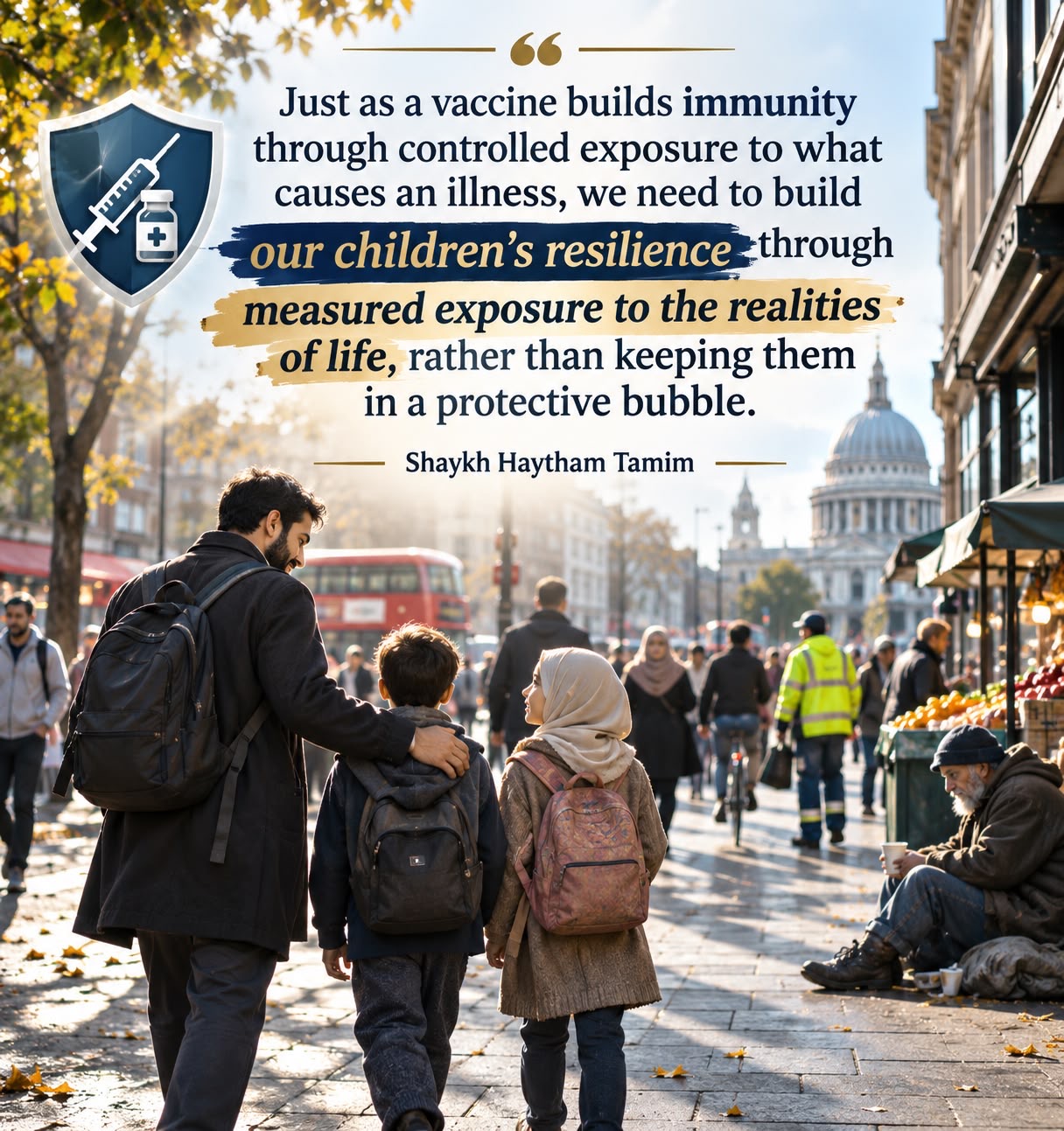
We need to prepare our children in the same way. If we wrap them in cotton wool and keep them entirely sheltered, they may struggle when they have to face the world themselves. Help them understand the challenges around them and how to navigate them.
Think of the principle behind vaccination: preparation helps us face what we may encounter. In education, we need to equip children with understanding and judgement, while guiding them appropriately.
This applies to artificial intelligence as well. It can be used for good or for harm. We need to help children use it beneficially.
I work with AI a lot. It has made my life much easier, but I need to check everything. Gathering the information, putting it together and presenting it can be very helpful. We need to make the most of what it offers and help children use it for good.
We have been given the keys: effort, understanding, sincerity and a connection with Allah. Use them, and seek excellence in this life and the next.
Adapted from the talk of Shaykh Haytham Tamim’s reminder to staff at Islamia school on 24th November 2026.