
The honour of studying the Seerah
It is an honour to talk about the best of Allah’s creation, our master Muhammad ﷺ. It is very difficult to cover the life of the Prophet ﷺ in just a few sessions. Studying his Seerah is a lifetime commitment. Where do we begin? Which aspects of his life should we focus on? There is so much to learn.
Last time, we discussed his teenage years and some of the important events in his early life. We also touched upon the Seal of Prophethood (Khatam al-Nubuwwah).
The Seal of Prophethood
Some historians described the Seal of Prophethood as a birthmark, but scholars of Seerah and Hadith have discussed its appearance and when it first appeared. It was approximately the size of a pigeon’s egg and was located on the Prophet’s ﷺ back, near his left shoulder, opposite the position of his heart.
Some of the companions had heard descriptions of this sign and wanted to see it for themselves. They knew that the final Messenger would have the Seal of Prophethood on his back. On different occasions, they approached the Prophet ﷺ to examine it, and some even touched it to confirm that it matched the descriptions they had received. For some, this was the final confirmation they were looking for. They recognised the sign and accepted him as the Messenger of Allah.
According to the opinion preferred by some scholars, the Seal of Prophethood appeared after the first incident of Shaqq al-Sadr, when the Prophet’s ﷺ chest was opened. Some Jewish and Christian scholars were also aware of this sign. Those who possessed knowledge of their scriptures recognised it as one of the distinguishing features of the final Messenger.
The Prophet’s ﷺ childhood and upbringing
The Prophet ﷺ passed through different stages in his early life. He was born an orphan, spent part of his childhood with his foster family, and was later cared for by his uncle Abu Talib. During these years, he developed many valuable skills. He worked as a shepherd and later became involved in business.
He was a very intelligent boy who learned quickly and asked questions. His character was second to none. He was known for his politeness, kindness and excellent manners, and these qualities made him beloved by those around him. Even as a child, the Prophet ﷺ was exceptional.
The Prophet’s ﷺ first business journey to Sham
As we mentioned previously, when the Prophet ﷺ was around twelve years old, he accompanied his uncle Abu Talib on a business journey to Sham. Sham, or the Levant, refers to the region encompassing present-day Syria, Lebanon, Jordan and Palestine.
Trade was an essential part of life in Makkah. The Quraysh were experienced merchants who travelled regularly to different regions to buy and sell goods.
Allah refers to these journeys in the Qur’an:
رِحْلَةَ الشِّتَاءِ وَالصَّيْفِ
“Their journeys in winter and summer.” (Quraysh 106:2)
The Quraysh travelled to Yemen during the winter and to Sham during the summer. Yemen was relatively close to Makkah, whereas Sham was further away. Winters in Arabia were short, as they still are today, and the majority of the year was warm. These two routes formed the main trading journeys of the Quraysh, but their commercial activities were not limited to Yemen and Sham.
Arab merchants travelled much further afield. Some reports mention journeys as far as India and even China. Overland routes connected them to neighbouring regions, while maritime trade enabled merchants to travel much greater distances. The Prophet ﷺ therefore grew up in a society where trade was central to everyday life.
The Prophet’s ﷺ encounter with Bahira
During his journey to Sham with Abu Talib, the Prophet ﷺ is reported to have met Bahira, a Christian monk. Some writers have questioned whether Bahira existed at all, but the account of their meeting is found in the Seerah literature.
The Prophet ﷺ was approximately twelve years old when this encounter took place. It was a brief meeting, nothing more. Unfortunately, some Orientalist writers, followed by others, have made accusations that the Prophet ﷺ learned religious teachings from Bahira and later used this knowledge to produce the Qur’an. Some have even claimed that he visited Bahira repeatedly and studied with him.
There is no authentic evidence to support these claims. The accounts do not establish that the Prophet ﷺ received religious instruction from Bahira, let alone that he studied with him over an extended period. We must distinguish between wh at has been reliably transmitted and what has been invented or assumed without evidence. The journey to Sham was an important part of the Prophet’s ﷺ early experience, but we should not attach unsupported stories to it.
How did the Prophet ﷺ acquire his business experience?
Later, when the Prophet ﷺ was in his twenties, Khadijah, who was a respected and successful businesswoman, invited him to manage her trading activities. She employed him to conduct business on her behalf. But this raises an interesting question: How did the Prophet ﷺ acquire the experience necessary to manage her business? This is something I wanted to investigate.
Khadijah was an established businesswoman. She had a profitable enterprise and would not have entrusted it to someone who had no knowledge or experience of trade. Of course, I am not suggesting that the Prophet ﷺ was a novice. Rather, I am asking the question from a business perspective. What experience did he have? Where did he acquire his commercial knowledge? How did he learn the skills required to manage trading journeys, negotiate transactions and conduct business successfully? These are questions worth exploring.
We know that he accompanied his uncle on trading journeys from a young age, but I wanted to look more closely at how he developed his knowledge and practical experience. So I began researching the sources to understand how the Prophet ﷺ acquired the business skills that eventually led Khadijah to entrust him with her commercial affairs.
How the Prophet ﷺ Developed His Business Skills
Learning responsibility from shepherding
The Prophet’s ﷺ business experience began at a very young age. As I mentioned previously, he worked as a shepherd, and this taught him valuable qualities, including responsibility, patience, resilience, trustworthiness and how to look after others. These are qualities you need in any business. The Prophet ﷺ began developing them very early in his life.
Makkah: A centre of trade and commerce
We also need to understand the environment in which the Prophet ﷺ grew up. Makkah was a major centre of trade. In our earlier sessions, I gave some background to help you understand what Makkah was like at that time. Apart from being a holy city, it was also a business hub.
The people of Makkah depended heavily on trade for their livelihood. They did not have manufacturing or agriculture to provide them with an income. This was very different from Madinah, which was an agricultural community where people cultivated crops, grew fruit and produced food.
Makkah had none of these advantages. Its people made their money through buying and selling, importing and exporting goods. Caravans were constantly arriving and departing, carrying products to and from different regions.
Growing up in this environment, the Prophet ﷺ would have been familiar with trading activities from an early age.
Learning from the markets of Makkah
Makkah had different types of markets. Some operated throughout the year, rather like the shopping centres we have today, where people could buy and sell goods regularly.
Others were seasonal markets, organised around particular times of the year, including the Hajj season and other months such as Rajab. Merchants would prepare their products in advance to take advantage of these trading opportunities.
As a young boy growing up in Makkah, the Prophet ﷺ would have been exposed to these markets and the activities taking place in them. This is where I believe he began developing many of his practical business skills.
By visiting markets, he would have had opportunities to observe how merchants bought and sold goods, examined the quality of their products, negotiated prices and bargained with customers. He was intelligent and quick to learn, so these experiences would have helped him develop an understanding of how business worked.
Of course, I am drawing conclusions here from what we know about Makkah and the Prophet’s ﷺ upbringing. We do not have detailed narrations describing every market he visited or every transaction he observed. Nevertheless, given the environment in which he grew up, it is reasonable to consider how these experiences contributed to his knowledge.
Learning through his journey to Sham
When the Prophet ﷺ was around twelve years old, his uncle Abu Talib was preparing for a trading journey to Sham. The Prophet ﷺ wanted to accompany him and asked his uncle to take him along. Abu Talib loved him dearly and agreed. This journey would have provided another important opportunity for the Prophet ﷺ to develop his knowledge of trade. Think about what was involved in travelling from Makkah to Sham at that time.
First, he would learn the route itself. If you remained in Makkah, you would never acquire this knowledge. You needed to travel to understand the roads, the distances and the different places along the way.
During a long journey, there would be various stopping points. To use our modern terminology, you would need to know where the petrol stations were, where you could find somewhere to sleep, where you could eat and where you could obtain supplies. Of course, they did not have petrol stations or modern hotels, but they had their own arrangements for resting, eating and preparing for the next stage of the journey. The Prophet ﷺ would have been exposed to these practical aspects of travelling with a trading caravan.
Understanding the risks of travelling
Another important skill was learning how to recognise and manage the dangers along the route. Travelling long distances was not without risk. There could be thieves, attacks on caravans and dangerous areas that merchants needed to avoid.
An experienced traveller would know which routes were safer, where to stop and which junctions to take. For example, someone might warn a young traveller, “Be careful when you reach this junction. If you take that road, there is a greater risk of encountering thieves.”
I am trying to imagine the practical lessons that the Prophet ﷺ would have learned during this journey. We know that the journey took place, but we do not have a detailed account of everything he saw or was taught along the way. However, when we consider what such a journey involved, we can appreciate the experience it would have offered him. He would have become familiar with the routes, the stopping places, the possible dangers and the precautions necessary to travel safely.
These were valuable skills for anyone who intended to become involved in long-distance trade.
Meeting merchants and learning about different markets
The caravan would not have travelled in complete isolation. Along the way, the Prophet ﷺ would have encountered other travellers, merchants and caravans moving between different trading centres.
This would have exposed him to people from different places and backgrounds.
When they eventually reached Sham, he would have encountered markets that were different from those in Makkah. There were new merchants, new products and different ways of conducting business. One of the most important things in business is knowing whom you can trust. When you enter a new market, you do not simply do business with the first person you meet. You need to know who is reliable, who has a good reputation and who can be trusted to fulfil an agreement.
Abu Talib was an experienced businessman. Although he was not particularly wealthy, he understood trade and knew how to deal with merchants. I believe the Prophet ﷺ would have benefited greatly from accompanying him and observing how he conducted his business.
Observing prices, products and negotiations
Now imagine the Prophet ﷺ as a curious twelve-year-old boy visiting these markets. I can imagine him walking around, looking at the different products, asking questions, checking prices and observing how merchants dealt with their customers. Again, I want to be clear that this is my attempt to visualise the journey. I have not read a narration describing these particular activities. But if we consider what happens when an intelligent young person accompanies an experienced businessman to a market, these are the kinds of things we would expect him to observe and learn.
He would see how products were displayed, how merchants described their goods and how they tried to attract customers. Even today, when you visit a busy market, you hear traders calling out to customers: “Come and buy!” “Buy one, get one free!” “This product is discounted!”
Merchants have always used different methods to promote their products and persuade customers to buy. Some are truthful and honest about what they are selling. Others exaggerate the quality of their goods, and some may even lie to make a sale.
The Prophet ﷺ would have been exposed to different approaches to selling and marketing. He could observe how traders communicated with customers, how they negotiated and how they presented their products. All of this would have contributed to his understanding of business.
Building experience over time
Of course, one journey would not have been enough to teach someone everything about business and trade. However, the Prophet ﷺ did not begin learning about business only when he travelled to Sham. He had grown up in Makkah, surrounded by merchants and trading activities. He would already have been familiar with the local markets in Makkah and the surrounding areas.
The journey to Sham would have expanded that experience by introducing him to new places, different merchants and unfamiliar markets. There was also the question of language. In Sham, he would have encountered people from different backgrounds. Many were Arabs who spoke Arabic, but there were also communities who spoke other languages.
This was another aspect of travelling beyond Makkah that would have broadened his experience. When we put these different experiences together, we begin to understand how the Prophet ﷺ could have developed the practical knowledge and skills that later made him a suitable person to manage Khadijah’s business.
Learning independence and responsibility from a young age
In Sham, there were Arab merchants as well as people who spoke other languages. I am not sure whether the Prophet ﷺ encountered these different languages during his journey. Maybe he did, maybe he did not. We do not have enough information to say. However, we know that there were many Arab merchants in the region and that trade took place between them.
The Prophet ﷺ returned to Makkah and continued growing, learning and developing his skills. From a very young age, he was keen to earn his living and contribute to his household. As we mentioned earlier, he was working as a shepherd when he was perhaps eight or ten years old. He was still a young boy, but he already had a sense of responsibility.
He wanted to contribute. He did not want to depend entirely on others. He wanted to become independent, and this is something we should encourage in our own children. We need to teach them how to take responsibility for themselves rather than always relying on others to provide for them.
What can we learn from the Prophet’s ﷺ independence?
This reminds me of a discussion that has been taking place recently in the news about young people who are not in education, employment or training. They have even created a term for them: NEETs, which stands for Not in Education, Employment or Training.
The discussion concerns young people, generally between the ages of sixteen and twenty-five, who are neither studying nor working nor receiving vocational training. According to the figures being discussed, around 20 per cent of this age group, approximately one million young people, fall into this category. They are not necessarily uneducated or illiterate, but they are not currently attending school, college or university, working or undertaking training.
This has led to a major debate about what the government should do. Should these young people continue receiving benefits, or should the government reduce their benefits to encourage them to enter employment or training? How do we help them become productive members of society rather than remaining dependent on financial support?
I have been following this discussion because it raises an important issue. We have a large number of young people who could be contributing to society, but their potential is not being used. Instead of helping them become independent, we are continuing to support them financially without necessarily enabling them to move forward.
The Prophet ﷺ demonstrated a different attitude from a very young age. He wanted to work, earn his living and contribute. He did not want to be someone who simply relied on others to feed and support him. He understood responsibility and wanted to play his part.
This is an important lesson for us as parents. We should encourage our children to develop independence, acquire skills and understand the value of contributing to their families and communities.
How the Prophet ﷺ acquired his commercial experience
Returning to the Prophet’s ﷺ early business experience, I believe he acquired his knowledge through a combination of activities. He learned from the markets of Makkah, from observing merchants, and from the journeys he undertook both locally and beyond Makkah.
His journey to Sham would have exposed him to different markets and trading practices. He also travelled to Yathrib, which later became known as Madinah. There were commercial connections between Makkah and Yathrib, particularly because Yathrib was famous for its dates.
Madinah was an agricultural community with extensive date cultivation. Makkah, by contrast, had very little agricultural land and could not produce large quantities of dates. Its people therefore relied on supplies coming from other places, including Yathrib. They also obtained agricultural products from places such as Ta’if, which we will discuss later, inshallah.
Through these different connections, the Prophet ﷺ would have become familiar with trading routes, products, markets and merchants. He would also have gained experience of the practical challenges involved in buying, selling and transporting goods.
This is my analysis of his upbringing and how he may have developed his commercial skills. I have tried to piece together the environment in which he grew up, the opportunities available to him and the experiences we know he had.
Why did Khadijah employ the Prophet ﷺ to manage her business?
I wanted to explain this background because it helps us understand an important question: why did Khadija employ him if he had no experience or knowledge of trade. Why would an established businesswoman entrust him with her commercial affairs? We need to understand how he developed his skills and reputation before reaching that stage of his life.
Khadijah’s business background
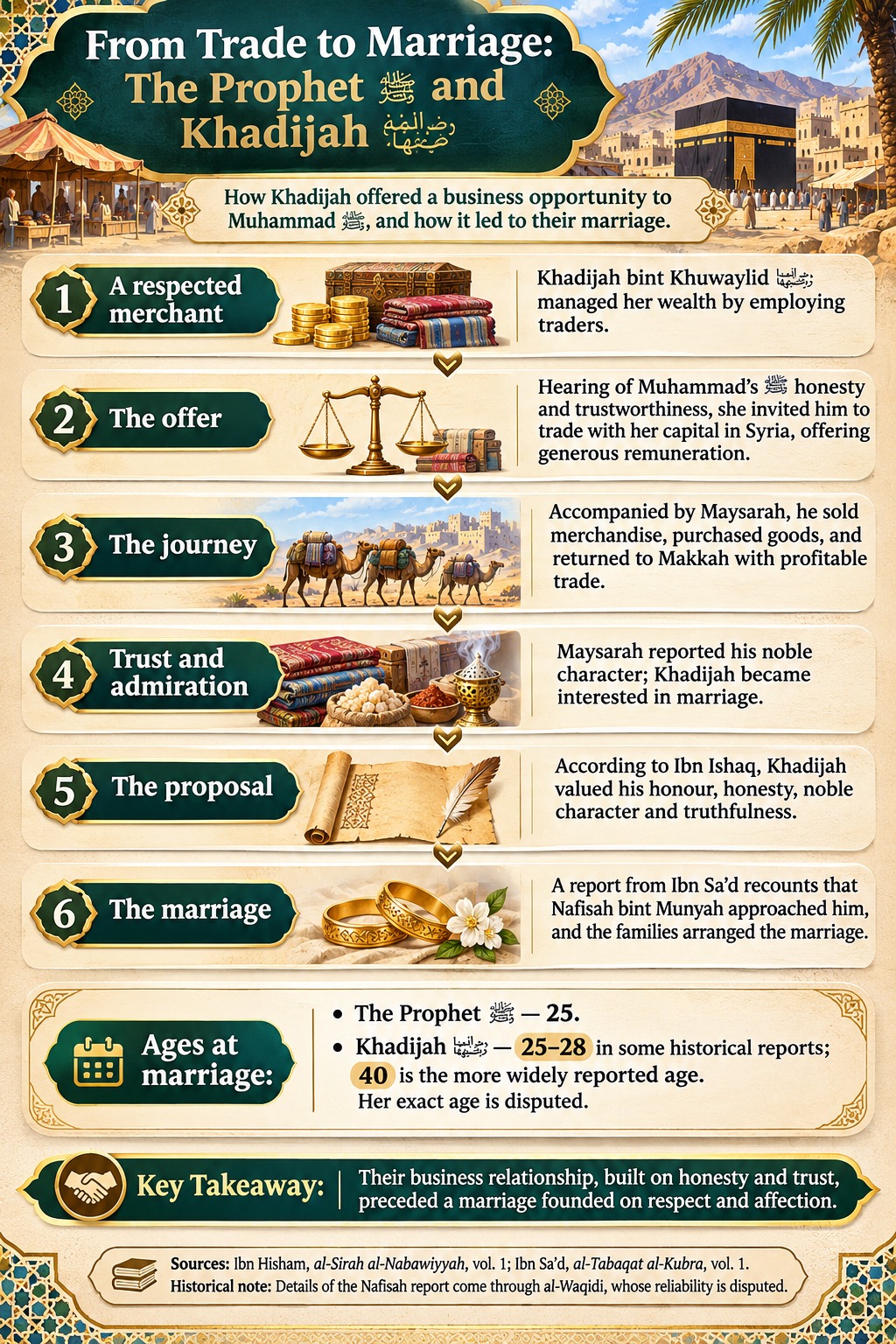
When the Prophet ﷺ was in his twenties, Khadijah bint Khuwaylid, may Allah be pleased with her, employed him to conduct business on her behalf. There are two narrations concerning how this arrangement began. According to one narration, Khadijah was already employing men to manage her trading activities, and she invited the Prophet ﷺ to work for her.
Another narration mentions that Abu Talib approached Khadijah and recommended his nephew. He knew the Prophet’s ﷺ excellent character and the experience he had acquired, so he suggested that she consider employing him.
Both accounts are possible. What is important is that Khadijah recognised his suitability and eventually entrusted him with her business. But this led me to another question. Just as I wanted to understand how the Prophet ﷺ acquired his business experience, I also wanted to know how Khadijah became involved in business.
Where did her wealth come from? How did she acquire her commercial knowledge? Was she already involved in trade before she married the Prophet ﷺ? So I began looking into her family background and the circumstances that led to her becoming a successful businesswoman.
Khadijah grew up in a business family
Khadijah was the daughter of Khuwaylid, a wealthy and established businessman in Makkah. Her father was involved in trade, including importing and exporting goods, and the family had considerable commercial experience. Her relative Hakim ibn Hizam, whom we will probably discuss later in the Seerah, was also a well-known businessman. Trade was therefore deeply rooted in her family.
Khadijah grew up in an environment where business was part of everyday life. She would have been familiar with the buying and selling of goods, trading journeys and the practical arrangements involved in managing commercial activities.
She was not someone who suddenly entered the world of business without any background. She came from a family that understood trade and had experience in it. This helps us appreciate why she was able to manage a successful commercial enterprise. However, another question remains: when did she begin running her own business?
We do not have an accurate historical record establishing exactly when she started. We know something about her family circumstances and her previous marriages, but the details of when she became independently involved in trade are less clear.
Khadijah’s marriages before the Prophet ﷺ
Before marrying the Prophet ﷺ, Khadijah had been married twice. The Prophet ﷺ was her third husband. Her first husband was Abu Halah. I tried to establish when this marriage took place and how many years it lasted, but I could not find accurate records giving us those details.
What we do know from the accounts discussed here is that she married Abu Halah and had two children with him. After his death, she inherited wealth from him. She subsequently married a second husband, with whom she had a daughter. According to the approximate chronology I have been considering, these two marriages may have lasted around seven years altogether, perhaps a little longer. However, we do not have precise dates to establish this with certainty.
Both of Khadijah’s previous husbands had passed away, and at least one of them was involved in business. She was therefore a widow when she married the Prophet ﷺ. This is another important point to reflect upon. The Prophet ﷺ had no hesitation in marrying a woman who had been married before and had children. He valued Khadijah for her character, dignity, intelligence and the qualities she possessed. Her previous marriages did not diminish her worth in his eyes.
Even today, some people are reluctant to marry a widow or a divorced woman, as though having been married before makes someone less desirable. Yet the Prophet ﷺ, who was marrying for the first time, chose Khadijah, a widow and a mother. His example reminds us that a person’s worth is not determined by whether they have been married before, but by their character and qualities.
These marriages are another part of Khadijah’s background that we need to consider when looking at how she acquired her wealth and developed her business.
Her father was already wealthy, she came from a family with extensive trading experience, and she also inherited wealth following her first husband’s death. All of these circumstances help us understand her financial position before she married the Prophet ﷺ.
Makkah as a centre for Arabian trade
Goods were brought to Makkah from surrounding villages, towns and cities. The merchants of Makkah would purchase these products, load them onto their caravans and transport them to places such as Sham, where they could sell them for a profit.
So the products traded by Makkan merchants were not necessarily produced in Makkah itself. They came from different parts of Arabia. Makkah served as a central marketplace where goods could be bought, collected and distributed to other regions.
To understand how this worked, think about a Sunday market. People come from surrounding villages and bring their products to sell, perhaps in a school playground or another open space. They set up their stalls, display their goods and customers come to buy from them.
Makkah operated in a similar way. Traders arrived from different places with their products, and the merchants of Makkah purchased goods that they could sell elsewhere.
Of course, they had to consider which products were suitable for long-distance transport. Fresh vegetables, for instance, would not survive a journey lasting fifteen or twenty days. By the time the caravan reached its destination, they would have spoiled.
Merchants therefore needed to choose products that could withstand long journeys and remain in good condition until they reached the market. This was another important part of business: understanding which products to buy, how to transport them and where they could be sold profitably.
What products did the merchants trade?
Among the goods traded were textiles and fabrics, including products brought from Yemen. Yemen was particularly well known for its textiles and fine fabrics. The Prophet ﷺ appreciated Yemeni clothing, and narrations mention his wearing special garments from Yemen, including a cloak associated with Eid.
Merchants could purchase these fabrics in Yemen, bring them to Makkah and then sell them in other markets. This was how they generated income, buying products in one place and selling them elsewhere for a profit. What, then, did they bring from Sham to Makkah?
There was a wide variety of goods, including olive oil, olives, perfumes, spices and other products that were not readily available in Makkah. Sham was also known for its agricultural produce. Coming from the Levant myself, I am familiar with the variety of fruits grown there. We have apples, oranges and many different kinds of fruit that could not be cultivated in Makkah.
These products could be purchased in Sham and transported to other markets, although merchants would naturally have to consider how well they would survive the journey. This was the nature of the trading business. Merchants identified products that were available in one region, purchased them at a suitable price and transported them to places where there was demand. The difference between the buying and selling prices, after accounting for their expenses, was their profit.
The Prophet’s ﷺ successful trading journey
How the Prophet ﷺ doubled Khadijah’s profits
During his journey to Sham, the Prophet ﷺ sold the goods he had brought from Makkah and purchased new products to take back. He had a good eye for quality and knew how to deal with people. His excellent manners, honesty and ability to negotiate helped him conduct business successfully and obtain good prices.
According to the well-known account, the journey was particularly profitable, and the business generated twice the usual profit. When Maysarah returned to Makkah, he reported to Khadijah that the Prophet ﷺ was a blessed person and that they had doubled their profit. Naturally, Khadijah wanted to know more. She asked Maysarah what he had observed during the journey. Maysarah began describing the Prophet’s ﷺ character, how he spoke to people, how he conducted business and how he treated those around him.
He explained that the Prophet ﷺ was honest, trustworthy, kind and respectful. He treated people well, spoke truthfully and conducted himself with dignity. He was not involved in indecent behaviour, and his conduct throughout the journey had been exemplary.
Khadijah already knew about the Prophet’s ﷺ reputation in Makkah. People spoke highly of his truthfulness and excellent character, but she had not yet experienced these qualities directly through a working relationship.
Now she had something more. Her trusted servant had accompanied the Prophet ﷺ on a lengthy journey, observed his behaviour and returned with a firsthand account of his character. This confirmed what she had already heard about him.
Khadijah recognises the Prophet’s ﷺ exceptional character
Imagine hearing all these qualities about one person. He is honest, trustworthy, truthful, kind, respectful and successful in his work. How could you not admire someone like that? Khadijah was deeply impressed by the Prophet ﷺ. His character appealed to her, and she began considering the possibility of marrying him. Why not? She was a respected woman with an excellent reputation, and he was a man of outstanding character. She recognised that he would make an excellent husband. But how should she approach him?
At that time, it was not customary for a woman to approach a man directly with a marriage proposal. Khadijah therefore discussed the matter with someone close to her, who offered to help. There are always people who know how to arrange these things. You explain what you would like to do, and they say, “Leave it to me. I will take care of it.” That is what happened here.
How Khadijah proposed marriage to the Prophet ﷺ
Khadijah’s intermediary approached the Prophet ﷺ and asked whether he was interested in getting married. He explained that he would like to marry, but he did not have the financial means to do so. He was still a young man establishing himself, and marriage required financial responsibility. Who would be willing to marry him when he had so little money? The intermediary then asked him what he would think if there were a woman from a noble family who was beautiful, respected and wealthy.
The Prophet ﷺ was interested but wondered who such a woman could be and whether she would accept him. She reassured him that she could arrange everything if he was willing. When he asked who the woman was, she replied, “Khadijah.” The Prophet ﷺ was surprised. Would Khadijah really accept him? She reassured him that she would, and the Prophet ﷺ subsequently discussed the matter with his uncle. This is how the marriage proposal began.
Was this the Prophet’s ﷺ only business journey for Khadijah?
The most famous narration mentions that the Prophet ﷺ conducted a successful trading journey for Khadijah, doubled her profit and received additional payment for his work. However, some narrations suggest that he undertook more than one journey on her behalf, possibly two or three, before they married.
This is worth considering because it suggests that Khadijah may have had more opportunities to observe his performance and develop confidence in his abilities. Whether it was one journey or several, what matters is that she came to recognise his excellent character and trustworthiness. He had demonstrated that he could manage her business responsibly and conduct himself honourably. He was the kind of person she wanted to marry.
How old was Khadijah when she married the Prophet ﷺ?
This brings us back to the question of Khadijah’s age, which I discussed earlier. The Prophet ﷺ was approximately twenty-five years old when they married. As I explained, I have looked into the different narrations concerning Khadijah’s age because the commonly repeated figure of forty is not the only opinion.
Based on my examination of the narrations and the chronology of her previous marriages, I consider it more likely that she was also in her twenties, perhaps around twenty-five to twenty-eight. This would mean that they were relatively close in age when they married.
There is another reason why I have considered this possibility.
Khadijah’s children and the question of her age
Khadijah had children from her previous marriages. In the account we have been discussing, she had three children before marrying the Prophet ﷺ: two boys and one girl. She subsequently had six children with the Prophet ﷺ: two sons and four daughters. If we accept the commonly repeated narration that she was forty years old when she married the Prophet ﷺ, we then have to consider the chronology of these six births. She would have been giving birth to children throughout her forties and potentially into her fifties.
If we allow approximately one or two years between the births, this raises questions about the timeline. This is one of the reasons why I have examined the reports about her age more closely. Based on the chronology I have considered, I believe the younger age is more likely and would place her death in her fifties rather than her sixties.
We do, however, need to distinguish between the different historical narrations and what we can establish with certainty. The precise age of Khadijah at marriage remains a matter of scholarly discussion, and the chronology of her children alone does not settle the question.
Khadijah’s marriage proposal: A lesson for today
Returning to the marriage proposal, it was Khadijah who took the initiative and proposed to the Prophet ﷺ. This is an important point to reflect upon. Remember, this happened during the period of Jahiliyyah, before Islam. Yet Khadijah did not consider it shameful to express her interest in marrying someone she admired and respected. She recognised the Prophet’s ﷺ excellent character, his honesty, trustworthiness and good manners. She felt that he was too good a person to let go, so she took the initiative.
Now, consider our situation in the twenty-first century. Suppose a young woman admires a man because of his character, his deen and his akhlaq, and she wishes to marry him. Is she allowed to propose? In some communities, people would be shocked. They might accuse her of being shameless or behaving inappropriately. They would say, “How can a woman propose to a man? She should never do that!” But why not?
If she is seeking marriage through halal means, what is wrong with that? She is not asking for anything impermissible. She wants to marry someone whom she believes would make a good husband.
Of course, approaching him through a third party, as Khadijah did, may be more socially acceptable and can make the process easier. But even if she approaches him directly, the question is whether what she is doing is halal or haram.
We sometimes confuse cultural taboos with religious rulings. Something may be unusual in a particular community, but that does not automatically make it impermissible. If a woman expresses her interest respectfully, with dignity and good intentions, why should she be criticised for seeking marriage?
Khadijah did not allow such concerns to prevent her from pursuing what she believed was a good opportunity. She recognised the Prophet’s ﷺ exceptional qualities and did not want to lose the opportunity to marry him. There is an important lesson here for us today.
How the marriage was arranged
According to the narration discussed here, Khadijah’s uncle, Amr ibn Asad, accepted the marriage proposal on her behalf. Her father, Khuwaylid, had already passed away. Some narrations suggest that her father was involved in arranging the marriage, but these are not regarded as authentic in the account we are following. It was her uncle who represented her family. Abu Talib accompanied the Prophet ﷺ, together with other members of their family, to formally propose.
This was customary among the Arabs, and we still see similar traditions today. When a family wishes to arrange a marriage, the men of the family often gather together and visit the prospective bride’s family. The father, uncles, brothers and other senior members of the family may attend. Their presence is a way of honouring the occasion and showing respect to the other family.
The bride’s family would similarly gather their relatives to receive the visitors. Marriage was not simply viewed as a matter between two individuals, but as an important occasion bringing families together. Abu Talib delivered a beautiful speech in which he spoke about the Prophet’s ﷺ character, his noble family, his lineage and his virtues. Following the discussion, the proposal was accepted, and the Prophet ﷺ married Khadijah. This marked a new chapter in his life.
Talk delivered to the Al Manaar Convert Club on 4th November 2026.
Related posts