
The difference in the verification methodology of legal rulings and seerah
The difference in the verification methodology of legal rulings and seerah
It is good to talk about the seerah of the Prophet ﷺ, but we should not only talk about it, we should try to learn lessons from his seerah and live by them. Anyone can pick up a book of seerah and read it. What we are trying to do is to walk through the seerah of the Prophet ﷺ together and understand what it means for us. His seerah is very extensive, so I am trying to summarise where possible while highlighting the most important aspects of his life.
From time to time, I will explain whether a particular event is authentically reported, whether its narration is weak, or whether there is some discussion among the scholars about it. As we mentioned in the introduction, the way scholars of hadith approached seerah narrations differs from the way they approached hadith relating to rulings. These two methodologies overlap and are interconnected, but they are not identical.
When scholars of hadith verify a narration, they apply strict criteria, particularly when it concerns matters of fiqh, halal and haram, or beliefs and aqeedah. In these areas, the scholars and critics of hadith are very rigorous. However, the same scholar, when writing about the seerah, may adopt a less stringent approach. A narration he accepts when recounting an event in the Prophet’s ﷺ life may not meet the standard he requires when establishing a religious ruling.
For example, scholars may accept some weak narrations in the seerah, provided they are not very weak or fabricated. I will give you examples as we go through the events and we need to be aware that these different approaches exist. Establishing what is halal or haram is different from recounting a historical event in the life of the Prophet ﷺ. Unless that event involves a ruling, it is not being used to establish halal and haram. If it does concern a ruling, then the stricter criteria apply. This is why the verification of seerah reports can differ from the verification of hadith used as evidence for religious rulings.
Recap
Last time, we discussed the birth of the Prophet ﷺ. The widely accepted position among scholars of hadith and seerah is that he was born in the Year of the Elephant. We know what happened that year: Abraha marched against Makkah with his army and elephants. The Prophet’s ﷺ birth is generally dated to around 570 or 571 CE.
As for the precise date, the most famous view is that he was born on Monday, the twelfth of Rabi al-Awwal. However, this is not the only reported date, and the scholars differed over the exact day of the month. His birth on a Monday is established in an authentic hadith. When he was asked about fasting on Mondays, he said:
فِيهِ وُلِدْتُ وَفِيهِ أُنْزِلَ عَلَيَّ
“On it I was born, and on it revelation was sent down to me.” (Sahih Muslim)
He marked the day of his birth by fasting. I know some people will not like describing this as celebrating his birthday and will say that he was not celebrating it. My understanding is that he acknowledged the day of his birth through fasting. Monday and Thursday were regular days of fasting for the Prophet ﷺ, alongside the practice of fasting on the thirteenth, fourteenth and fifteenth of the lunar month.
We also discussed the parents of the Prophet ﷺ and the scholarly debate over their salvation. Are they saved or not? The view I mentioned was that they are saved and are counted among Ahlul Fatrah, the people of the interval. I described this as the majority opinion, although the issue is disputed among scholars. Imam al-Suyuti was among those who strongly defended their salvation, and this is also the position adopted by Egypt’s Dar al-Ifta.
Ahlul Fatrah refers to those who lived during an interval between messengers and whom the prophetic message had not reached. In our discussion, we were speaking about the Arabs descended from Ibrahim and his son Ismail, peace be upon them, before the coming of Prophet Muhammad ﷺ. They had lived through a long period without a messenger being sent to them. The term Ahlul Fatrah, “the people of the interval”, is used by scholars when discussing their circumstances and their accountability.
There is an authentic narration in Sahih Muslim in which a man asked the Prophet ﷺ where his father was. The Prophet ﷺ answered that he was in the Fire. As the man turned away and began to cry, the Prophet ﷺ called him back and said:
إِنَّ أَبِي وَأَبَاكَ فِي النَّارِ
“Indeed, my father and your father are in the Fire.” (Sahih Muslim)
Imam al-Suyuti and other scholars discussed this narration and compared it with another narration by the same narrator in which the Prophet ﷺ did not say, “My father and your father,” but said:
حَيْثُمَا مَرَرْتَ بِقَبْرِ كَافِرٍ فَبَشِّرْهُ بِالنَّارِ
“Whenever you pass the grave of a disbeliever, give him tidings of the Fire.” (Sunan Ibn Majah)
There is a substantial scholarly discussion surrounding this issue. Imam al-Suyuti wrote several booklets defending the salvation of the Prophet’s ﷺ parents. Among the reports he discussed was a narration that the Prophet ﷺ asked Allah to revive his parents, and Allah accepted his request and revived them. They believed in him and passed away and were therefore saved. This narration is weak, but it has several chains of transmission. Al Suyuti collected these chains and considered that, taken together, they strengthened the narration sufficiently for him to accept it. Other scholars of hadith disputed his assessment, so this remains his position rather than an agreed-upon judgement.
Imam al-Suyuti passed away in 911 AH, so we are speaking about a relatively late scholar, not someone from the earliest generations. Many scholars who came after him followed his approach, while others disagreed with his conclusions. There is also a third approach to reconciling these narrations: some scholars argued that the statement, “My father and your father are in the Fire,” was superseded by what happened later. According to their explanation, the Prophet ﷺ subsequently asked Allah to revive his parents, and they accepted Islam.
Those who take this view are not saying that the narration in Sahih Muslim is inauthentic. They accept it but understand it as referring to an earlier point, before the reported revival of his parents. This is how they reconcile the accounts. However, this explanation itself depends on accepting the disputed reports of their revival. I have presented these views to show you that the answer is not as straightforward as it might initially appear. We sometimes expect everything to be black or white, but there can be many shades in between.
My own view, which I believe is a strong one, is the position I mentioned at the beginning: we classify the parents of the Prophet ﷺ among Ahlul Fatrah, the people of the interval who had not received a messenger. The strong evidence for this is Allah’s statement in the Qur’an:
وَمَا كُنَّا مُعَذِّبِينَ حَتَّىٰ نَبْعَثَ رَسُولًا
“We would never punish until We had sent a messenger” (Surat al-Isra, 17:15).
They had not received a messenger, and Allah tells us that He does not punish before sending one. This is why I regard this as a strong position, independently of whether someone agrees or disagrees with Imam al-Suyuti’s assessment of the other narrations.
Nursing
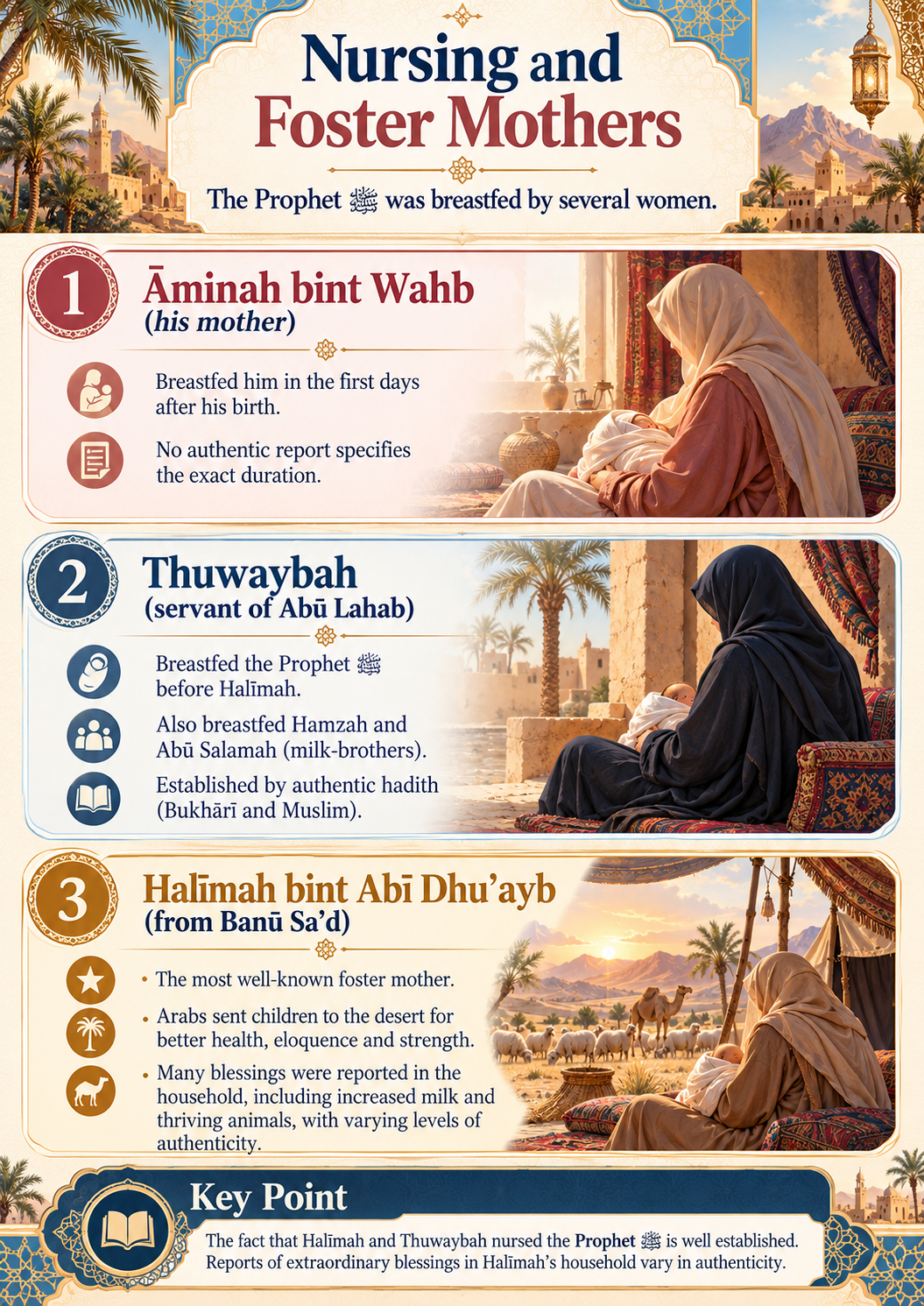
Returning to the seerah, after his birth, the first person to nurse the Prophet ﷺ after his birth was his own mother. She breastfed him during the earliest days of his life. We do not have a precise narration establishing exactly how long she breastfed him or how long he remained with her before Halima came to Makkah. We are speaking approximately about those early days and months, rather than a duration we can establish with certainty.
The first nursing mother after his own mother was Thuwaiba, whom we mentioned briefly last time. In Arabic, a nursing mother is called a murdi‘a. Thuwaiba was a female servant of Abu Lahab, the uncle of the Prophet ﷺ. Abu Lahab’s name was Abdul Uzza; Abu Lahab was the name by which he became known. Thuwaiba breastfed the Prophet ﷺ and therefore became his mother through breastfeeding.
Thuwaiba also breastfed Hamza, the uncle of the Prophet ﷺ. This means that Hamza was both his uncle by blood and his brother through breastfeeding. They shared the same nursing mother, so they were milk-brothers as well as uncle and nephew. Thuwaiba was therefore another mother to the Prophet ﷺ, following his own mother.
Then Halima came into his life and had the good fortune of taking Muhammad ﷺ into her home. He spent several years in her care—around five or six years, depending on the narrations being discussed. Her name was Halima bint Abi Dhuaib, and she is well known as Halima al-Sa‘diyya because she belonged to Bani Saad, the tribe among whom she lived.
To understand this arrangement, we need to picture what Makkah was like at the time. Like any city, it brought together people from different places, with different ways of speaking. It was open for business, and people came from outside to trade and settle there. Its population was not limited to those originally from Makkah. Rural communities were different: people were more likely to remain among their own community, living and dying in the same place.
Someone might leave a rural area to settle in Makkah, but movement in the other direction was less common. This mattered because language was very important to the Arabs. In a city, the mixing of people also brought a mixing of dialects and changes in speech. Families in Makkah were therefore keen to send their children to nursing mothers outside the city. One of their main reasons was to preserve the purity of their children’s Arabic.
In those rural communities, the language was less affected by incoming dialects and outside influences. Children would grow up hearing and speaking the Arabic of that community. In one respect, you could compare it to sending a child to a boarding school: parents sent their children away to an environment they believed would benefit their upbringing. In this case, developing their language was one of the principal benefits.
Another reason was the fresh air and healthier surroundings. Outside the city, children had open spaces, fields and animals around them. They were not confined within a city surrounded by mountains, as Makkah was. There was more space for them to grow up, and families regarded that environment as better for their children. These were among the reasons behind the practice of sending children to nursing mothers outside Makkah.
Halima
Halima was one of the women who came seeking a child to nurse and care for. As we learn from the seerah accounts, she and her husband were very poor. These were the circumstances in which she came to Makkah, hoping to find a child whose family would provide payment for her care.
Halima hoped to take a child from a wealthy family so that she could improve her financial circumstances. However, her riding animal was so weak that she arrived behind the other women. Those who arrived earlier had already taken children from families who could afford to pay them well. No one was keen to take the Prophet ﷺ because he was an orphan. His father was not there, and they wondered how much they could expect to receive from his family. They were looking for an income, so an orphan was not their first choice.
Halima was therefore faced with returning empty-handed or taking this orphaned child. Having made the journey, she decided that she would take him rather than return without a child. This was her fortunate day: she was entrusted with caring for the best of Allah’s creation. When you read the seerah accounts of what happened to Halima, her husband and their animals, you find extraordinary changes in their circumstances. These were manifestations of the barakah of the Prophet ﷺ.
She had arrived behind the others because her mount was weak and struggling, yet on the return journey it moved ahead of them. Her companions could hardly believe that this was the same animal. They asked what had happened to it: how could the animal that had struggled on the outward journey now travel so quickly? This was among the blessings associated with her taking the Prophet ﷺ into her care.
Halima took him home with her husband. Remember that she was already nursing a child of her own, which is why she had milk and was able to take another baby to breastfeed. Her children therefore became the brothers and sisters of the Prophet ﷺ through breastfeeding. When she put him to her breast, she experienced an abundance of milk unlike anything she had known before. She could feed him until he was satisfied and then feed his milk-brother as well. This was another blessing she experienced after taking the Prophet ﷺ.
Once he was in her home, Halima continued to see goodness and signs of blessing. She loved him and treated him as her own son. He played outside with her children and grew up among them. From time to time, she took him to visit his mother, so that she could see him, before returning with him to Bani Saad. He remained in Halima’s care for several years, until the event we are about to discuss.
The opening of the chest
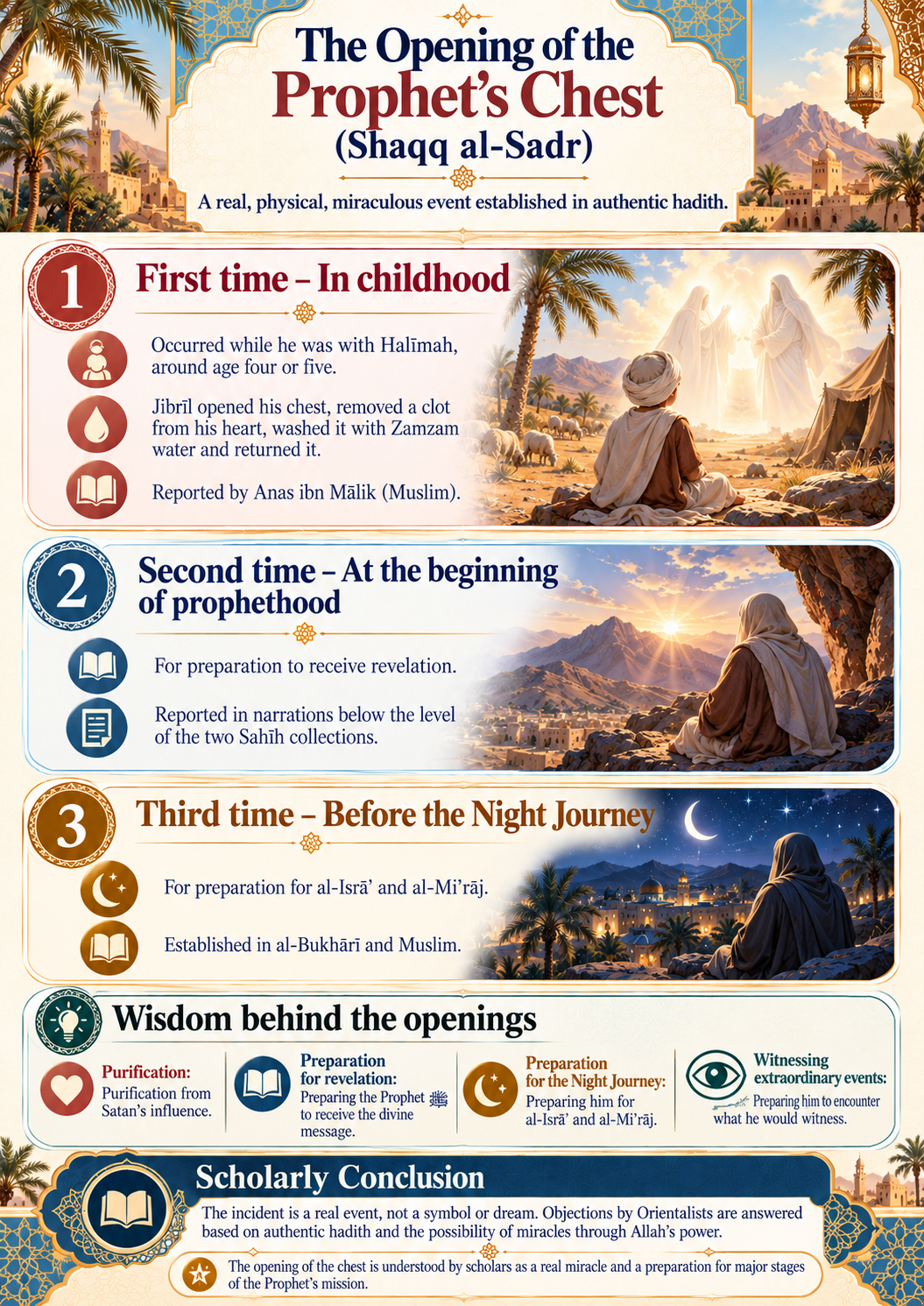
He was around four years old when this happened, although there is some discussion in the seerah about his precise age. One day, while he was playing outside with the other children, his milk-brother came running back in terror. He shouted that two men had taken his brother, laid him on the ground and opened his chest. He thought that Muhammad ﷺ had been killed. Halima and her husband were terrified and hurried out to find him. They found him alive, but very pale and shaken.
This is the well-known event called Shaqq al-Sadr, the opening of the chest of the Prophet ﷺ. Its occurrence during his childhood is recorded in Sahih Muslim. Anas ibn Malik narrated that Jibreel came while the Prophet ﷺ was playing with the other boys, laid him down, opened his chest and removed his heart. He then extracted a clot, washed the heart with Zamzam water in a golden basin and returned it to its place. The children ran to his nursing mother because they believed he had been killed, but when they reached him, they found him with his colour changed. (Sahih Muslim)
You might think of this as a kind of surgery, although it was an extraordinary event performed by an angel. Some of you may wonder about pain and how this could happen. Today, we use anaesthetic for an operation. In the lesson, I describe this by comparison as a special “anaesthetic”, but Allah knows how it took place. We should not imagine that an event carried out by Jibreel had to follow the procedures of an ordinary human operation.
Anas, who narrated this hadith, was not present during the Prophet’s ﷺ childhood in Makkah. He came to serve him later, in Madinah, when he was about ten years old. His mother brought him to The Prophet ﷺ and offered her son to serve him. Others had brought gifts, and this was what she could offer. Anas remained in his service for ten years, so he knew him closely and had the opportunity to observe what others might not have seen.
Anas said:
وَقَدْ كُنْتُ أَرَى أَثَرَ ذَلِكَ الْمِخْيَطِ فِي صَدْرِهِ
“I used to see the trace of that stitching on his chest.” (Sahih Muslim)
He could still see the mark left by this event. Although this was an extraordinary occurrence, it left a physical trace that Anas himself observed many years later.
How many times did the opening of his chest occur? Scholars have discussed three or four occasions, but I will take you through three here rather than discuss the fourth. The narrations differ in their strength, although I consider the reports we are discussing to be acceptable. The first occasion was during his childhood, while he was living with Halima.
Regarding the second occasion, some scholars place it at another point during his youth. My understanding is that it occurred before he received revelation, when he was in his late thirties. His chest was opened, his heart was washed and it was returned to its place. There is discussion about the timing of this report, so we should distinguish the event being narrated from the question of precisely when it happened.
The third occasion was before the Night Journey and Ascension, when the Prophet ﷺ was in his fifties. In the chronology I am using here, this was around the eleventh year after the beginning of revelation. Jibreel came, opened his chest and washed his heart before returning it to its place. The opening of his chest in preparation for the Ascension is recorded in authentic narrations in both Sahih al-Bukhari and Sahih Muslim.
The question, then, is why this happened. What was the purpose of opening and washing his heart? In the narration of the childhood event, Jibreel removed a small clot and said:
هَذَا حَظُّ الشَّيْطَانِ مِنْكَ
“This is Satan’s portion of you.” (Sahih Muslim)
These words are central to understanding the purification described in the hadith and the preparation of the Prophet ﷺ for what lay ahead.
Jibreel removed this portion from his heart, protecting the Prophet ﷺ from Shaytan’s influence and strengthening him to remain on the straight path. Shaytan would have no control over him. To use a modern comparison, it is like updating the security system on your computer: you strengthen its protection so that viruses and hackers cannot gain access. These events strengthened the protection of the heart of the Prophet ﷺ, layer upon layer, preserving its soundness.
I mentioned an account of hackers in France gaining access to refrigeration systems and raising the temperature to fifty degrees, leaving the food to be thrown away. They entered through the system and caused destruction. The comparison here is that a well-protected system prevents an intruder from gaining access. In the case of the Prophet ﷺ, these events provided protection against Shaytan. This is an illustration to help us understand the meaning of that protection.
Another purpose was to prepare the Prophet ﷺ to receive the Qur’an. During his childhood, Allah protected him from wrongdoing. He was a child who lived and played among other children, and children sometimes do things they should not do. However, when we read his seerah, we find accounts of Allah protecting him from joining in certain actions, even before he became a prophet.
One account mentioned in this connection describes children removing their clothes and going about unclothed. The Prophet ﷺ was among them, but when he was about to do the same, he fainted. When he regained consciousness, he did not follow them. The point is that Allah protected him from his childhood. Even when he might have been about to imitate those around him, he was prevented from doing so.
Likewise, the people around him worshipped idols and prostrated before them, but the Prophet ﷺ was protected from this. He did not worship their idols or prostrate before them, nor did he have any affection for them. His upbringing took place within that society, yet Allah preserved him from its idolatry.
Later, this preparation was for receiving revelation. Allah says:
إِنَّا سَنُلْقِي عَلَيْكَ قَوْلًا ثَقِيلًا
“Indeed, We will send down upon you a weighty word” (Surat al-Muzzammil, 73:5).
This weighty message required someone who could carry it. The Prophet ﷺ could not bear that responsibility through his own strength alone; Allah strengthened him to receive and convey it.
The Qur’an also tells us where this revelation was received:
نَزَلَ بِهِ الرُّوحُ الْأَمِينُ عَلَىٰ قَلْبِكَ لِتَكُونَ مِنَ الْمُنْذِرِينَ
“The Trustworthy Spirit brought it down upon your heart, so that you might be among the warners” (Surat al-Shuara, 26:193–194).
The Qur’an was revealed upon the heart of the Prophet ﷺ. Such a responsibility required a strong heart, and this helps us understand the wisdom of Allah strengthening and preparing his heart.
When he was in his fifties, he was prepared for al-Mi’raj, the Ascension to the heavens. On this occasion, the account describes him as initially sleeping when the angels came. The sleep of the prophets is not like ours: their eyes sleep, but their hearts do not sleep. The Prophet ﷺ was aware of what was happening. Jibreel came, and the opening and washing of his chest formed part of the preparation for the journey of al-Isra wal-Mi’raj.
Allah prepared him for a journey beyond our ordinary experience and imagination. Consider the mount he rode, al-Buraq. The Prophet ﷺ described it with the words: يَضَعُ حَافِرَهُ عِنْدَ مُنْتَهَى طَرْفِهِ, meaning, “It placed its hoof at the furthest point of its sight.” Look into the distance during the day and consider how far you can see. The description gives us some sense of the extraordinary distance covered in a single stride. (Sahih Muslim).
In describing the speed of this journey, I compared it to the speed of light, or even something faster. The point of that comparison is its extraordinary nature, beyond the journeys we know. The Prophet ﷺ did not need an oxygen mask or the equipment we associate with travel beyond the earth. Allah enabled him to undertake it and prepared him for what he would experience.
We previously devoted three detailed sessions to al-Isra wal-Mi’raj. During that journey, the Prophet ﷺ witnessed many extraordinary things. He was shown Jannah, and Jibreel took him into it. He also witnessed scenes of punishment. These were experiences for which he needed preparation, and the greatest honour of the journey was his meeting with Allah.
Here we come to an issue on which scholars differed, beginning with the Companions themselves: did the Prophet ﷺ see Allah during that journey? Aisha maintained that he did not. Other Companions are cited in support of the view that he did, although the nature of that seeing requires careful discussion. We should not attempt to describe what we do not know.
The view I follow is that Allah prepared the Prophet ﷺ for this encounter, and I understand the opening of his chest as part of that preparation. Without Allah enabling and strengthening him, he could not have experienced it. We can consider this alongside the account of Musa (peace be upon him) who asked:
رَبِّ أَرِنِي أَنْظُرْ إِلَيْكَ
“My Lord, show Yourself to me so that I may look at You.”
Allah replied:
لَنْ تَرَانِي
“You will not see Me” (Surat al-Araf, 7:143).
The explanation I am following is that Musa (peace be upon him) had not been prepared for this, whereas Allah prepared the Prophet ﷺ for the honour granted to him. I recognise that this is disputed, and I am not presenting it as the only opinion. I acknowledge and respect the other view, but this is the position I follow. These events prepared the Prophet ﷺ for the journey of al-Mi’raj and for the encounter with Allah that I have described.
The Prophet ﷺ received the gift of salah for his Ummah and returned with this precious gift from his journey. Allah prescribed five daily prayers through which we affirm His oneness and express our gratitude to Him. This was the gift he brought back to his Ummah from al-Isra wal-Mi’raj.
Returning to the opening of his chest during his childhood among Bani Saad, Halima was terrified by what had happened. She feared that he might have been touched by a jinn or harmed by something evil. She did not understand what had occurred and wanted to return him to his mother before anything else happened to him.
Yet Halima herself had previously persuaded his mother to let him remain with her for longer. She had encouraged Aminah to leave him in her care, explaining that the environment would be better for him and help him grow stronger and healthier. His mother had agreed. Now, after this frightening event, Halima’s concern for his safety led her to bring him back. This marked the end of his stay among Bani Saad.
Return to Makkah
The Prophet ﷺ then lived with his mother until she passed away when he was six years old. His grandfather, Abdul Muttalib, took responsibility for him, but he too passed away two years later, when the Prophet ﷺ was eight. His care then passed to his uncle Abu Talib, who had a large family to support. Ali was, of course, one of Abu Talib’s children, although he had not yet been born at this stage.
From his childhood, the Prophet ﷺ was intelligent and perceptive. He could see that his uncle was caring for many children, and he did not want to be an additional burden. He began working while he was young so that he could earn something and help his uncle, even if it was only a small amount. This was when he worked as a shepherd, looking after sheep in return for payment.
Abu Hurayrah narrated that the Prophet ﷺ said:
مَا بَعَثَ اللَّهُ نَبِيًّا إِلَّا رَعَى الْغَنَمَ
“Allah sent no prophet who had not tended sheep.”
His Companions asked whether he had done so too, and he replied:
نَعَمْ كُنْتُ أَرْعَاهَا عَلَى قَرَارِيطَ لِأَهْلِ مَكَّةَ
“Yes, I tended them for the people of Makkah for a few qirats.” He earned a modest payment, but he was content to work and contribute. (Sahih al-Bukhari)
Shepherding
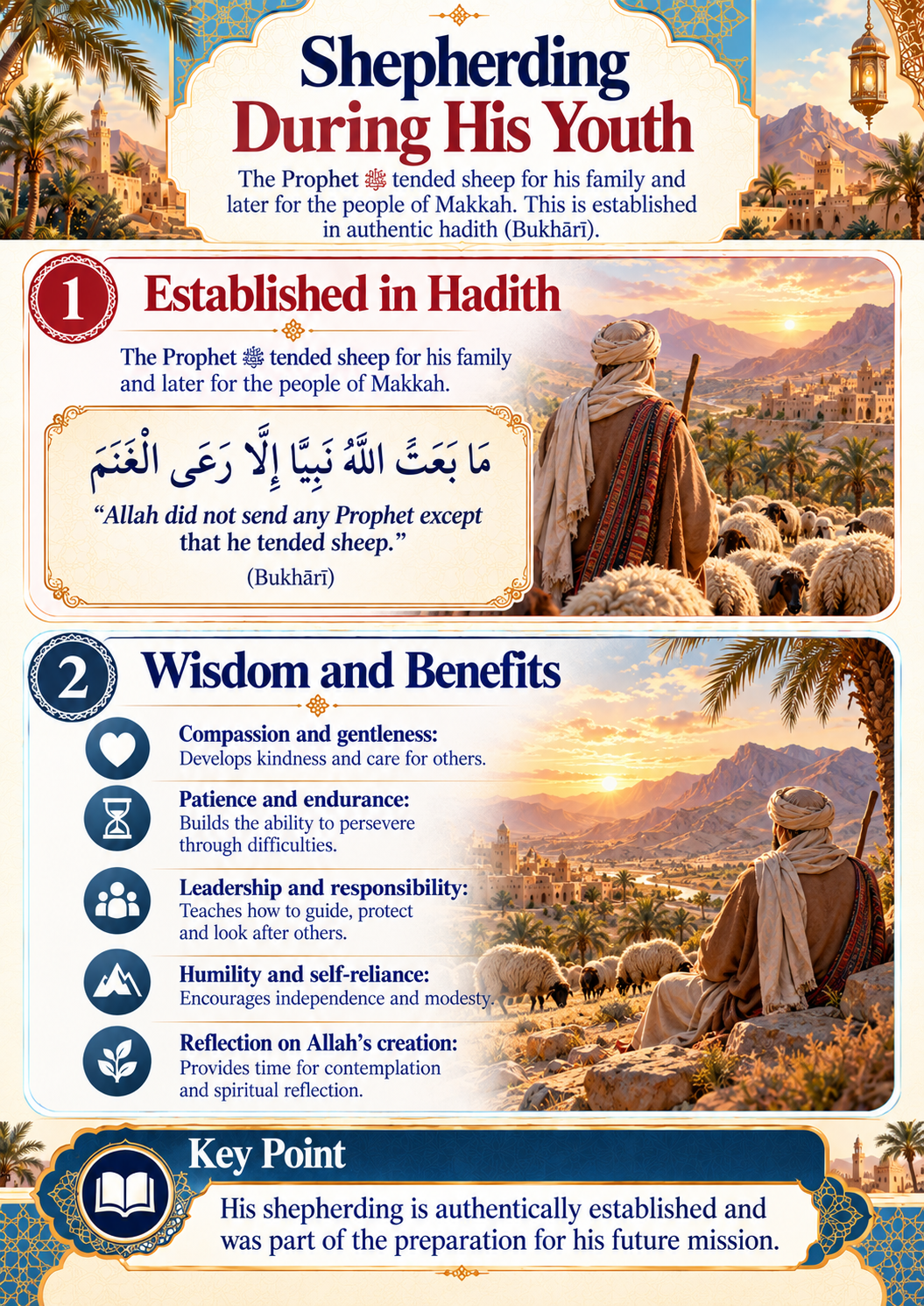
There is something beautiful about shepherding and the lessons it teaches. For a long time, I have wanted to deliver a course exploring these lessons. InshaAllah, when Allah permits, we will have that opportunity. There is a great deal to learn from this work, beginning with independence and responsibility. A shepherd has a flock entrusted to him, and he must learn how to care for each animal.
Shepherding also requires patience. If one sheep wanders away, you have to go and find it and bring it back. You must protect the flock, pay attention to its needs and learn how to guide it safely through danger. At the same time, the work gives you space for reflection. You have time to contemplate Allah’s creation, including the animals in your care, and to observe what is happening around you.
These lessons come at a cost. The work involves tiredness, patience and sometimes frustration. It can also bring pain: an animal might be stolen, killed or die. You learn to deal with loss as well as the daily demands of caring for the flock. All these experiences help prepare a person for the realities of life.
For the Prophet ﷺ, this work was an early experience of earning and taking responsibility. It was also a familiar practice among families of modest means. Children would help look after the animals and contribute to the household. Wealthier families might not have needed their children to do this, but for poorer families it was part of everyday life.
There is a lesson here for how we raise our own children. We need to teach them responsibility rather than wrap them in cotton wool and shield them from every difficulty. They need opportunities to face reality and discover what it means to work, make an effort and be accountable for something. A part-time job, weekend work or a summer job can help them develop these qualities.
Encourage them to take such opportunities rather than keeping them at home and protecting them from every challenge. Of course, we must protect our children, but we should not become overprotective. If we remove every difficulty from their path, we risk leaving them pampered and easily overwhelmed when they eventually encounter hardship.
When children learn responsibility from an early age, they develop the ability to cope with the challenges of life. They gain experience, patience and confidence in their capacity to manage difficulties. Excessive protection can undermine that development. We may believe we are helping them, but if we never allow them to face responsibility, we can leave them less prepared for the life ahead of them.
Talk delivered to the Al Manaar Convert Club on 13th October 2026.
Related posts