
At the end of Surat al-Anbiya, Allah talks about the people of Jannah.
إِنَّ ٱلَّذِينَ سَبَقَتۡ لَهُم مِّنَّا ٱلۡحُسۡنَىٰٓ أُوْلَـٰٓٮِٕكَ عَنۡہَا مُبۡعَدُونَ (١٠١) لَا يَسۡمَعُونَ حَسِيسَهَاۖ وَهُمۡ فِى مَا ٱشۡتَهَتۡ أَنفُسُهُمۡ خَـٰلِدُونَ (١٠٢) لَا يَحۡزُنُهُمُ ٱلۡفَزَعُ ٱلۡأَڪۡبَرُ وَتَتَلَقَّٮٰهُمُ ٱلۡمَلَـٰٓٮِٕڪَةُ هَـٰذَا يَوۡمُكُمُ ٱلَّذِى ڪُنتُمۡ تُوعَدُونَ (١٠٣)
But those for whom We have decreed Paradise will be kept far from Hell- they will not hear a murmur from it- and endlessly they will enjoy everything their souls desire. They will have no fear of the great Terror: the angels will receive them with the words, ‘This is the Day you were promised!’ [21:101-103]
Allah opens these windows to the unseen for us in several places in the Quran, helping us to visualise both the good and bad sides of the akhirah.
These ayahs don’t yet show Jannah itself, but how the believers will feel on the Day of Judgement. We can contrast them with the ayahs at the opening of the next surah, Surat al-Hajj, which shows a terrifying scene where even a breastfeeding mother will suddenly not recognise her own child, and people will be so disoriented that they will appear drunk.
يَـٰٓأَيُّهَا ٱلنَّاسُ ٱتَّقُواْ رَبَّڪُمۡۚ إِنَّ زَلۡزَلَةَ ٱلسَّاعَةِ شَىۡءٌ عَظِيمٌ۬ (١) يَوۡمَ تَرَوۡنَهَا تَذۡهَلُ ڪُلُّ مُرۡضِعَةٍ عَمَّآ أَرۡضَعَتۡ وَتَضَعُ ڪُلُّ ذَاتِ حَمۡلٍ حَمۡلَهَا وَتَرَى ٱلنَّاسَ سُكَـٰرَىٰ وَمَا هُم بِسُكَـٰرَىٰ وَلَـٰكِنَّ عَذَابَ ٱللَّهِ شَدِيدٌ۬ (٢)
People, be mindful of your Lord, for the earthquake of the Last Hour will be a mighty thing: on the Day you see it, every nursing mother will think no more of her baby, every pregnant female will miscarry, you will think people are drunk when they are not, so severe will be God’s torment. [22:1-2]
Your destiny is written before you are even born
There is part of a long hadith which says that while a baby is in the womb, an angel writes down their destiny: their rizq, their lifespan, their actions, and their final destination – if it will be Jannah or Jahannam.
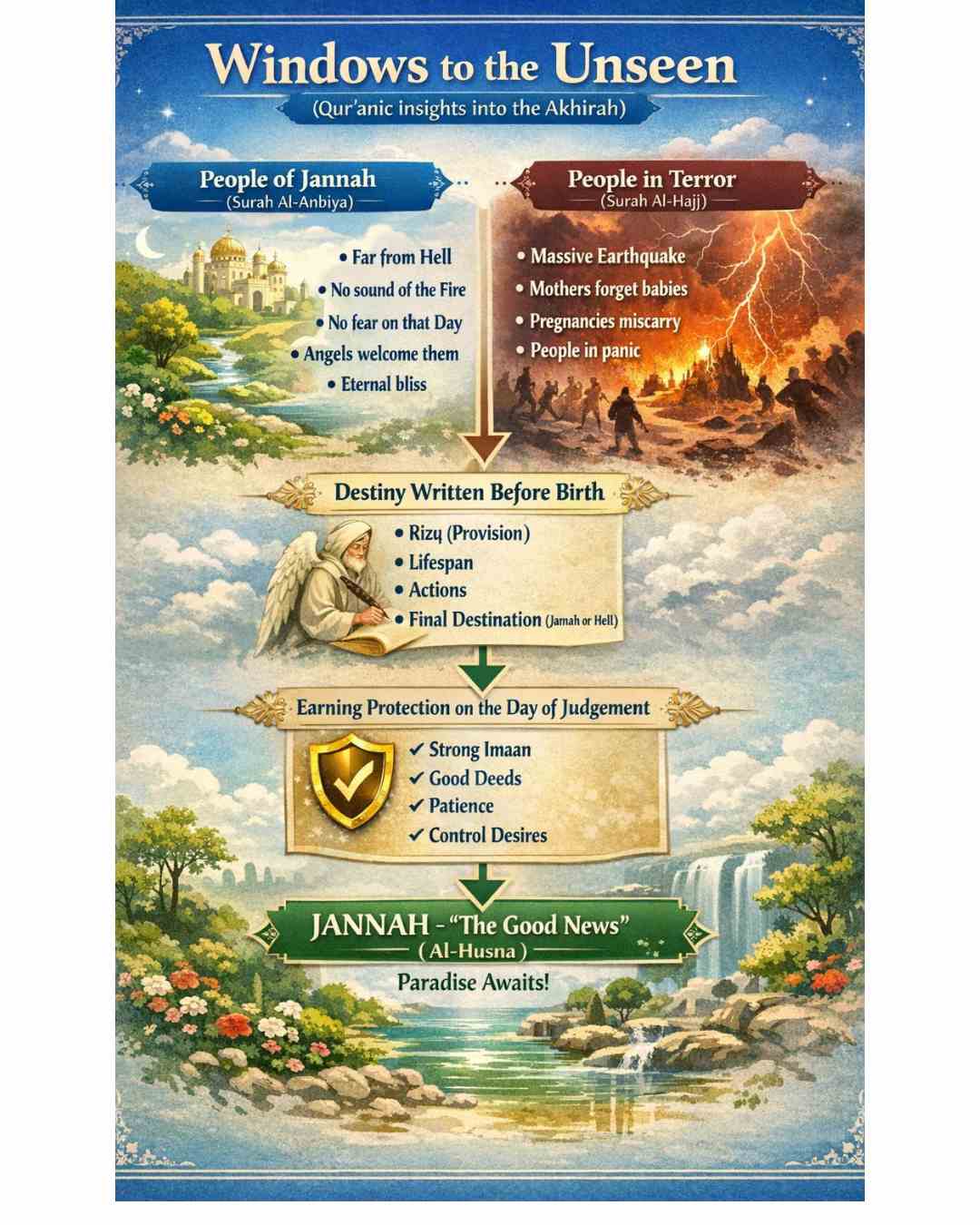
These things were written for you before you were even born, because Allah knows everything about everything. However this does not mean that your destiny will force you to do things: your actions will still be by your own choice, even though Allah knows what they are going to be.
`Abdullah bin Mus’ud narrated that Allah’s Messenger ﷺ said:
قَالَ عَبْدُ اللَّهِ حَدَّثَنَا رَسُولُ اللَّهِ صلى الله عليه وسلم وَهْوَ الصَّادِقُ الْمَصْدُوقُ قَالَ “ إِنَّ أَحَدَكُمْ يُجْمَعُ خَلْقُهُ فِي بَطْنِ أُمِّهِ أَرْبَعِينَ يَوْمًا، ثُمَّ يَكُونُ عَلَقَةً مِثْلَ ذَلِكَ، ثُمَّ يَكُونُ مُضْغَةً مِثْلَ ذَلِكَ، ثُمَّ يَبْعَثُ اللَّهُ مَلَكًا، فَيُؤْمَرُ بِأَرْبَعِ كَلِمَاتٍ، وَيُقَالُ لَهُ اكْتُبْ عَمَلَهُ وَرِزْقَهُ وَأَجَلَهُ وَشَقِيٌّ أَوْ سَعِيدٌ. ثُمَّ يُنْفَخُ فِيهِ الرُّوحُ، فَإِنَّ الرَّجُلَ مِنْكُمْ لَيَعْمَلُ حَتَّى مَا يَكُونُ بَيْنَهُ وَبَيْنَ الْجَنَّةِ إِلاَّ ذِرَاعٌ، فَيَسْبِقُ عَلَيْهِ كِتَابُهُ، فَيَعْمَلُ بِعَمَلِ أَهْلِ النَّارِ، وَيَعْمَلُ حَتَّى مَا يَكُونُ بَيْنَهُ وَبَيْنَ النَّارِ إِلاَّ ذِرَاعٌ، فَيَسْبِقُ عَلَيْهِ الْكِتَابُ، فَيَعْمَلُ بِعَمَلِ أَهْلِ الْجَنَّةِ ”.
“(The matter of the Creation of) a human being is put together in the womb of the mother in forty days, and then he becomes a clot of thick blood for a similar period, and then a piece of flesh for a similar period. Then Allah sends an angel who is ordered to write four things. He is ordered to write down his (i.e. the new creature’s) deeds, his livelihood, his (date of) death, and whether he will be blessed or wretched (in religion). Then the soul is breathed into him. So, a man amongst you may do (good deeds till there is only a cubit between him and Paradise and then what has been written for him decides his behaviour and he starts doing (evil) deeds characteristic of the people of the (Hell) Fire. And similarly a man amongst you may do (evil) deeds till there is only a cubit between him and the (Hell) Fire, and then what has been written for him decides his behaviour, and he starts doing deeds characteristic of the people of Paradise.” (Bukhari)
Al Husna
The ayahs in Surat al-Anbiya talk about people ‘whom We have decreed Paradise’ – i.e. those whom it has already been written for. The ayah also uses the word ‘al-husna’. The literal meaning of al-husna is simply “the best” or the “the most perfect”, but as with many such words in the Qur’an, it describes something implied. Imam al-Qurtubi suggests Jannah, which makes sense, as both words are feminine. Ibn ‘Ashur suggests ‘state’ or ‘promised outcome’, or ‘treatment’ as in “the best state” or “the best promised outcome” or “the best treatment”. The meaning implied is “the good news”.
Earning Allah’s protection on the Day of Judgement
Allah talks about how these people will be so far away from Hell that even though the sound of the blazing fire can be heard for miles, they won’t be disturbed even by a slight hissing, hasees.
This protection from any fear on the Day of Judgement is Allah’s reward for all the good they did in the dunya. Scholars have also said that the use of ‘al-husna’ to mean Jannah also implies the actions that the people had to do to get to this point. This protection does not come free of charge: they had to earn it with their imaan and good deeds, and they will receive what they deserve for their hard work and patience.
We ask Allah to make us among the people of Jannah, and we ask Him to enable us to control our desires and channel them in a way that pleases Him. Ameen.
Based on the khutbah of Shaykh Haytham Tamim on Ramadan Night 22, 6th March 2026. Transcribed by Hana Khan.
The People of Jannah
By Samia Ahmed
During the twenty second night of Ramadan, Shaykh Haytham reflected on a powerful passage in Surah al Anbiya that opens a window for us into the unseen world.
The Quran does something remarkable. It allows us to see what our eyes cannot see. It brings the Hereafter close to our hearts as though we are looking through a window into the Day of Judgement itself.
Allah Almighty describes two very different scenes.
One scene is filled with terror.
The other is filled with peace.
Through these verses Allah allows us to witness the fate of those who rejected Him, and the honour awaiting those who believed.
Allah says:
إِنَّ الَّذِينَ سَبَقَتْ لَهُم مِّنَّا الْحُسْنَىٰ أُولَٰئِكَ عَنْهَا مُبْعَدُونَ
“Indeed those for whom the best reward has already preceded from Us, they will be kept far away from it.” (Surah al Anbiya 21:101)
One of the names of Paradise is Al Husna, the ultimate goodness, the most beautiful reward.
Allah is telling us that those who strive for goodness in this life will receive goodness in the next.
But the Quran does not simply tell us this. It paints the scene for us so that our hearts can feel it.
On the Day of Judgement, the believers will be received by the angels with comfort and reassurance. While others tremble in fear, the believers will be protected from that overwhelming terror.
Allah tells us that they will not even hear the terrifying sounds of Hell.
They will be safe.
They will be honoured.
They will be welcomed.
Meanwhile those who lived conducting tyranny, oppression and arrogance will be received very differently. The angels will confront them in a terrifying manner.
The contrast is striking.
When we pause and truly reflect on these verses, they give us goosebumps.
It is as though Allah is allowing us to glimpse the final outcome of every life.
Why does the Quran show us these scenes?
Because Allah is guiding our hearts.
He is giving hope to the believers so that they continue striving.
And He is warning those who turn away, so they understand the weight of their choices.
Shaykh Haytham reminded us that long before we were born, four matters were written for every one of us.
For every unborn child Allah has already decreed:
Their provision.
Their lifespan.
Their actions.
And their final destination.
These are written because Allah is Al Alim, the All Knowing.
He knows everything about everything.
Nothing escapes His knowledge.
Yet despite this knowledge, Allah has given us choice.
Our choices are real. Our striving is real. Our repentance is real.
This life is the arena in which we choose the path that leads us either closer to Allah or further away.
And this is why these verses should shake our hearts.
Because Allah is asking us a question without words.
Are we striving to become among the people of Jannah?
Or are we distracted by the temporary pleasures of this world?
When we reflect deeply, another emotion begins to surface.
A sadness.
Because many people spend their lives chasing fleeting moments of happiness while forgetting the One who gave them life.
For moments of enjoyment, they sacrifice an eternity of peace.
They fill their days with the dunya but empty their hearts of the remembrance of Allah.
Shaykh Haytham reminded us that Jannah is not something that comes without effort.
It requires patience.
Patience in worship.
Patience in staying away from what Allah has forbidden.
Patience when life tests us.
The path to Jannah is built upon perseverance.
Yet Allah has not left us without guidance.
He has shown us the path clearly in the Quran.
If we follow the guidance of Allah, if we strive sincerely, if we return to Him again and again, then we can become among the people of Jannah.
That possibility should fill our hearts with hope.
But Ramadan is also a mirror.
Sometimes this blessed month reveals our shortcomings.
It shows us how easily we become distracted.
How quickly we lose focus.
How often we fall short of the standards we know Allah deserves from us.
Yet even this realisation is a mercy.
Because recognising our weakness is the first step to turning back to Allah.
Perhaps the greatest gift of these verses is that they remind us of where we are truly heading.
This life is not the destination.
It is the journey.
And Allah, through the Quran, is allowing us to look through a window into the end of that journey.
May Allah make us among those who are welcomed by the angels with peace.
May He protect us from the terror of that Day.
And may He make us among the people of Al Husna, the people of Jannah.
Ameen.
Related posts